
Can Brinker Turn Chili's $5M AUV Into Its Next Growth Engine?
Source: zacks.com
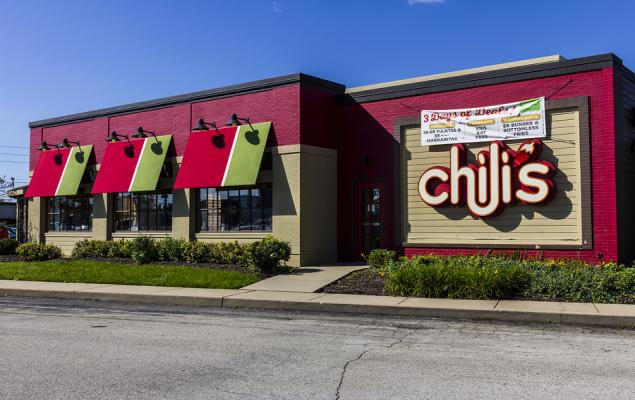
Chili's average annual unit volumes rose to approximately $5.0M in fiscal 2026 from just over $4.5M in fiscal 2025, supported by 9.2% comparable-sales growth and 3.6% traffic growth. Fiscal Q4 comps increased 5.6%, including 1.5% positive traffic, while company sales reached roughly $1.41B versus $1.33B a year earlier. Brinker plans 60-80 Chili's reimages in fiscal 2027 and approximately 10% of the fleet annually from fiscal 2028, using higher volumes to fund reinvestment in value, service, menu innovation and throughput. EAT shares are up 33.9% over six months, though fiscal 2026 EPS estimates have declined over the past 30 days despite implying 21% year-over-year growth.
Analysis
The relevant question is not whether Chili's can sustain elevated sales per restaurant, but whether incremental volume converts to EBITDA after value-led pricing, labor investment and remodel disruption. At a mature casual-dining footprint, throughput gains carry unusually high incremental margins once fixed occupancy and management labor are covered; however, 60-80 remodels could temporarily dilute restaurant contribution and consume cash before any productivity benefit appears. The next 1-3 months hinge on whether traffic remains positive without further promotional intensity and whether management protects restaurant-level margins as beef, chicken and wage costs evolve.
EAT's relative valuation discount can close only if consensus moves from treating the turnaround as a comp-driven event to underwriting a durable earnings base. The important confirmation is not another strong comp print, but stable guest-check mix, positive traffic against increasingly difficult comparisons, and evidence that reimaged units outperform control restaurants enough to justify broader capital deployment. A deceleration toward flat traffic, a widening value gap versus DRI/TXRH, or FY27 remodel capex that rises without a corresponding margin/return framework would undermine the rerating thesis.
Second-order competitive pressure falls most directly on mid-scale, value-sensitive dine-in chains such as DRI and BJRI rather than CMG or SHAK, whose customer occasions and price points are less substitutable. CMG's throughput investments are structurally more scalable because they improve capacity without requiring systemwide aesthetic capex; EAT therefore needs demonstrable returns on remodels to avoid exchanging a near-term traffic win for lower free-cash-flow conversion. The contrarian view is that the stock's prior outperformance already discounts much of the operational improvement, while recent downward EPS revisions suggest the market may be underestimating reinvestment and normalization risk.
AllMind Terminal
AI-powered research, real-time alerts, and portfolio analytics for institutional investors.
Request TrialMarket Sentiment
Overall Sentiment
moderately positive
Sentiment Score
0.52
Ticker Sentiment
Key Decisions for Investors
- Maintain a tactical long EAT only on post-earnings confirmation that traffic stays positive and restaurant-level margin is at least stable year over year; target a 10-15% rerating over 3-6 months if FY27 EPS consensus begins rising. Exit on negative traffic or a remodel-capex increase without disclosed cash-on-cash returns.
- Prefer a 3-6 month pair of long EAT / short BJRI or DRI for value-occasion share capture, sized modestly given differing commodity and franchise exposures. Cover if EAT's traffic premium disappears for two consecutive reporting periods or DRI/BJRI show material traffic stabilization.
- Do not chase CMG or SHAK on this news: their productivity narratives are already distinct and there is no clean read-through from casual-dining value traffic. Monitor CMG comparable sales and margin for evidence that lower-income trade-down is broadening beyond EAT's specific execution.
- Set an FY27 earnings watch item for remodel economics: require unit-level sales lift, incremental margin and payback disclosures before underwriting the fleet-wide reimage cadence. Absent that data, treat the remodel program as a free-cash-flow risk rather than an earnings catalyst.
More News
- AMD joins the $1 trillion club as chip rally surges - our AI Strategy saw it early
- Perpetual underdog AMD nips at Nvidia's heels as it joins the $1T club
- Intel surges 12% as CPU stocks rally. Here's what's driving the move
- Muse, Meta's extraordinarily privileged AI assistant, has a serious 0-day
- Why Intel, Arm, and Other AI Chip Stocks Soared Today
- Meta announces AI shopping partnership with Spotify