
HoneyNaps Develops Next-Generation Wireless PSG system Using Four Skin Patches
Source: PR Newswire
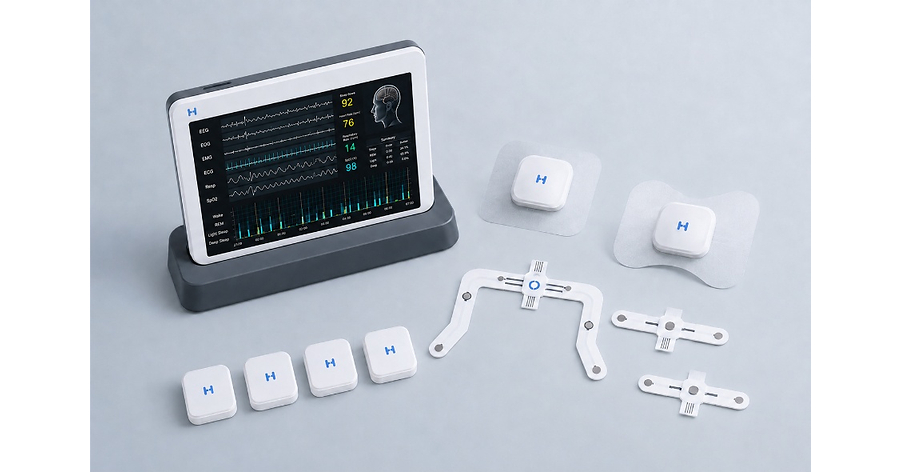
HoneyNaps launched a next-generation wireless polysomnography (PSG) system that replaces 24+ wired sensors with four compact skin patches (Head, Chest, Body, Leg) to reduce patient discomfort and eliminate cables. The platform pairs patch-based signal capture (EEG/EOG/ECG/EMG, airflow, SpO₂, position/activity) with SOMNUM AI software that automates sleep-stage and event detection (e.g., apnea events, arousals, periodic limb movements) to improve clinician efficiency. The low-power, noise-reduced design targets use in hospitals and future home sleep testing/remote monitoring, with potential expansion of its digital healthcare services.
Analysis
This is a workflow-automation story, not a near-term hardware revenue story. The economic value is in shifting the bottleneck from technician-heavy setup and manual scoring toward software-mediated triage, which should expand utilization more than it displaces it. The most exposed public beneficiary is likely the downstream therapy stack: if diagnosis becomes easier and more portable, more apnea gets identified and more patients flow into PAP initiation, adherence software, and recurring consumables.
The first 1-3 month catalyst is validation, not sales: reimbursement language, clinician acceptance, and any pilot data from large sleep programs. Without those, the market should treat the announcement as optionality rather than incremental earnings power. Over 6-18 months, the bigger issue is mix shift away from traditional in-lab PSG economics; that pressures labor-intensive sleep lab operators and any vendor relying on installed, cable-heavy workflows.
Contrarian take: the consensus may be too focused on replacement risk and too little on demand creation. Historically, lower-friction diagnostics tend to enlarge the addressable market, especially for underdiagnosed sleep apnea, so the durable winner may be the company that captures treatment conversion rather than the one that owns the sensor format. HCSG has no obvious direct read-through here; if there is any linkage, it is remote and second-order via hospital outsourcing budgets, not a tradeable earnings impact. Falsifiers are straightforward: no payer coverage, weak equivalence data, or lack of conversion from diagnosis to treatment.
AllMind Terminal
AI-powered research, real-time alerts, and portfolio analytics for institutional investors.
Request TrialMarket Sentiment
Overall Sentiment
mildly positive
Sentiment Score
0.20
Ticker Sentiment
Key Decisions for Investors
- No direct trade in HCSG; treat as a watch item only. The linkage to wireless PSG is too indirect to underwrite a position before there is evidence of hospital services exposure or contract commentary.
- Initiate or add to long RMD on 1-3 month weakness if sleep-diagnostic adoption data improves. Thesis: broader, lower-friction diagnosis expands the PAP funnel; upside is secular, but entry should wait for validation that this is not just a press-release cycle.
- Use RMD Jan-2027 call spreads for convex exposure to a larger diagnosis funnel, but size modestly. Risk/reward improves only if reimbursement and home-testing adoption turn into real volume, not just prototype announcements.
- If follow-on data shows home PSG adoption taking share from legacy sleep labs, consider a relative-value short in sleep-lab/legacy diagnostics exposure versus RMD. Enter only after reimbursement or pilot evidence; otherwise the pair is premature.
More News
- Putin reportedly suggests summit with Trump and Xi to decide fate of Ukraine
- China's CXMT sees shares drop over 6% as investors look past chipmaker's profit turnaround
- Asian stocks skid, Wall Street and bonds aided by oil slip
- India’s Finance Minister blames easy exits and excess liquidity for equity market's underperformance
- Zoom and big financial firms add ‘Proof of Human’ badges from Sam Altman’s World to stop fraud and deep fakes
- The next AI race will be won at the credit desk
From AllMind Research
- Anthropic IPO Preview: Valuation, Timing, and What to Watch
- Shein After the IPO: Venue, Valuation, and What Must Be Proved
- What AI Research Tools Should a Small Hedge Fund Buy First?
- AlphaSense vs Hebbia vs AllMind: Choose by Workflow
- AllMind Discusses Ontario's AI Economy with Minister Stephen Crawford and Supply Ontario CEO James Wallace