
CATL lanza un sistema de almacenamiento de energía de capacidad ultraelevada en All Energy 2026
Source: PR Newswire
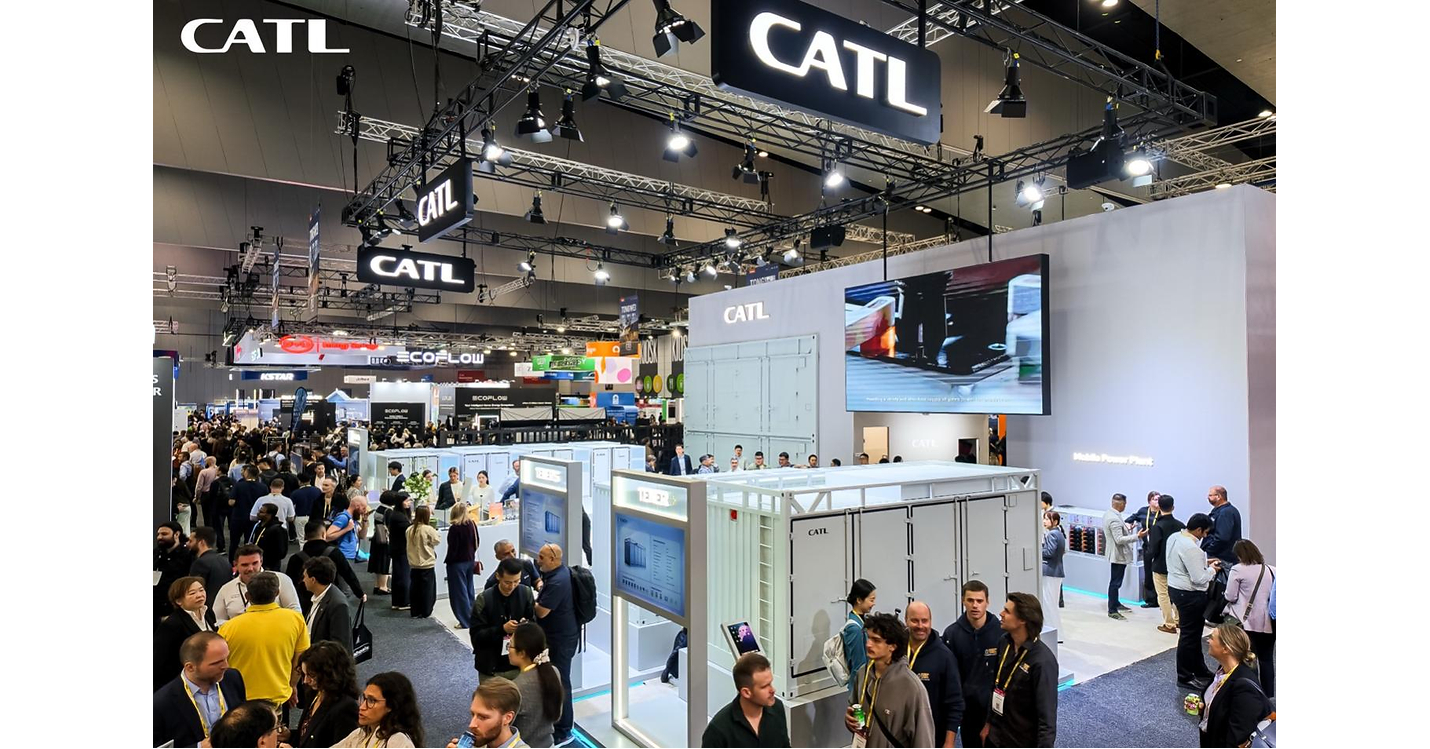
CATL globally launched its TENER+ 9 MWh grid-scale storage system and introduced TENER Sodium, a sodium-ion system offering more than 30 MWh, over 10,000 cycles at 45°C and 95% round-trip efficiency. TENER+ can reduce required container count by up to 40% and project footprint by 12%; CATL also signed MoUs with Hitachi Energy, EPEC Group and UNSW Sydney to support Australian deployment and integration. Australia’s renewables supplied a record 44.3% of NEM generation in Q3 2026, while CATL reports more than 17 GWh of installed storage capacity in the country.
Analysis
The investable signal is a potential reduction in project execution risk, not near-term equipment demand. Pairing CATL’s battery systems with Hitachi Energy’s conversion equipment and local validation/integration partners could improve bankability and shorten commissioning timelines if the MoUs become contracted, referenceable projects. That would pressure suppliers whose edge is integration rather than cells, including Fluence and Wärtsilä, while increasing competition for Tesla’s Megapack; the announcement alone does not establish a cost or performance advantage over them.
The larger second-order risk is market cannibalization. More storage can earn value from evening peaks, but as batteries scale, arbitrage spreads may compress. Revenue durability will increasingly depend on grid-forming, frequency and capacity services—not installed MWh alone. Sodium could diversify CATL’s stationary-storage supply chain and, if independently validated at commercial scale, reduce exposure to lithium inputs; this is not yet evidence of lower delivered project cost or a substitute for lithium across all use cases.
Days: the release may support sentiment, but the MoUs are not orders. Over 1–3 months, verify binding contracts, project economics, warranty/degradation terms, sodium deployment data and Australian grid-connection approvals. Over 6–18 months, watch commissioning and realized availability, alongside NEM battery revenue and spread compression. The contrarian risk is that investors capitalize product-life and efficiency claims before independently verified operating data exist. No immediate directional trade is justified on this release alone.
AllMind Terminal
AI-powered research, real-time alerts, and portfolio analytics for institutional investors.
Request TrialMarket Sentiment
Overall Sentiment
moderately positive
Sentiment Score
0.55
Key Decisions for Investors
- Do not chase the announcement as an order-growth catalyst: treat the MoUs as options on future execution, not booked demand. Revisit only when binding supply agreements, awarded capacity and delivery schedules are disclosed.
- Put CATL’s Australian storage pipeline on watch; require independent validation of lifetime degradation, round-trip efficiency, warranty coverage and installed cost before underwriting a sodium-versus-lithium advantage.
- Monitor Australian battery revenue composition and NEM peak/off-peak spreads over the next 1–3 months. If capacity additions coincide with sustained spread compression, reduce exposure to merchant-storage economics and favor projects with contracted capacity or grid-service revenues.
- Track competitor bids and commissioning outcomes from Fluence, Wärtsilä and Tesla. Evidence that CATL’s integrated partnerships shorten approvals or improve project returns would strengthen the competitive thesis; failed connection milestones or weak field performance would falsify it.
More News
- Stocks slump, bonds leap as AI giants’ spending spooks investors
- DoorDash offers $17 billion for Instacart: ‘the largest companies are only eating more and more of the pie’
- Alphabet Erases $500 Billion as ChatGPT, Google AI Cut into Search
- Alphabet just had its worst day as a public company. BofA now values Google search at a lower multiple than fossil fuel stocks
- Christine Lagarde, Boris Vujčić: Monetary policy statement
- Alphabet’s stock has worst day in over 20 years, dragging the S&P 500 to first loss in four days