
CookieYes lanza un servidor MCP para gestionar el consentimiento de cookies en Claude y ChatGPT
Source: PR Newswire
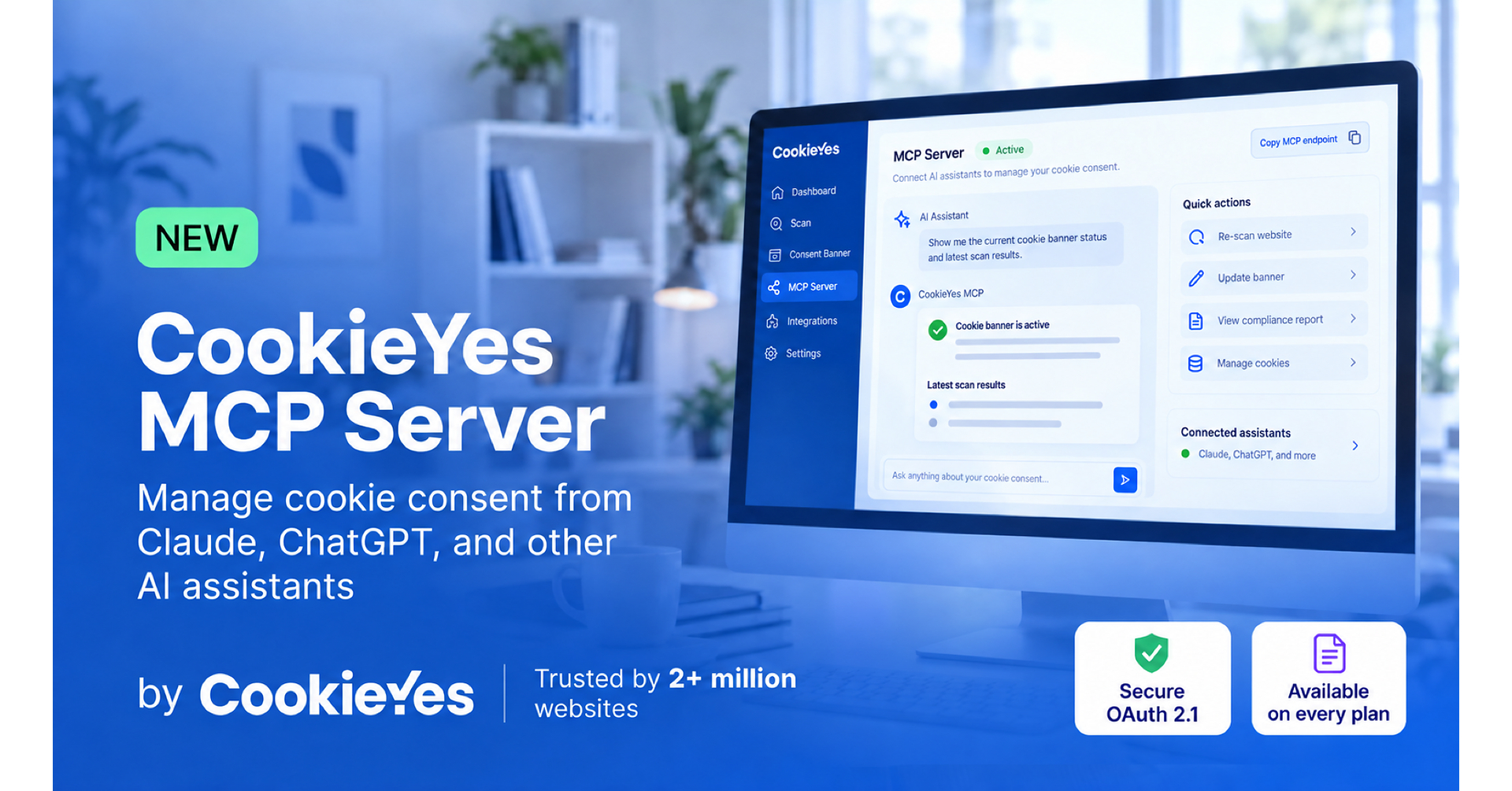
CookieYes launched an MCP server that enables users to manage cookie-consent configurations, scans and approved banner updates through AI assistants including Claude and ChatGPT. The service, available across all plans including the free tier, provides 10 tools, with configuration-changing actions requiring user approval. Access is secured through OAuth 2.1 with PKCE, while connected AI clients are restricted from personal data, consent records, cookie values, credentials and billing information.
Analysis
This is not a material earnings catalyst for DPZ or GOOG; the investable implication is broader: MCP lowers the workflow friction that has kept consent-management platforms embedded in compliance teams rather than operating as a self-service layer for marketing and web operations. If adoption is real, it should improve retention and potentially reduce support cost per managed domain, but offering the capability on free tiers limits near-term monetization and makes this primarily a competitive-feature parity signal.
For GOOG, wider AI-mediated consent configuration marginally supports the durability of its privacy-compliance ecosystem and could reduce implementation friction for advertisers and publishers. The offset is that easier banner deployment does not solve the underlying structural issue for ad-tech: more consistent consent enforcement can reduce addressable audiences and measurement quality in regulated geographies. The relevant 1-3 month read-through is whether Google CMP peers and enterprise privacy vendors—OneTrust, TrustArc, Didomi—announce comparable agent integrations or pricing changes; rapid replication would confirm MCP is a distribution feature rather than a moat.
The non-obvious risk is agentic misconfiguration, not data exfiltration. Approval gates reduce direct unauthorized changes, but a poorly scoped prompt or erroneous cookie scan can still drive blanket suppression of marketing tags, creating conversion-measurement losses for customers and reputational liability for the vendor. Over 6-18 months, vendors with auditable change logs, granular permissions and reversible policy deployment should gain share over lightweight banner tools; a public proxy is likely unavailable, so this is not yet a standalone listed-equity trade.
AllMind Terminal
AI-powered research, real-time alerts, and portfolio analytics for institutional investors.
Request TrialMarket Sentiment
Overall Sentiment
moderately positive
Sentiment Score
0.42
Ticker Sentiment
Key Decisions for Investors
- No directional trade in DPZ: the news has no identifiable revenue or margin linkage; maintain existing fundamental positioning and avoid treating its customer relationship as a demand signal.
- Maintain GOOG exposure rather than add on this catalyst alone; monitor next-quarter disclosures on advertiser measurement, consented inventory and EU revenue growth. A material deterioration in measurement or regulated-market ad growth would challenge the benign read-through.
- Create a 1-3 month alert basket around public privacy/ad-tech proxies including GOOG, PUBM and MGNI: look for enterprise CMP vendors moving MCP functionality behind paid tiers or reporting lower implementation time. That would indicate monetizable workflow consolidation; absent pricing power, treat the theme as feature parity.
- For portfolios long ad-tech, hedge execution risk—not this announcement—with modest relative underweight in smaller measurement-dependent platforms versus GOOG if EU consent-policy enforcement tightens; unwind if regulated-region ad-spend growth remains stable through the next earnings cycle.
More News
- Jensen Huang says Nvidia will sell twice as many chips next year
- Warsh says AI’s hyperscalers are part of why your borrowing costs are rising: ‘The competition for capital is real’
- AI coding agents' 0-click RCE flaw could hand attackers keys to the kingdom
- Goldman’s top strategist just added hard numbers to his earnings-bubble warning
- Waymo to bring autonomous ride-hailing to Singapore in 2028
- Waymo says Singapore will be its next international robotaxi city