
Global Smart Refrigerator Market Set to Reach USD 14.30 Billion by 2034 as AI Integration, Connected Home Adoption and Energy-Efficient Technologies Accelerate, reports Maximize Market Research
Source: PR Newswire
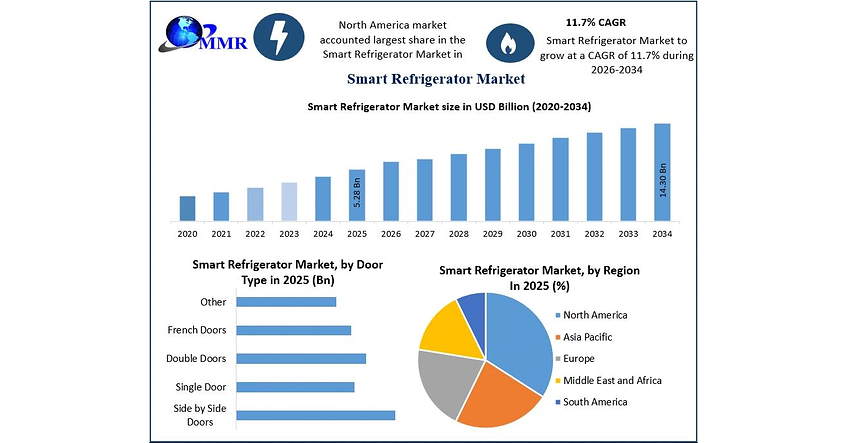
The global smart refrigerator market was valued at USD 5.28 billion in 2025 and is forecast to reach USD 14.30 billion by 2034, implying an 11.7% CAGR from 2026 to 2034. The report cites smart-home adoption, AI and IoT features, and demand for energy-efficient appliances as growth drivers; North America leads the market, while Asia Pacific is expected to grow fastest. Manufacturers including Samsung, GE Appliances, LG and Haier introduced or expanded AI-enabled refrigerator features in 2026.
Analysis
The investable signal is weaker than the headline growth forecast suggests: this is a vendor-sponsored market estimate, not evidence of realized orders, pricing power, or incremental profit. The key economic question is whether smart features raise average selling prices and retention enough to offset hardware, software-support, cybersecurity, and warranty costs. Inventory tracking and conversational AI may improve product differentiation, but consumers can already use phones and smart-home hubs for many of these tasks; feature parity could turn AI into a promotional cost rather than a durable moat.
Near term, the named launches are product announcements, not proof of sell-through. Over 1–3 months, watch appliance-company earnings for unit volumes, premium mix, realized pricing, and promotional intensity. Over 6–18 months, the more durable opportunity is likely in efficient compressors and compliance-driven replacement demand; regulation can support upgrades, but also raises redesign and input costs. Asia growth claims do not establish near-term export or earnings exposure for any named company.
GOOG has a plausible ecosystem option through Gemini integration, but the article provides no evidence of meaningful licensing, usage, or revenue. For WHR, ELUX.B, and AMC (Amica S.A.), the article does not establish company-specific smart-refrigerator sales or economics. The consensus risk is treating a large category forecast as an earnings catalyst: long replacement cycles and weak proof of consumer willingness to pay could make adoption and monetization lag. Falsify that caution with reported smart-model sell-through, sustained premium pricing, or explicit margin/guidance contribution; absent those, no directional trade is warranted.
AllMind Terminal
AI-powered research, real-time alerts, and portfolio analytics for institutional investors.
Request TrialMarket Sentiment
Overall Sentiment
mildly positive
Sentiment Score
0.30
Ticker Sentiment
Key Decisions for Investors
- Do not trade the market-size CAGR as an earnings revision signal; the forecast methodology and company-level revenue bridge are not supplied.
- Keep WHR, ELUX.B, and AMC (Amica S.A.) on watch rather than initiating positions. Reassess only if filings or earnings quantify connected-appliance mix, pricing, volume, and margin impact.
- Treat GOOG’s Gemini integration as optionality, not a material catalyst, unless Alphabet or Samsung discloses commercial terms, attributable usage, or monetization.
- For the next 1–3 months, monitor appliance earnings and retailer checks for premium-model sell-through, discounting, and inventory; stronger adoption without margin erosion would challenge the cautious view.
More News
- US stock market hits all-time high as investors bet big on AI
- What Marvell's rosy long-term guidance means for our AI chip stocks
- U.S. stock futures steady after tech rally lifts S&P 500, Nasdaq to records
- Google teams with nuclear power giant to give reactors a tune-up
- Why is Broadcom stock rallying today?
- Meta Muse gives AMD a boost as AI momentum shifts to personal agents