
Global Dimethyl Carbonate Market to Reach USD 2.15 Bn. by 2034 as Battery Electrolyte Demand, EV Growth and High-Purity Solvent Applications Accelerate Market Expansion, says Maximize Market Research
Source: PR Newswire
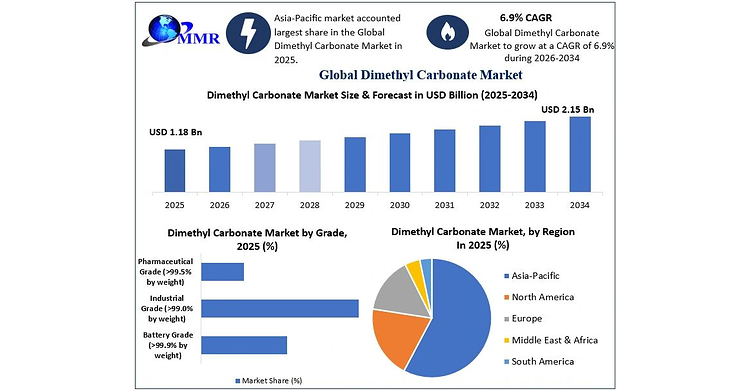
Global dimethyl carbonate (DMC) demand is forecast to rise from $1.18 billion in 2025 to $2.15 billion by 2034, a 6.9% CAGR, driven by lithium-ion battery electrolytes, EVs, energy storage and polycarbonate applications. Battery-electrolyte demand is projected to grow at an 8.32% CAGR through 2031 as EV battery demand exceeded 950 GWh in 2024, up more than 25% year over year. Supply-chain localization is accelerating, including UBE's planned Louisiana capacity of 100,000 tonnes of DMC and 40,000 tonnes of EMC annually, although feedstock volatility and >99.9% purity requirements could pressure producer costs and margins.
Analysis
This is not investable demand evidence by itself: the addressable market remains too small to materially alter earnings for BASF (BAS), Huntsman (HUN), Thermo Fisher (TMO), or Merck & Co. (MRK). More importantly, the named Merck exposure refers to Merck KGaA rather than U.S.-listed MRK, making the supplied ticker linkage economically misleading. The tradable implication is concentrated in Asian electrolyte specialists—Guangzhou Tinci (002709 CH) and Shida Shenghua (603026 CH)—where battery-solvent mix and utilization can move margins far more than industry growth rates.
The key second-order issue is likely oversupply, not scarcity. New localized North American capacity is strategically valuable to cell makers seeking qualification redundancy, but solvent capacity typically precedes gigafactory utilization; a slower EV ramp would pressure DMC/EMC contract pricing and delay fixed-cost absorption. High-purity qualification creates switching costs once a supplier is embedded, so the first measurable catalyst is customer qualification and offtake disclosure, not nameplate capacity announcements. Over 6-18 months, localized supply should modestly reduce imported-electrolyte exposure for North American battery projects, but it is unlikely to generate a broad rerating for diversified chemical companies.
Contrarian view: the market may overstate the direct linkage between battery GWh growth and DMC value growth. Electrolyte formulation shifts toward silicon-anode, high-voltage, and LFP systems can change solvent intensity and favor specialty additives or alternative carbonate blends; volume growth does not automatically translate into DMC pricing power. Feedstock and energy costs, Chinese capacity additions, and battery-factory utilization remain the dominant determinants of producer returns over the next 1-3 months.
AllMind Terminal
AI-powered research, real-time alerts, and portfolio analytics for institutional investors.
Request TrialMarket Sentiment
Overall Sentiment
mildly positive
Sentiment Score
0.38
Ticker Sentiment
Key Decisions for Investors
- No directional position in BAS, HUN, TMO, or MRK on this item; estimated DMC exposure is immaterial relative to consolidated earnings, and MRK is not the relevant Merck entity.
- Place a 1-3 month watch on UBE (4208 JP): consider a long only after disclosed Louisiana project capex, customer offtake, and startup timing establish returns above cost of capital. Falsify on capex escalation, delayed commissioning, or absence of contracted volume.
- For China access, monitor a relative-value long Tinci Materials (002709 CH) versus a broad China battery-material basket only if electrolyte shipment growth and gross-margin stabilization are confirmed in the next earnings cycle. The upside rests on qualification-driven mix; exit if Chinese electrolyte pricing falls faster than raw-material costs or utilization declines.
- Use U.S. battery-project utilization as the leading risk indicator rather than EV sales headlines. If announced North American cell plants defer ramps, avoid localized solvent-supply longs for 6-12 months because under-absorption and contract-price competition would outweigh strategic-localization narratives.
More News
- Germany's RAG Foundation could sell entire Evonik stake
- Moderna has been on a tear since mid-August. Citi now sees it plunging 60%
- Why is Moderna stock down 4% today?
- Merck reports positive phase 2 trial results for HS treatment
- South Korea’s exports hit record high on AI boom
- In photos: China's Xi hardens Taiwan warning as country celebrates week-long National Day holiday
From AllMind Research
- Anthropic IPO Preview: Valuation, Timing, and What to Watch
- Shein After the IPO: Venue, Valuation, and What Must Be Proved
- What AI Research Tools Should a Small Hedge Fund Buy First?
- Introducing AllMind: A New Data & AI Workspace for Institutional Investors
- AI Tools for Private Equity Due Diligence: A Buyer Workflow