
Sutton (formerly Digit) targets the spreadsheet workaround with a build-your-own tool for operations teams
Source: PR Newswire
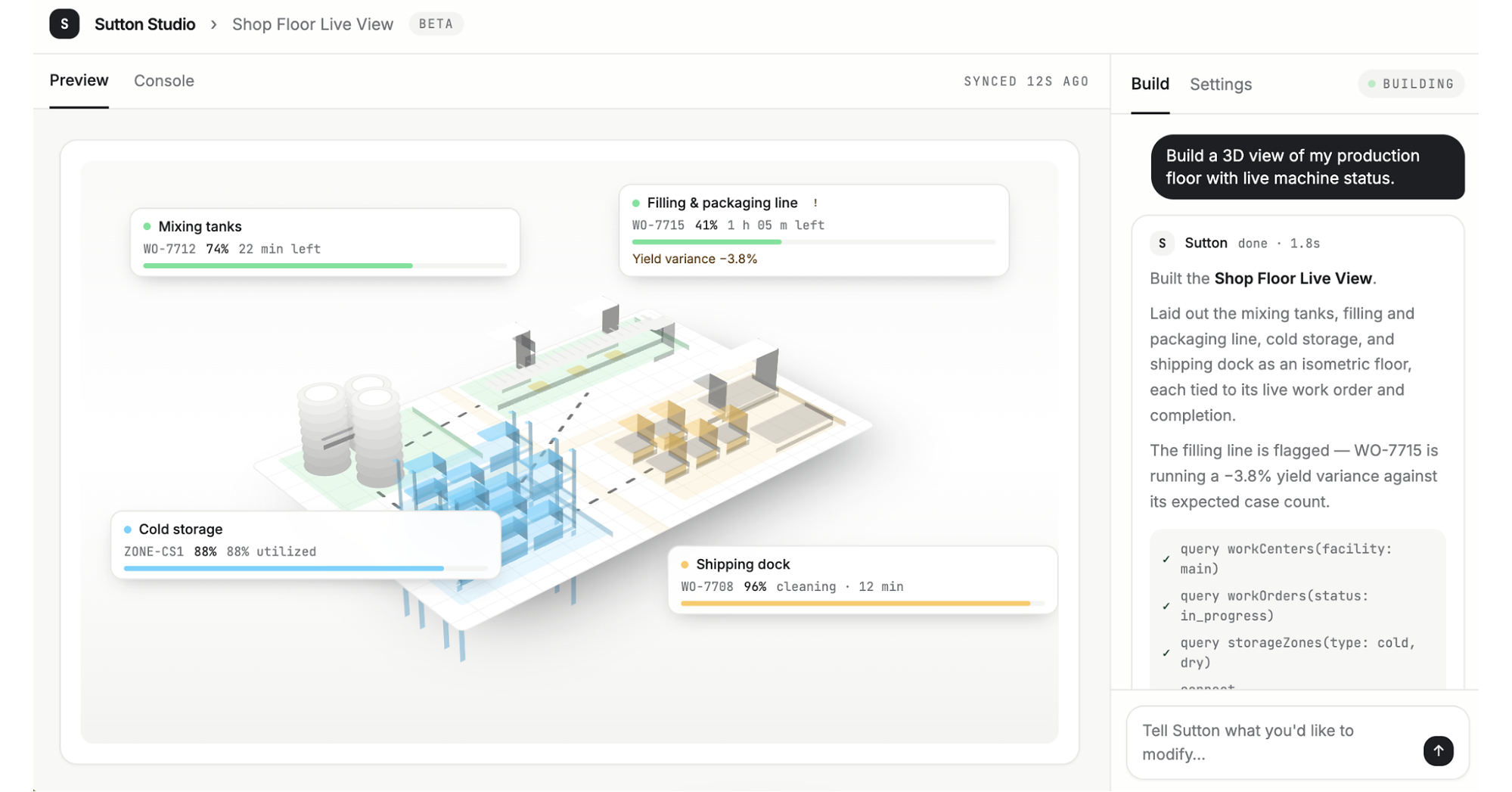
Sutton, formerly Digit, launched Sutton Studio, a no-code tool that enables manufacturing and distribution operators to create custom workflows, dashboards and reports directly on live ERP data. The product targets spreadsheet-based operational workarounds and customization delays, with examples including supplier scorecards, inspection forms, delivery boards and yield trackers. The launch is a product-positioning development for the private ERP provider, though it provides no financial metrics, customer-growth figures or independently verified performance data.
Analysis
This is not a public-markets catalyst by itself, but it reinforces a broader ERP buying criterion: manufacturers increasingly value configurable workflow layers over monolithic implementation projects. If adoption is real, the pressure falls first on small and mid-market ERP vendors whose services revenue depends on customization backlogs, while cloud incumbents with credible low-code ecosystems—MSFT, ORCL and SAP—benefit from the category validation. The key economic question is whether natural-language configuration lowers deployment friction enough to improve customer acquisition and retention, rather than merely shifting support burden into governance and data-quality remediation.
The second-order constraint is operational control. In regulated, traceable, or safety-sensitive manufacturing, unsupervised user-built workflows can create audit gaps, inventory inaccuracies, and planning errors; that favors platforms with role-based access, version control, testing environments, and immutable logs. A high-profile failure would slow adoption across the category and support incumbent vendors' argument that governed extensibility—not rapid app generation—is the differentiator. Over the next 6-18 months, the investable read-through is therefore stronger for hyperscalers and enterprise application vendors monetizing AI copilots, security, and data platforms than for standalone vertical-software challengers.
Contrarian view: the market may overestimate the displacement risk to legacy ERP vendors. Most mid-market operators do not replace a system of record to obtain a dashboard or inspection form; they layer point solutions onto existing ERPs. The nearer-term revenue pool is likely integration, identity/security, and cloud data infrastructure, with MSFT particularly positioned through Power Platform, Azure AI and Dynamics cross-sell. There is no evidence here of material customer scale, pricing power, retention uplift, or independently verified implementation savings, so no direct trade should be initiated on this announcement.
AllMind Terminal
AI-powered research, real-time alerts, and portfolio analytics for institutional investors.
Request TrialMarket Sentiment
Overall Sentiment
mildly positive
Sentiment Score
0.35
Key Decisions for Investors
- No standalone position on this private-company product launch; set a watch item for disclosed customer count, net revenue retention, implementation duration, and evidence of governed workflow controls before assigning competitive-disruption value.
- Maintain a 6-18 month relative preference for MSFT over smaller vertical-software and legacy on-premise ERP exposure: low-code/AI workflow demand can expand Azure, Power Platform, Dynamics, identity, and governance attach rates. Reassess if enterprise AI software spending decelerates or Microsoft reports weakening Dynamics backlog/growth.
- Monitor ORCL and SAP earnings for cloud application bookings, AI attach rates, and implementation-services commentary. A sustained acceleration in cloud ERP migrations would validate the broader thesis; stable license renewals with no cloud conversion uplift would falsify the expected category benefit.
- For logistics/manufacturing software holdings, require evidence that AI-built workflow features reduce support tickets and deployment costs rather than increase them. Rising professional-services expense, security incidents, or customer churn after feature rollout would be an early negative signal.
More News
- Japan’s corporate leaders sound alarm over weak yen — even dollar-earners are voicing concerns
- Fed hikes again - an AI-Picked insurer is still cashing in
- Berkshire May Boost Japan Trading House Holdings, Itochu Says
- US official says upcoming spectrum auctions could generate more than $100 billion
- 'Science fiction': Transport companies — the backbone of economy — are sounding alarm on fuel prices
- Investors react to Fed hike and market sell-off: Brace for 'higher for longer' rates
From AllMind Research
- Anthropic IPO Preview: Valuation, Timing, and What to Watch
- Shein After the IPO: Venue, Valuation, and What Must Be Proved
- What AI Research Tools Should a Small Hedge Fund Buy First?
- AI Research Tools for Pension Funds and Allocators
- AllMind's Data Standardization Methodology: Our Approach to Fundamentals