
Gen Z Trusts AI Companies, Influencers and Social Media Least Among 14 Types of Organizations Tested, New Rival Technologies Study Shows
Source: PR Newswire
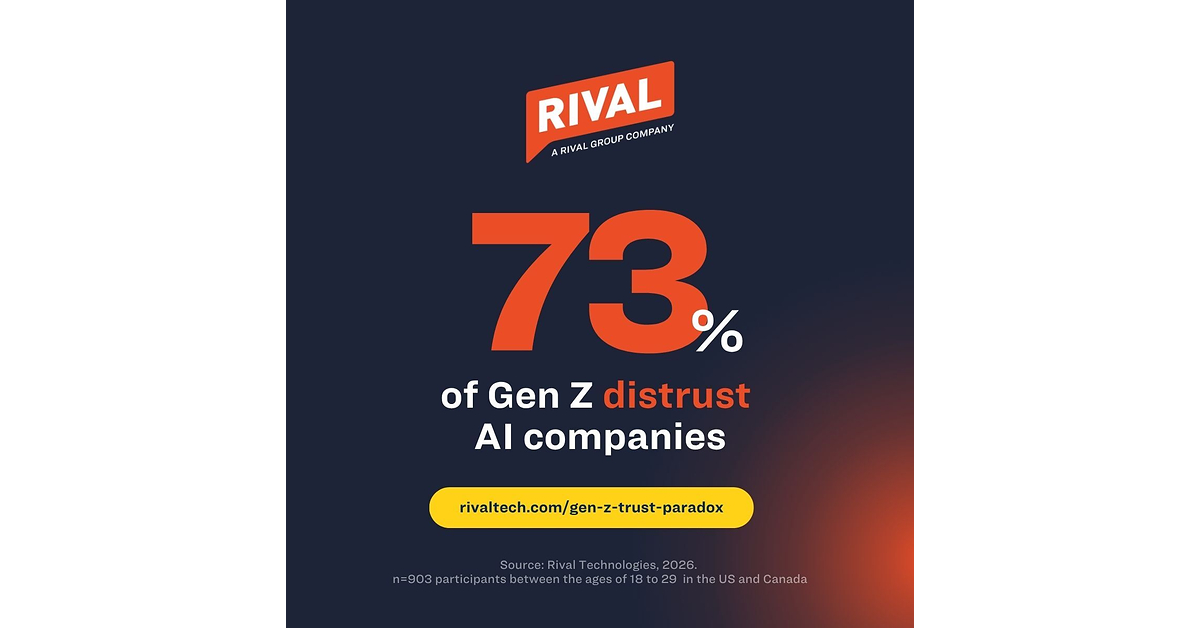
A Rival Technologies study of 903 Gen Z consumers finds very low trust in AI companies (24% trust, 73% distrust), with social media platforms close behind (33% trust) and influencers at 31% trust. Despite heavy usage for news (62% cite social media as a top news source), trust is fragile and consistently low across age groups and both the US and Canada (e.g., Canada: AI trust 14% vs 33% in the US). The results suggest reputational headwinds for AI and social-media business models, but the news is primarily consumer-research/positioning rather than direct financial performance impact.
Analysis
The market read-through is less about Gen Z and more about distribution economics: the channels that are cheapest for customer acquisition are also the least trusted, which raises conversion friction for consumer AI, influencer marketing, and social-first brands. That does not hit every AI name equally—infra and enterprise software are less exposed—but it does argue for a valuation gap between “AI as a tool” and “AI as a consumer promise,” with the latter facing higher CAC, more disclosure burden, and faster sentiment decay if product quality disappoints.
Legacy content and direct-brand businesses look comparatively better positioned. A trusted news brand can capture value even when its content is consumed through low-trust platforms, while hospitality benefits from being in a rare high-trust bucket among Gen Z. That supports relative resilience for NYT versus platform-adjacent media monetization, and keeps ABNB structurally better placed than travel intermediaries that rely more heavily on promotional messaging. CCL is a weaker expression: trust helps, but cruise demand is still dominated by price and macro, so the signal is secondary rather than catalytic.
The near-term catalyst is mostly sentiment and ad-budget allocation over the next 1-3 quarters; the 6-18 month issue is whether AI-branded consumer products can sustain premium multiples without proof of habitual use. Contrarian view: this survey may be over-read because Gen Z’s distrust of “AI companies” can coexist with high usage of AI-enabled products when the feature is embedded, invisible, or productivity-linked. Falsifiers are simple: improving retention, lower CAC, or stronger paid conversion in consumer AI; for the media/travel winners, any slowdown in direct traffic, subscriptions, or bookings would undermine the trust thesis.
AllMind Terminal
AI-powered research, real-time alerts, and portfolio analytics for institutional investors.
Request TrialMarket Sentiment
Overall Sentiment
mildly negative
Sentiment Score
-0.18
Ticker Sentiment
Key Decisions for Investors
- Relative-value: long NYT / short RVTI for 1-3 months. Thesis is that trust supports direct-brand monetization while AI-branded research tools face higher skepticism and more valuation pressure. Cut if NYT subscription ARPU softens or RVTI shows accelerating ARR/retention metrics.
- Do not chase consumer-facing AI beta here; treat this as a watch item for social/AI platform proxies. If the next earnings cycle shows weaker ad conversion or higher CAC, that would confirm a more durable headwind than this survey alone implies.
- Long ABNB on pullbacks versus travel intermediaries with weaker brand trust. Best held 6-18 months if Gen Z travel demand remains intact; thesis fails if booking growth slows or marketing efficiency deteriorates.
- Stay underweight CCL as a pure trust beneficiary. Any positive read-through is too indirect to offset cruise cyclicality; reconsider only if forward bookings and onboard spend both reaccelerate.
More News
- Will Warner Bros. kill Skydance — or will David Ellison kill Warner Bros?
- Netflix Is Treading Water Around a 2-Year Low. Is It the Most Obvious Growth Stock to Buy in October?
- Musk says Terrafab chip factory could outperform rivals despite challenges
- CBO chief warns it’s ‘probably not plausible’ that a strong economy alone can steady U.S. debt as 5%-6% growth is needed—more than Bessent’s 3% view
- Stocks saw new highs and big declines: How the volatile AI trade moved last week's market
- Nvidia GPUs are everywhere. Here are the ways companies are accessing them