
Macabacus intègre directement une fonctionnalité de révision de contenu basée sur l'IA dans les présentations PowerPoint
Source: PR Newswire
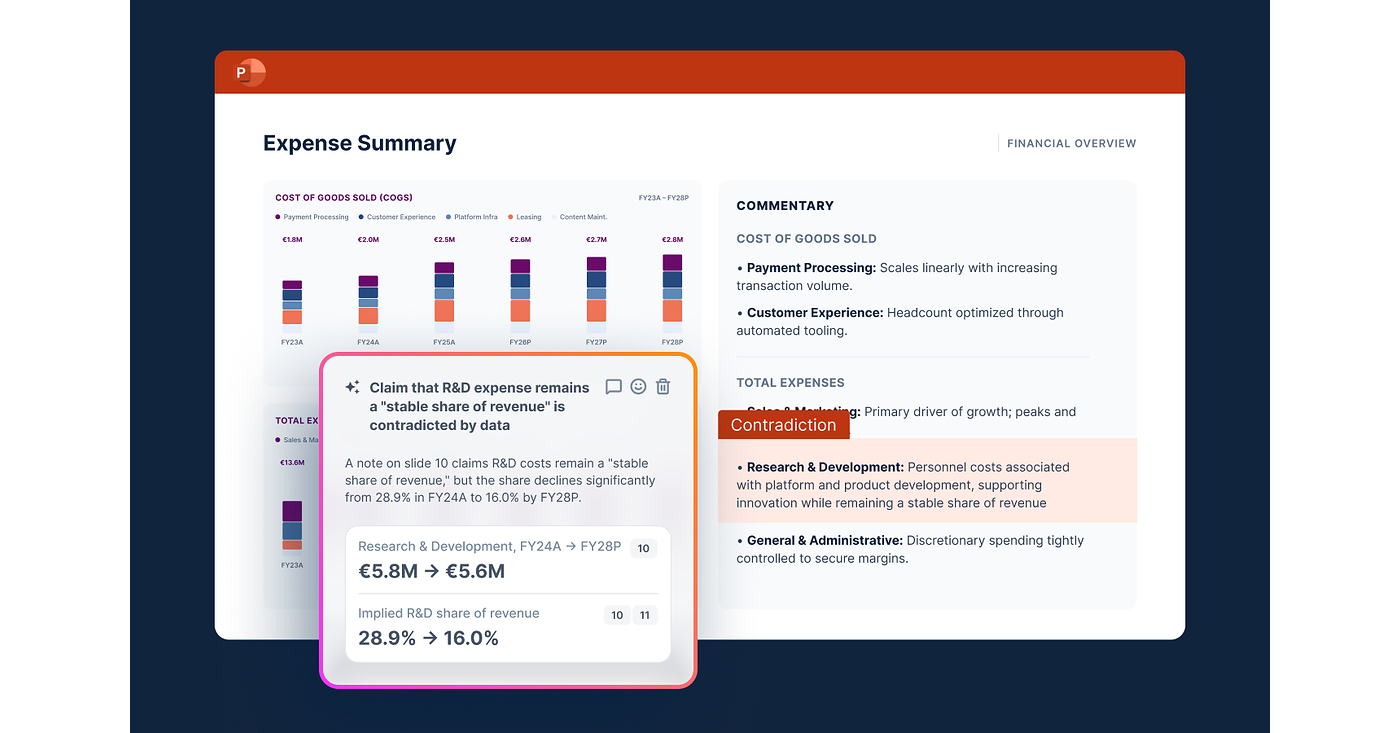
Macabacus launched Deck Check AIR, a generative-AI presentation-review tool integrated directly into PowerPoint for financial and professional-services teams. The product is designed to identify calculation errors and logical inconsistencies in high-stakes financial presentations, addressing a reported 62% of teams that have delivered client-facing AI-generated errors. Deck Check AIR supports Anthropic, OpenAI and Gemini models, can be added to Macabacus Enterprise licenses, and states that customer data and intellectual property are neither used for model training nor retained.
Analysis
The investable read-through to MSFT is immaterial: a third-party add-in reinforces PowerPoint’s workflow gravity but does not create a measurable incremental Azure, Copilot, or M365 revenue catalyst. More importantly, vendor-neutral model support limits proprietary cloud capture; customers can route workloads to Anthropic, OpenAI, or Gemini while retaining the Office interface. That architecture favors the application-layer vendor on user experience, but it also caps switching costs and makes pricing power vulnerable if Microsoft expands native presentation-review capabilities.
The nearer-term competitive pressure is on standalone financial-document AI vendors and point-solution quality-control tools, not on broad productivity platforms. If regulated finance teams adopt AI creation tools faster than AI verification tools, an error-control layer can become a required procurement category; however, the claimed error prevalence is vendor-sponsored and does not establish willingness to pay, deployment velocity, or retention. Over the next 1-3 months, the relevant evidence is enterprise seat expansion, attach-rate uplift, and whether large banks permit external-model API usage under their data-governance policies.
The contrarian view is that “bring your own LLM” may be a feature rather than a moat. Large financial institutions often standardize on one approved model and may prefer native Microsoft Copilot controls, audit trails, and procurement consolidation over another add-in. Over 6-18 months, successful adoption could therefore validate demand for slide-level AI assurance while increasing the likelihood that MSFT, OpenAI, or Adobe productizes the functionality and compresses independent vendors’ economics.
AllMind Terminal
AI-powered research, real-time alerts, and portfolio analytics for institutional investors.
Request TrialMarket Sentiment
Overall Sentiment
moderately positive
Sentiment Score
0.42
Ticker Sentiment
Key Decisions for Investors
- No directional MSFT trade on this launch; treat it as a low-materiality ecosystem datapoint. Reassess only if Microsoft signals PowerPoint/Copilot quality-assurance features or reports a sustained M365 Copilot attach-rate acceleration tied to finance and professional-services workflows.
- Maintain a watch alert on MSFT for native PowerPoint review, model-audit, or enterprise LLM-governance releases over the next 1-2 quarters. Such an announcement would be incrementally positive for M365 retention and Copilot monetization, while likely impairing private workflow-tool vendors.
- For software-book positioning, favor diversified platform exposure via MSFT over unlisted or small-cap single-feature AI workflow vendors until independently verifiable enterprise adoption data emerge. Falsification: evidence that regulated customers require multi-model interoperability and reject Microsoft-native tooling on governance or model-quality grounds.
More News
- Goldman says these top tech stocks have plenty of upside ahead of earnings
- The AI graveyard: a running list of projects and startups that didn’t make it
- As AI Labs Burn Cash, the Real Question Is Which Suppliers Get Paid
- Microsoft's $50 Billion Gamble: Can Microsoft's Azure Growth Justify Its Exploding AI Budget?
- The PHP Meltdown Shows How AI Makes Bugs More Exploitable
- 'Father of the PlayStation' Ken Kutaragi sides with Sony on the physical discs debate