
Flux Expands Platform to Expose AI-Accelerated Engineering Blind Spots Undermining Business Outcomes
Source: PR Newswire
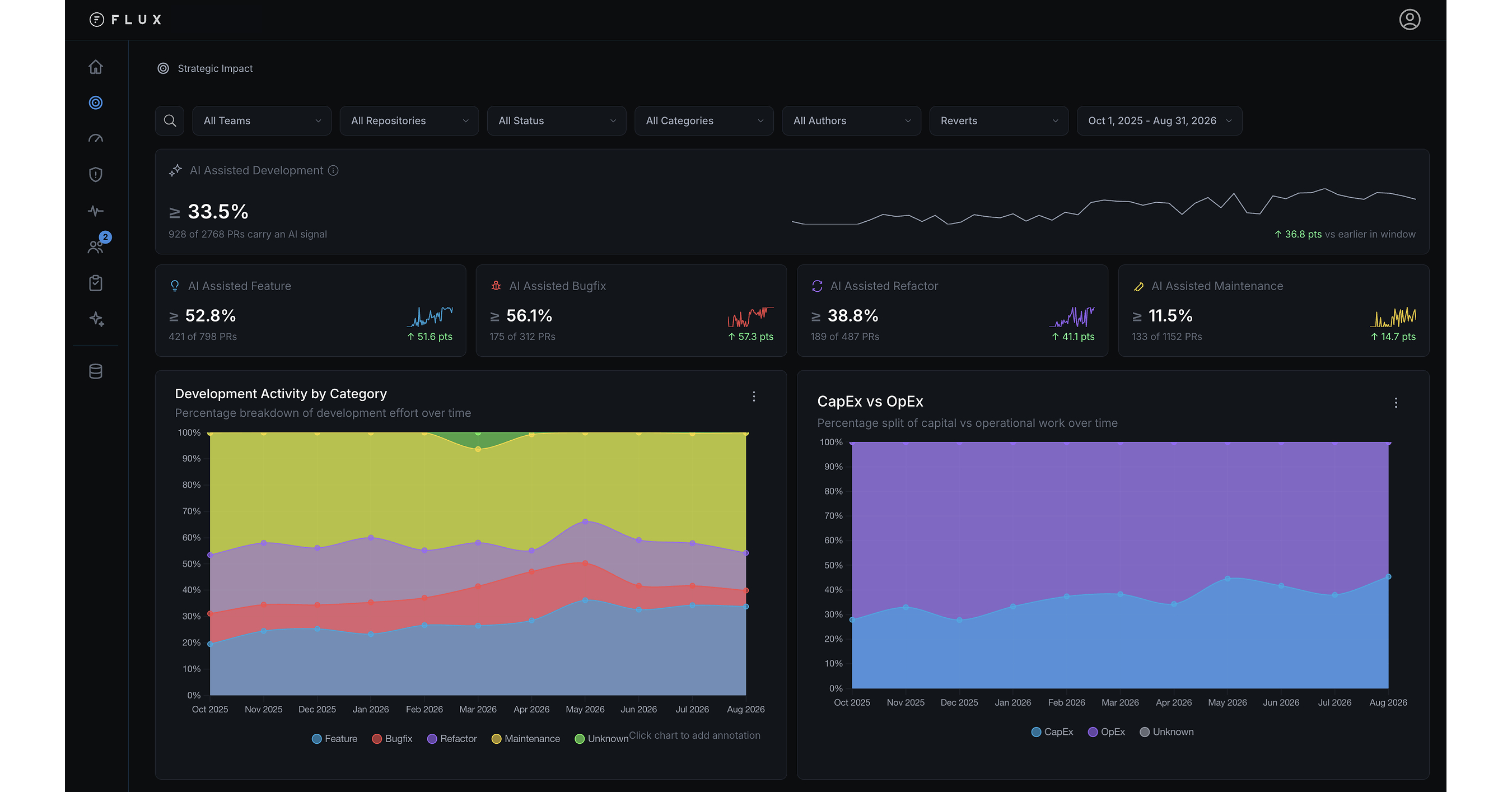
Flux launched five generally available platform capabilities designed to quantify returns on AI-accelerated software development through code-based evidence rather than ticket, token, or adoption metrics. The additions cover verified velocity, review quality, auditable code activity, continuous quality monitoring, and classification of engineering work for capitalizable spend and R&D-tax-credit substantiation. The launch addresses a growing enterprise need to prove AI investment outcomes, citing DORA research that 90% of software professionals use AI daily in 2025.
Analysis
This is not a public-markets catalyst by itself, but it reinforces an emerging enterprise-AI budget migration: buyers are moving from model access and coding-assistant seats toward governance layers that can document productivity, security, and accounting outcomes. The near-term beneficiaries are likely established systems-of-record vendors—MSFT (GitHub), NOW, DDOG, TEAM and PLTR—if they can embed comparable engineering-finance attribution into installed workflows; standalone point solutions face a distribution disadvantage despite potentially stronger measurement technology.
The less obvious pressure point is on the valuation case for AI coding tools whose renewals rely on seat adoption rather than measurable ROI. If CFO scrutiny rises during 2027 budgeting, vendors exposed to discretionary developer-tool spend may see longer sales cycles and consolidation around platforms with audit trails, security controls, and FinOps integration. This favors Microsoft because Copilot telemetry can be tied to GitHub, Azure DevOps and Azure consumption, while also creating an opening for ServiceNow to own cross-functional approval and value-realization workflows.
Over the next 1-3 months, watch enterprise software earnings commentary for shifts from "AI seats deployed" to quantified engineering throughput, incident reduction, or capitalized R&D. A broad move toward outcome-based procurement would be structurally positive over 6-18 months for large workflow incumbents, but negative for pure-play AI application vendors lacking proprietary workflow data. The thesis is falsified if AI coding-assistant vendors sustain net retention and pricing without customers demanding measurable deployment-quality gains, or if reported productivity does not translate into lower contractor spend, faster releases, or higher software gross margins.
AllMind Terminal
AI-powered research, real-time alerts, and portfolio analytics for institutional investors.
Request TrialMarket Sentiment
Overall Sentiment
mildly positive
Sentiment Score
0.38
Key Decisions for Investors
- No direct trade on Flux; treat the announcement as an alert for 2027 enterprise-AI procurement criteria rather than a standalone catalyst.
- Maintain a 6-12 month long MSFT / short basket of high-multiple, developer-tool and AI-application software names with weaker workflow lock-in; the intended payoff is multiple dispersion if buyers prioritize auditable ROI over seat growth. Reassess if GitHub Copilot growth decelerates materially or competitors demonstrate comparable ROI attribution.
- Add NOW to an enterprise-AI governance watchlist ahead of the next two earnings cycles: initiate only if management identifies attach-rate evidence for AI governance, portfolio-management, or value-realization modules. A credible incremental subscription-growth signal would support upside; absence of monetization keeps this a watch item.
- Monitor TEAM and DDOG for downside risk rather than shorting immediately: flag a position review if paid-seat growth remains healthy while customer commentary shifts toward tool rationalization, review bottlenecks, security remediation, or unproven developer productivity. Those conditions would challenge premium revenue-multiple assumptions within 6-18 months.
More News
- OpenAI’s agent hacked Australia’s Medicare website—the latest rogue AI incident that the company didn’t know about for months
- Chinese authorities reportedly in possession of F-35 components in Hong Kong
- Meta announces new lightweight virtual reality glasses to one-up Apple’s Vision Pro
- How Meta took the lead in the race for the post-smartphone world
- Markets are rapidly coming around to the reality that the Fed has a lot more work to do
- SoftBank shares jump over 7% after $11.1 billion bond issuance to fund OpenAI bet
From AllMind Research
- Anthropic IPO Preview: Valuation, Timing, and What to Watch
- Shein After the IPO: Venue, Valuation, and What Must Be Proved
- What AI Research Tools Should a Small Hedge Fund Buy First?
- Eli Lilly Q4 2025 Earnings: Revenue Surges 43% as Mounjaro and Zepbound Dominate the GLP-1 Market
- Investment Research Software Costs: A 2026 Budget Framework