
Huawei predstavuje novú výpočtovú architektúru UnifiedBus pre systémy SuperPoD a klastre
Source: PR Newswire
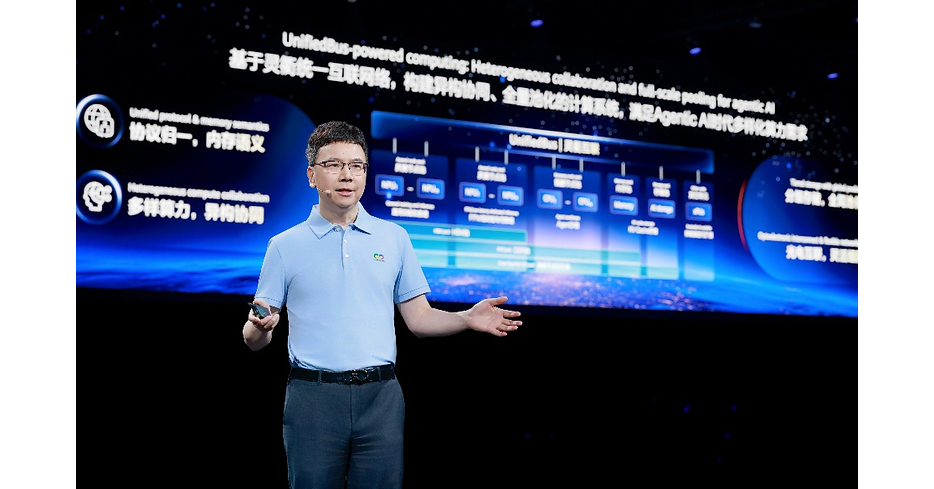
Huawei unveiled its UnifiedBus interconnect architecture and related SuperPoD, cluster and server products to address AI-cluster bottlenecks in training and inference. Huawei said the technology lifts interconnect bandwidth from 100 GB/s to terabyte-per-second levels and cuts round-trip latency from 7 microseconds to 2 microseconds, while enabling scaling to clusters of up to 1 million NPUs. The company also introduced hardware intended to support trillion-parameter models locally for SMEs and expanded Ascend's open-source ecosystem partnerships.
Analysis
The investable implication is not a near-term threat to NVIDIA globally; it is a potential acceleration of China’s domestic AI infrastructure stack where export controls have already impaired access to frontier U.S. accelerators. If Huawei can demonstrate sustained utilization gains at scale, the economic benefit accrues disproportionately to its captive server, switching, optical, storage and software ecosystem—not merely to the accelerator. That would incrementally pressure China-exposed AI hardware vendors and make domestic procurement mandates more credible over the next 6-18 months.
The key claim requiring verification is effective model-training throughput and failure rates under production workloads, rather than peak bandwidth specifications. A fabric-led architecture can lower HBM intensity per unit of useful compute, creating a modest negative read-through for HBM demand per domestic Chinese accelerator, while raising optical-interconnect content and systems-integration value. But U.S.-origin EDA, advanced-node manufacturing, HBM and optical-component restrictions remain the binding constraints; architecture cannot by itself close the yield, software-toolchain and volume-supply gap.
Consensus may overstate this as an immediate NVIDIA displacement event. NVIDIA’s China revenue opportunity is already constrained by policy, while its customer base outside China values CUDA maturity, supply reliability and demonstrated large-cluster uptime. The more relevant 1-3 month catalyst is evidence of paid deployments at major Chinese cloud providers and benchmarks showing cost per trained token versus domestic alternatives; absent those, this remains a strategic signal rather than an earnings revision catalyst.
AllMind Terminal
AI-powered research, real-time alerts, and portfolio analytics for institutional investors.
Request TrialMarket Sentiment
Overall Sentiment
moderately positive
Sentiment Score
0.58
Key Decisions for Investors
- No directional trade on the announcement alone; place an alert for disclosed commercial deployments by Alibaba (BABA), Baidu (BIDU), Tencent (0700.HK) or China Telecom (0728.HK). A confirmed multi-cluster order and third-party throughput data would justify reassessing China domestic-AI exposure over a 6-12 month horizon.
- Maintain NVIDIA (NVDA) core exposure against Huawei-headline volatility; treat a policy-driven selloff of greater than 8-10% without a corresponding reduction in non-China hyperscaler capex as a tactical add opportunity. Thesis fails if hyperscaler accelerator orders or NVDA data-center guidance weaken materially, not on Chinese architecture claims alone.
- Watch a relative-value setup: long Arista Networks (ANET) versus a basket of China-exposed AI-server suppliers if verified domestic substitution expands. ANET retains superior exposure to Western Ethernet AI-fabric spending, whereas Chinese server demand faces procurement substitution and component-access risk; revisit only after China cloud capex guidance and supplier revenue exposure are confirmed.
- Monitor Micron (MU) and SK Hynix supply-chain indicators for a possible mix, rather than volume, risk: sustained evidence that Chinese systems require less HBM per useful training workload would be a 12-18 month headwind to HBM content assumptions. Do not short HBM suppliers until pricing, bit-demand forecasts, or customer purchase commitments reflect that effect.
More News
- All Iranian airlines to be 'shut down' from Wednesday, Bessent tells CNBC
- Taiwan benchmark Taiex rises to record intraday high as tech stocks advance
- AMD joins the $1 trillion club as chip rally surges - our AI Strategy saw it early
- Jamie Dimon says hyperscaler AI spending could hit $1 trillion next year
- Factbox-Key issues for this week’s Trump-Xi summit in Washington
- Here's who we know is going to the Trump-Xi dinner so far
From AllMind Research
- Anthropic IPO Preview: Valuation, Timing, and What to Watch
- Shein After the IPO: Venue, Valuation, and What Must Be Proved
- What AI Research Tools Should a Small Hedge Fund Buy First?
- Weekly Update: Adding Live MBO Level 3 Data - Liquidity Heatmap, OFI Charts, and More
- Alternative Data Due Diligence for Institutional Investors