
Culture Amp's 2026 AI at Work Benchmark: 85% Are Encouraged to Use AI. 42% Don't Know Why
Source: PR Newswire
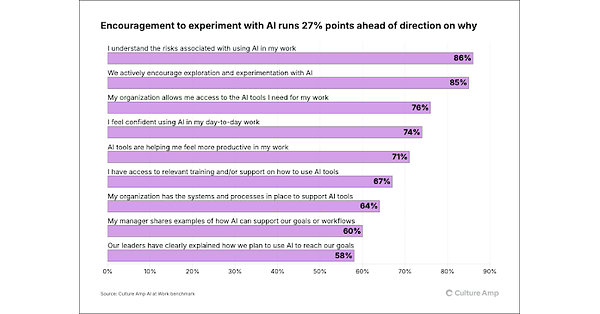
Culture Amp's survey of approximately 112,000 employees found 71% say AI improves productivity, rising to 93% among power users, but workloads remain largely unchanged. While 85% are encouraged to experiment with AI, only 58% say leadership has explained how AI supports company direction, creating a 27-point leadership-guidance gap. Career-opportunity awareness fell 10 percentage points since July 2025, highlighting employee uncertainty about AI's implications for advancement despite stable 66% career-development satisfaction.
Analysis
The investable read-through is not AI-tool demand but the likely lag between license deployment and measurable labor-cost or revenue productivity. Enterprises appear to be creating capacity without redesigning workflows, service levels, spans of control, or performance metrics; that delays ROI proof and raises the risk of 1-3 quarter scrutiny of discretionary AI-seat spending. Vendors whose valuation assumes rapid per-seat monetization from generic copilots face the greatest multiple risk if customers cannot translate usage into budget relief.
The second-order beneficiary is the workflow/control layer: NOW and CRM have a clearer path to capture value when customers formalize process changes, approvals, and customer-service automation rather than merely distribute assistants. That is a 6-18 month implementation cycle, not an immediate revenue catalyst. The survey is voluntary and skewed toward more AI-engaged employers, so it should not be extrapolated into a broad productivity or labor-displacement forecast; if even early adopters cannot show workload reduction, consensus estimates for near-term enterprise AI ROI may be too optimistic.
There is no company-specific earnings implication for NDAQ, DLB, or MCD from this dataset. ASAN is a watch item rather than a trade: improved task throughput could support collaboration-software engagement, but unclear organizational priorities can just as easily constrain net seat growth and make AI features table stakes rather than incremental monetization. The thesis turns more constructive only if enterprise vendors begin disclosing renewal uplift, paid AI attach rates, or lower implementation time alongside stable gross retention.
AllMind Terminal
AI-powered research, real-time alerts, and portfolio analytics for institutional investors.
Request TrialMarket Sentiment
Overall Sentiment
mixed
Sentiment Score
0.08
Key Decisions for Investors
- Do not trade NDAQ, DLB, or MCD on this item; the evidence is an employee-sentiment survey with no identifiable revenue, cost, or capital-allocation linkage to those issuers.
- Over a 6-12 month horizon, favor a modest long NOW / short ASAN relative-value position only after confirming NOW paid GenAI workflow bookings and ASAN net revenue retention trends. The mechanism is monetizable process automation versus potentially commoditized collaboration AI; exit if NOW subscription growth decelerates by more than 300 bps or ASAN reaccelerates net retention for two consecutive quarters.
- For AI-application exposure, require proof of customer ROI before adding to high-multiple software longs: monitor paid AI attach, renewal pricing, headcount-per-revenue, and implementation duration in the next two earnings cycles. Absent those disclosures, treat AI-productivity claims as retention support rather than incremental revenue.
- Set an alert for broad SaaS guidance revisions tied to elongated AI pilots or weak paid-feature conversion over the next 1-3 months; that would support reducing exposure to premium-valued application software before consensus revenue estimates reset.
More News
- Stocks stage a comeback after Fed-induced declines — plus, what's ailing Boeing
- Orion180 Insurance prices US IPO below range, raises $240 million
- Why is T-Mobile stock sliding today?
- Why is Lucid stock rallying today?
- Why is Raiffeisen Bank International stock tumbling today?
- Real-Economy Corporate Events Investors Should Watch This Month
From AllMind Research
- Anthropic IPO Preview: Valuation, Timing, and What to Watch
- Shein After the IPO: Venue, Valuation, and What Must Be Proved
- What AI Research Tools Should a Small Hedge Fund Buy First?
- How to Build an Automated Research Process for a Fund
- Weekly Update: AI-Powered Report Editing, Investor Relations, and Enhanced Search