
Lacuna Ads Brings Supply, Demand and Intelligence Together to Catalyze Programmatic Growth
Source: PR Newswire
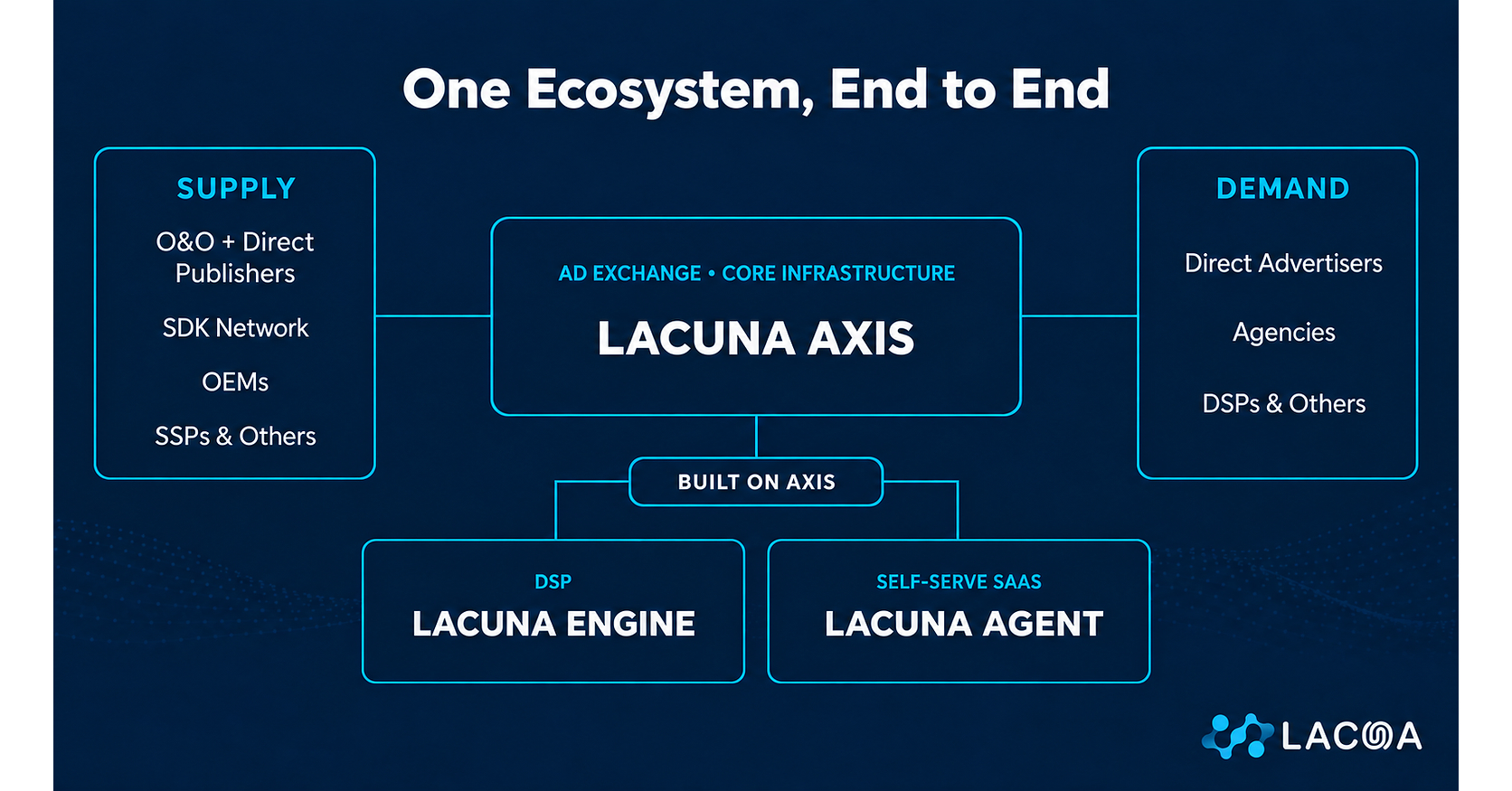
Lacuna launched Lacuna Ads, an integrated programmatic advertising ecosystem combining its ad exchange (Lacuna Axis), demand-side optimization platform (Lacuna Engine), and self-service SaaS infrastructure offering (Lacuna Agent). The platform is supported by owned-and-operated and direct publisher inventory with more than 2.4 billion app installs, while Lacuna processes over 200 billion daily requests and 180 million daily impressions globally. The company aims to improve supply-demand matching, real-time bidding, traffic routing, and yield optimization through proprietary data models and AI.
Analysis
This is strategically more relevant to public ad-tech multiples than to near-term earnings: an integrated exchange/DSP/SaaS stack can improve bid density and reduce intermediary leakage, but it also creates inherent neutrality concerns. Independent buyers and publishers generally resist routing decisions through a platform that owns inventory, particularly where measurement, auction mechanics, and demand optimization sit under one roof. The likely competitive pressure is therefore greatest at the low-quality mobile-app inventory end of the market, not on The Trade Desk (TTD)'s premium omnichannel position; PubMatic (PUBM), Magnite (MGNI), and mobile-focused AppLovin (APP) have more direct exposure to pricing and supply-path-optimization competition.
The claimed operational scale is not itself investable without externally observable proof of incremental net revenue, take rate, publisher retention, and invalid-traffic controls. Over the next 1-3 months, customer wins or named agency/DSP integrations could validate product-market fit; absent those, this is a low-impact private-company launch rather than a catalyst for listed peers. Over 6-18 months, successful vertical integration could compress SSP economics and increase demand for independent verification, benefiting DoubleVerify (DV) and Integral Ad Science (IAS), since buyers may seek third-party safeguards when transaction infrastructure and inventory ownership converge.
Contrarian view: market participants often treat AI optimization claims as evidence of durable differentiation, but mobile programmatic optimization is readily replicated unless proprietary supply materially improves conversion outcomes. The more probable initial outcome is higher traffic-routing efficiency within the operator's own network, while external adoption remains constrained by transparency, data-portability, and conflict-of-interest questions.
AllMind Terminal
AI-powered research, real-time alerts, and portfolio analytics for institutional investors.
Request TrialMarket Sentiment
Overall Sentiment
mildly positive
Sentiment Score
0.38
Key Decisions for Investors
- No immediate directional trade on the launch; it lacks disclosed financial terms, public-market exposure, or independently verifiable customer adoption. Set an alert for named agency, DSP, or large-publisher integrations and for evidence of sustained external supply onboarding over the next 1-3 months.
- Maintain a relative preference for TTD over a basket of PUBM and MGNI on a 6-12 month horizon: TTD's buyer-side workflow and premium-channel exposure are less vulnerable to low-end mobile supply commoditization. Falsify if TTD reports worsening platform take rate, material mobile performance-advertising share loss, or decelerating agency spend while PUBM/MGNI demonstrate accelerating net revenue retention.
- Watch DV and IAS for a second-order beneficiary setup rather than chase immediately. Initiate only following evidence that vertically integrated mobile exchanges are winning meaningful budget, because increased demand for independent fraud, suitability, and measurement controls would be a 6-18 month revenue tailwind; the thesis fails if buyers accept platform-native measurement without incremental third-party verification spend.
- For APP, treat any broad market read-through as neutral-to-cautious rather than automatically bullish: additional optimization capacity in mobile performance advertising may raise auction competition for advertiser budgets. Reassess after APP's next earnings on software-platform revenue growth, advertiser retention, and incremental margin; strong reacceleration in those metrics would outweigh the competitive concern.
More News
- South Korea’s exports hit record high on AI boom
- Asian stocks dip, bonds in focus after torrid September
- US judge approves settlement allowing Paramount to acquire Warner Bros
- RAM supply set to worsen, says Micron, as CEO celebrates ‘much higher’ prices
- Tencent leases 100,000 chips from Oracle for $7 bln- FT
- Paramount Skydance prices $42 billion debt for Warner Bros deal