
Disney lays off around 300 employees as D'Amaro pushes cost cuts
Source: proactiveinvestors.com
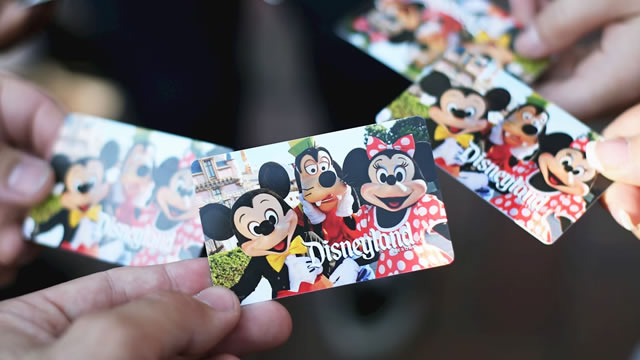
Walt Disney is laying off about 300 employees, primarily in human resources and technology roles, as CEO Josh D'Amaro cuts costs to fund growth investments. The reductions are negative for affected staff but signal continued expense discipline and strategic resource reallocation; the limited scale is likely to have only a modest impact on Disney shares.
Analysis
The financial impact is immaterial in isolation: a sub-1% headcount action will not alter Disney's FY earnings trajectory unless it signals a broader reset in the corporate cost base. The relevant read-through is whether management redirects savings into high-return direct-to-consumer product, advertising technology and parks capacity rather than using them to defend declining linear-network economics. Investors should demand evidence in the next two reporting cycles through lower corporate overhead, sustained Disney+ engagement and streaming-margin expansion; absent that, the action is multiple-neutral optics.
Near term, DIS can trade defensively if the market interprets the move as an admission that growth investments are not producing adequate returns. Over 1-3 months, the catalyst is guidance: a raised segment-operating-income or free-cash-flow outlook would validate operating leverage and support multiple expansion versus WBD and PARA, whose balance-sheet constraints limit reinvestment flexibility. Over 6-18 months, reducing internal technology capacity could become a hidden risk if it slows ad-tech monetization, personalization, or sports-product execution; that would advantage NFLX, which retains a clearer technology-led operating model.
The contrarian view is that the market may overfocus on nominal savings rather than capital-allocation discipline. If this is an early step toward simplifying overlapping platforms and corporate functions, Disney has more latent margin upside than headline estimates imply because parks, experiences and advertising carry high incremental returns once fixed costs are controlled. The thesis is falsified by a material cut to FY free-cash-flow guidance, streaming-margin stagnation for two consecutive quarters, or evidence that technology/product roadmaps slip.
AllMind Terminal
AI-powered research, real-time alerts, and portfolio analytics for institutional investors.
Request TrialMarket Sentiment
Overall Sentiment
moderately negative
Sentiment Score
-0.45
Ticker Sentiment
Key Decisions for Investors
- Maintain a neutral-to-modest long DIS only on confirmation of execution: add after the next earnings release if management raises full-year free-cash-flow or segment-profit guidance and direct-to-consumer margins continue expanding. Target a 10-15% upside over 3-6 months from earnings-estimate and valuation support; exit if guidance is cut or streaming profitability stalls for two quarters.
- Use a 3-6 month relative-value expression: long DIS / short WBD in equal dollar exposure, contingent on DIS demonstrating corporate-cost leverage. Disney has a stronger balance sheet and more self-funded reinvestment capacity, while WBD is more vulnerable if advertising and legacy-network cash flows weaken; close the spread if DIS fails to show overhead leverage at the next two results.
- Do not buy DIS volatility solely on this announcement. Establish an alert around earnings for corporate-overhead savings, technology-roadmap milestones and direct-to-consumer advertising metrics; without quantified savings or an upgraded outlook, the news is insufficient to justify a standalone position.
More News
- Paramount and Warner Bros. Discovery to Merge Into Skydance (SKYD). Will Skydance Achieve David Ellison’s "Quality Storytelling" Vision?
- Disney licenses lineup of movies, TV shows to Netflix including ’Ice Age,’ ’Will Trent’
- Mark Ruffalo says Paramount’s $111 billion Warner Bros. deal ‘Will stifle creativity, weaken free speech, and cost people their jobs’
- David Ellison says combined Paramount and Warner Bros. Discovery will be named Skydance
- Paramount and Warner Bros Discovery to become Skydance
- Paramount’s Warner Bros. megamerger will just be called Skydance