
Nordic bringt Edge-KI auf batteriebetriebene WLAN-Geräte und erreicht mit neuer nRF71-Serie zwanzigmal geringeren Standby-Stromverbrauch
Source: PR Newswire
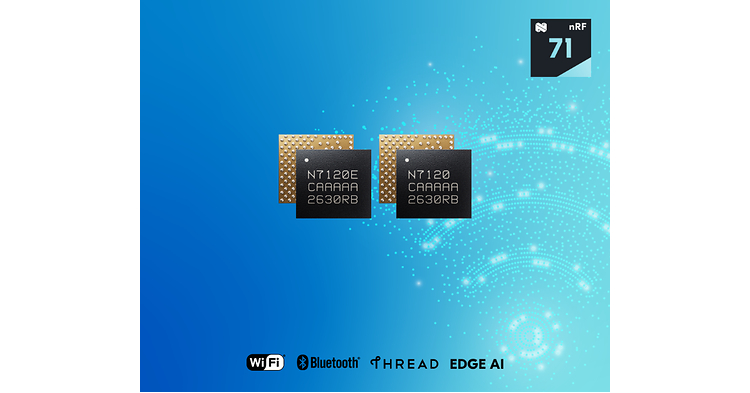
Nordic Semiconductor introduced its nRF71 series, combining Wi-Fi, Bluetooth LE, Thread and edge AI on a single chip for battery-powered devices. Nordic says standby power consumption is up to 20 times lower than its current nRF70 Wi-Fi products, while the Axon NPU runs machine-learning models 10–17 times faster than the 256-MHz Arm Cortex-M33 alone. The nRF7120 and nRF7120E are available as samples to selected customers.
Analysis
The economic upside is less about the launch itself than whether Nordic can turn its existing developer ecosystem into design wins where customers currently need separate connectivity and compute components. If the integration works at system level, it could increase Nordic’s share of the bill of materials while pressuring stand-alone low-power Wi-Fi, MCU and edge-inference suppliers, including Espressif, Silicon Labs and Infineon. But integration also risks cannibalizing Nordic’s own separate-radio or MCU content; net revenue per device, not chip count, is the key test.
The announcement is an option on future product cycles, not evidence of near-term earnings acceleration: samples are limited to selected customers, and embedded-device qualification and production ramps can take months to years. The quoted standby and inference comparisons are company claims; test conditions, whole-device power, silicon cost, yields and production availability remain unverified. Simultaneous radio operation and on-device AI also need validation in real workloads, not just component benchmarks.
Near term, the likely market effect is modest. Over 1–3 months, customer sampling or credible design-win disclosures could improve confidence; over 6–18 months, production adoption and incremental content determine whether this merits a higher growth multiple. The contrarian risk is that investors capitalize the AI narrative before customers accept the power, cost and development trade-offs. No valuation or price data is supplied, so a directional NOD trade is not justified on this release alone.
AllMind Terminal
AI-powered research, real-time alerts, and portfolio analytics for institutional investors.
Request TrialMarket Sentiment
Overall Sentiment
mildly positive
Sentiment Score
0.35
Ticker Sentiment
Key Decisions for Investors
- Treat NOD as a watch rather than an immediate launch-driven buy. Reassess on named customer design wins, production timing, or segment guidance that attributes revenue to the new platform.
- Track whole-device standby power, bill-of-materials cost, silicon availability and customer qualification—not only the announced chip-level comparisons. These are the data points needed to establish whether integration expands Nordic’s content or mainly replaces its existing products.
- For a 1–3 month catalyst check, monitor Electronica follow-through and subsequent customer or channel validation. Lack of production commitments, or delays beyond sampling, would weaken the near-term thesis.
- Falsify the structural thesis if Nordic’s connectivity revenue or margin outlook fails to improve as the product enters production, or if customer testing shows that power, cost or radio coexistence limits adoption. Avoid extrapolating the product announcement into a broad edge-AI sector trade without evidence of demand.
More News
- What Wall Street billionaires are saying about Democrats' midterm sweep
- NextDC shares surge 43% after Goodman, Digital Realty stake purchases
- Voters rebuff data centers in every ballot measure except one during the 2026 midterms
- Asian chip stocks slide as disappointing Qualcomm, Arm earnings weigh
- Oil and data centre stocks sink after US midterms
- China Blocks SoftBank Acquisition of ABB Robot Unit, FT Says