
Global Government AI CITY Innovation Summit Successfully Held
Source: PR Newswire
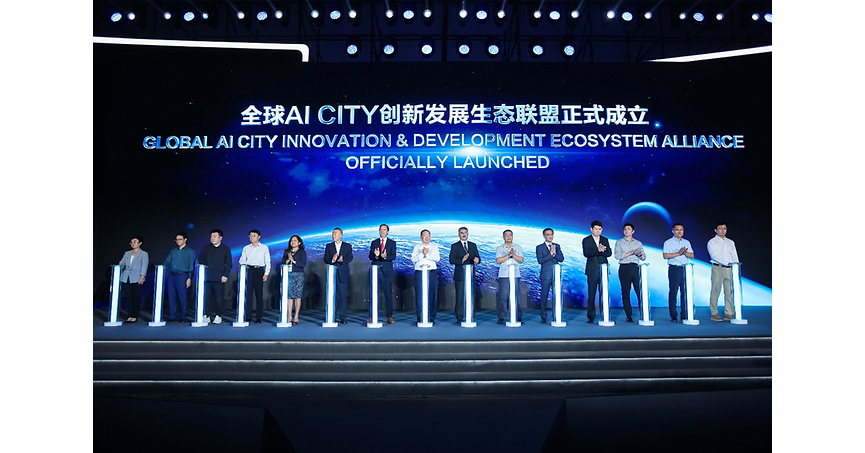
Huawei and 14 partners launched the Global AI CITY Innovation & Development Ecosystem Alliance at a Shanghai summit attended by more than 500 participants. The alliance will focus on compute collaboration, data circulation, and urban AI applications; Huawei and China's State Information Center also released a 2026 report outlining an AI CITY development framework. The announcement highlights ecosystem-building and product capabilities but provides no financial results or quantified commercial commitments.
Analysis
The investable signal is not the alliance announcement; it is whether Huawei converts city-agent demonstrations into funded, repeatable procurement. Government buyers can create durable vendor dependence once compute, data systems, and frontline workflows are integrated, but localization and sovereignty requirements also fragment deployments into country-specific projects—limiting the software-scale economics implied by the “ecosystem” framing. Huawei and implementation partners could benefit if deployments become multi-year contracts; competing cloud and systems vendors may lose access where local-data rules favor domestic infrastructure. The counterweight is procurement friction: budget approvals, integration costs, and regulatory review can stretch sales cycles, while partner participation does not establish revenue commitments or product adoption.
Near term (days to weeks), this is mainly narrative support for AI-infrastructure sentiment, not evidence of incremental earnings. Over 1–3 months, watch for named tenders, contract values, delivery milestones, and customer references beyond demonstrations. Over 6–18 months, repeat deployments and disclosed backlog would test whether city AI is a scalable demand pool or bespoke systems integration. The contrarian point: “city super agents” may overstate near-term compute intensity; efficiency gains could reduce labor costs without producing large incremental infrastructure budgets. Geopolitical restrictions, data-transfer limits, or weak local budgets could further constrain cross-border replication.
AllMind Terminal
AI-powered research, real-time alerts, and portfolio analytics for institutional investors.
Request TrialMarket Sentiment
Overall Sentiment
mildly positive
Sentiment Score
0.25
Key Decisions for Investors
- No trade on the announcement alone. Treat the alliance and company examples as commercial claims until supported by awarded contracts, realized revenue, or repeat deployments.
- Set an alert for public tender awards and budget disclosures in the cited markets, plus evidence of deployments outside the showcased Chinese cities; verify contract scope, delivery timing, and whether Huawei is prime contractor or one supplier.
- For any listed AI-infrastructure exposure, require evidence that city-government demand is incremental to existing budgets before adding risk; the supplied company mapping contains no tickers, so avoid inferring a direct listed proxy.
- Falsification: downgrade the theme if the next 6–18 months show no repeat awards or measurable backlog conversion, or if procurement delays, export restrictions, or data-sovereignty rules prevent replication across jurisdictions.
More News
- Why did CoreWeave stock get crushed this week? Look to this corner of the debt market for clues
- AI stock sell-off ramps up over debt-fueled data center spending fears: ‘Full-blown crisis of confidence'
- Dow falls 189 points as AI stocks slide and oil prices surge
- Wall Street Anxiety Spreads as AI Rout Meets $110 Oil Shock
- Wall Street's fear gauge is ripping. Traders see it going even higher
- All the news about the iPhone Duo