
Abacus Health Solutions Reports Long-Term Weight Loss Maintenance Outcomes, Addressing a Critical Evidence Gap in Obesity Care
Source: PR Newswire
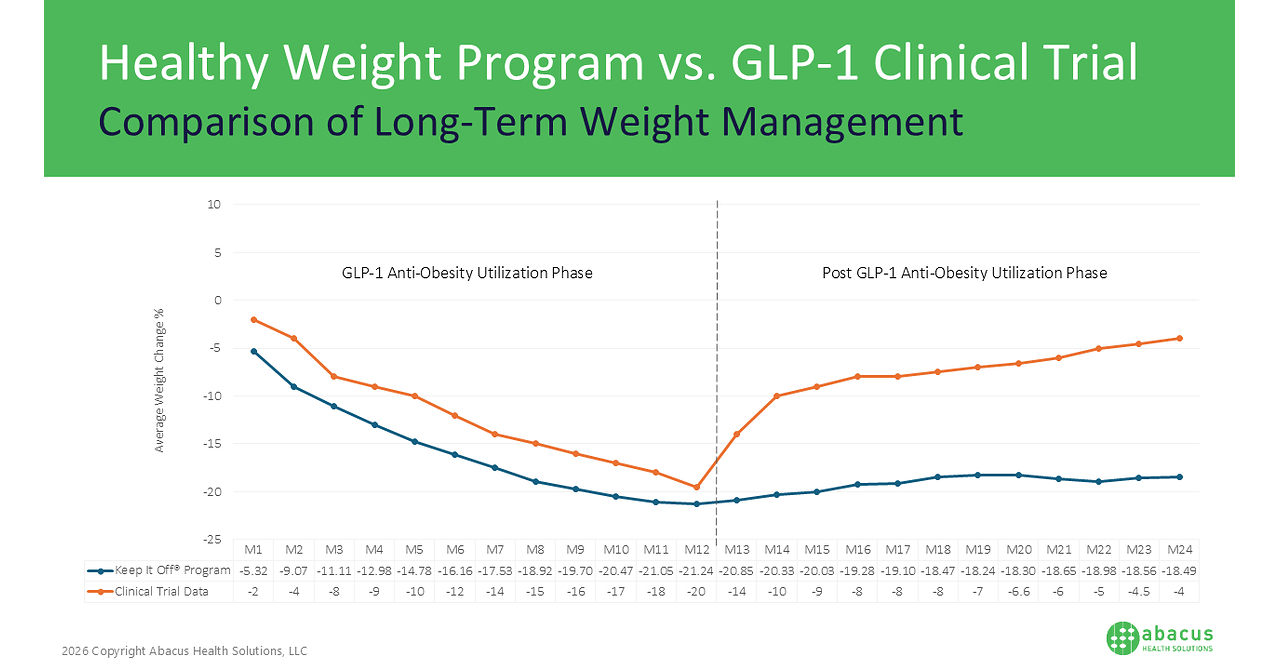
Abacus Health Solutions reports objective 24-month weight outcomes from its Healthy Weight Program: average weight loss of 21.0% at 12 months, with 18.0% maintained at 24 months—one year after discontinuing GLP-1 anti-obesity medication. The findings challenge the notion that continued GLP-1 use is the only path to long-term loss by combining medication with behavioral support and a structured maintenance phase. The evidence gap around post-GLP-1 maintenance appears to be narrowing, though this is company-program level rather than a broad market-moving catalyst.
Analysis
The market implication is not that obesity treatment demand disappears, but that the economics may shift from a lifetime drug subscription to a hybrid of pharmacology plus maintenance services. If payers believe a meaningful subset can hold losses after tapering, they will push for shorter coverage windows, step-down protocols, and outcomes-based contracts, which lowers the implied lifetime value of each GLP-1 patient. That is a medium-term margin and multiple issue, not a day-one revenue hit.
The likely winners are organizations that monetize engagement, monitoring, and maintenance workflows rather than fill counts: payer services, behavioral-health platforms, and digital coaching vendors. The losers are consumer or telehealth models priced on perpetual refills, because their unit economics depend on repeat utilization and high churn resistance. For the large GLP-1 manufacturers, this is a valuation nuance rather than an earnings event: the core demand story stays intact, but terminal penetration and duration assumptions could be haircut if employers embrace lower-cost maintenance pathways.
Treat the release skeptically. It is directionally useful but likely reflects a highly selected, highly compliant cohort; what matters is whether independent claims data show the same retention outside a coached program. The near-term catalyst is not the press release itself but employer renewals, PBM formulary resets, and any public evidence on post-discontinuation regain over the next 1-3 quarters. If real-world data contradict this, the thesis fails quickly; if not, pressure on chronic-use assumptions builds over 6-18 months.
AllMind Terminal
AI-powered research, real-time alerts, and portfolio analytics for institutional investors.
Request TrialMarket Sentiment
Overall Sentiment
mildly positive
Sentiment Score
0.15
Key Decisions for Investors
- No immediate directional trade in LLY or NVO from this release alone; treat it as a watch item until independent payer or claims data confirm lower post-discontinuation regain.
- If HIMS rallies on obesity-related enthusiasm, consider a small 1-3 month put spread or short against UNH as a relative-value expression of lower GLP-1 duration assumptions; risk is that the study proves non-replicable and the trade gets squeezed.
- Favor payer and benefit-admin names on weakness over consumer GLP-1 access models over the next 1-3 months: UNH/CVS are better positioned if employers push for maintenance programs instead of indefinite drug coverage.
- Set a falsifier alert for any credible real-world dataset showing weight regain reaccelerates within 6-12 months after stopping therapy; that would invalidate the maintenance thesis and support covering any short exposure to GLP-1 access enablers.
More News
- Order to limit Starshield for Ukraine came from inside White House: Reuters reports
- FDA approves Enspryng for thyroid eye disease treatment
- The Tesla Roadster 2 Is Here—and It Flies
- Ukraine to resume strikes on Russian refineries, shattering hopes of an 'energy ceasefire'
- Hybe shares jump 10% as K-pop sensation BTS' tour lifts earnings hopes
- What's behind the sell-off in AI neocloud stocks like CoreWeave and Nebius