
Synchrony and Oxford Economics Find Trust Will Define the Future of AI Shopping
Source: PR Newswire
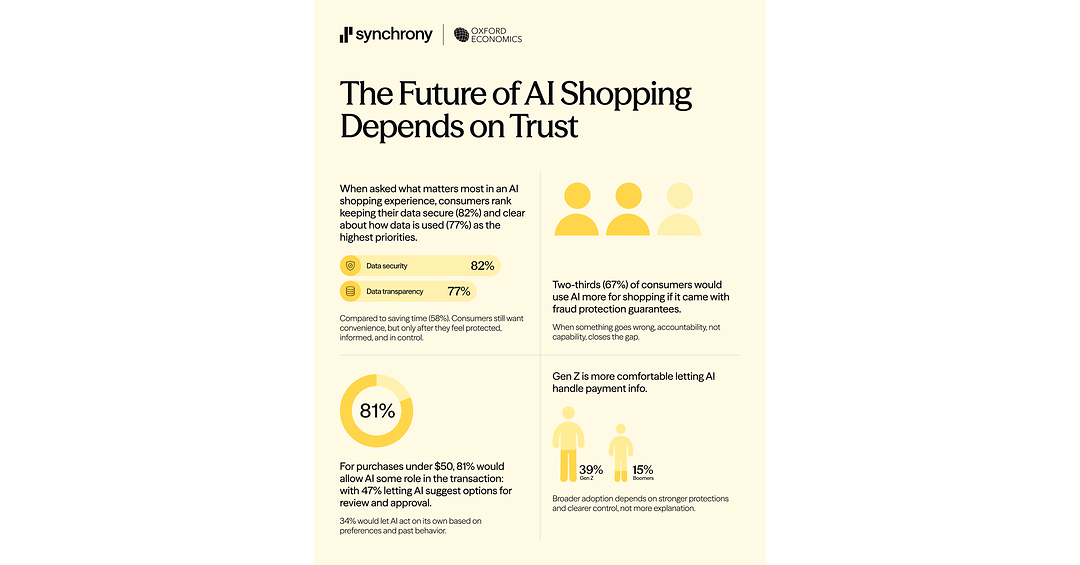
Synchrony's survey of 2,000 U.S. consumers finds that trust is the primary constraint on agentic-commerce adoption: 82% prioritize data security and 77% transparency, versus 58% prioritizing time savings. Fraud protection could materially support adoption, with 67% saying they would use AI shopping more if it included such protection; consumers are most comfortable delegating low-value purchases, while 46% would not use AI for purchases of $5,000 or more. Synchrony is developing AI-commerce capabilities for financing, rewards and offers and is working on interoperable industry standards, but the release provides no financial guidance or near-term revenue impact.
Analysis
The investable implication is not near-term transaction-volume acceleration but a shift in where checkout economics accrue. Agent-mediated shopping reduces the value of merchant-owned discovery and increases the value of tokenized credentials, real-time authorization, dispute resolution and rewards portability—structurally favoring V, MA and FIS over retailers whose economics depend on impulse purchasing, proprietary site traffic or opaque promotional pricing. SYF has a credible role in preserving private-label financing and loyalty offers inside agent workflows, but this is presently a positioning claim rather than a measurable earnings catalyst.
The gating constraint is liability architecture. If consumers expect easy reversals for unauthorized or erroneous agent transactions, issuers and networks may initially absorb higher fraud, chargeback and servicing costs before pricing catches up; this is a potential margin headwind for subprime-heavy consumer-credit lenders including SYF, COF and DFS. Conversely, vendors able to provide identity, transaction monitoring and merchant-side fraud orchestration—such as RDDT? No, more directly S, OKTA and NICE—could see demand, though none should be bought solely on this survey.
Over the next 1-3 months, the relevant catalyst is evidence that major platforms and merchants adopt interoperable agent-payment standards with explicit consent and dispute rules. Over 6-18 months, agents could compress merchants' ability to segment offers and steer consumers toward higher-margin products, raising retailer promotional intensity while improving the negotiating leverage of rewards issuers. The contrarian view is that delegated purchasing remains concentrated in replenishment and low-consideration categories; without material growth in authenticated payment volume or partner-originated receivables, the market should not award SYF an AI multiple.
AllMind Terminal
AI-powered research, real-time alerts, and portfolio analytics for institutional investors.
Request TrialMarket Sentiment
Overall Sentiment
mildly positive
Sentiment Score
0.20
Ticker Sentiment
Key Decisions for Investors
- No new standalone SYF position on this release; treat it as a watch item. Reassess after two reporting periods if management discloses incremental partner wins, agent-originated application/transaction volume, or evidence that fraud and servicing costs remain contained.
- Prefer a 6-12 month long V / short XRT pair for a modest allocation: payment-network economics benefit from higher authenticated digital transaction throughput, while broad specialty retail faces greater price transparency and weaker direct-channel differentiation. Exit if retailer gross-margin guidance stabilizes while network cross-border and credential-on-file growth decelerate.
- For SYF holders, monitor net charge-offs, fraud-loss provisions and promotional financing yields rather than AI partnership announcements. A material rise in fraud-related losses or a sequential deterioration in net interest margin without receivables growth would falsify the constructive strategic read.
- Watch for formal liability or consent standards from card networks, CFPB-related guidance, or major AI-platform payment integrations over the next 3-6 months. If standards place reimbursement liability primarily on issuers, reduce exposure to SYF and other unsecured-credit lenders before the effect appears in reported charge-offs.
More News
- South Korea’s exports hit record high on AI boom
- In photos: China's Xi hardens Taiwan warning as country celebrates week-long National Day holiday
- Asian stocks dip, bonds in focus after torrid September
- RAM supply set to worsen, says Micron, as CEO celebrates ‘much higher’ prices
- Tencent leases 100,000 chips from Oracle for $7 bln- FT
- Asia stocks rise on chipmaker gains, soft U.S. inflation; Nikkei outperforms
From AllMind Research
- Anthropic IPO Preview: Valuation, Timing, and What to Watch
- Shein After the IPO: Venue, Valuation, and What Must Be Proved
- What AI Research Tools Should a Small Hedge Fund Buy First?
- Stop Treating AI Like a Chatbot: What Are Agents, SubAgents, MCP, and Skills, and How Do They Actually Work?
- Earnings-Triggered Research Automations: A Control Guide