
NY's 50+ Voters Outnumber Younger Voters by 1.3 Million in Historical Turnout Scenario, New Analysis Finds
Source: PR Newswire
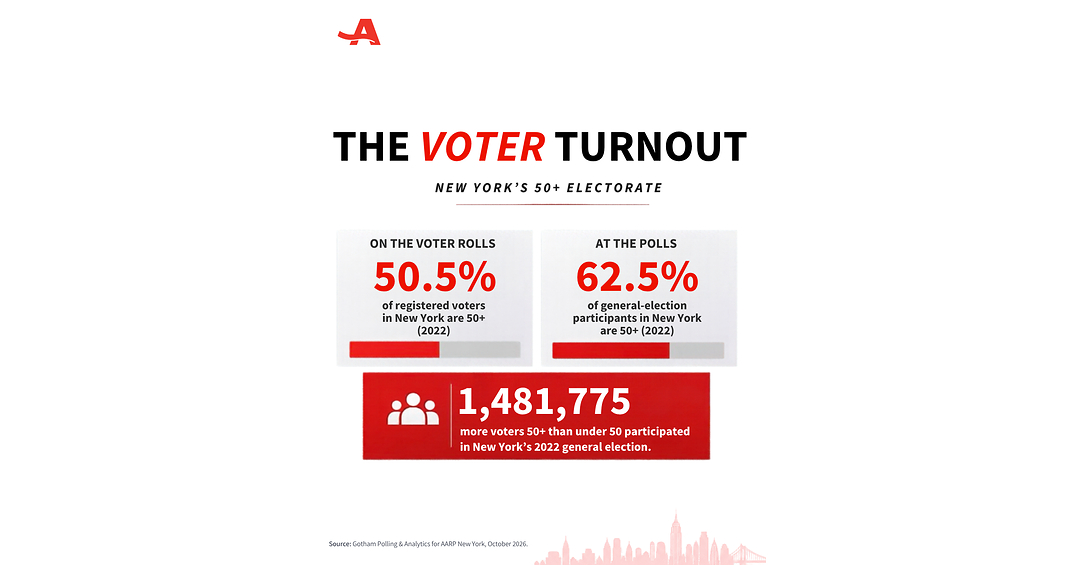
A Gotham Polling & Analytics analysis prepared for AARP New York estimates that, if turnout resembles the 2018 and 2022 gubernatorial elections, about 3.7 million New York voters age 50+ could participate in the 2026 general election, versus 2.4 million under 50—a difference of 1.3 million. This is a historical scenario, not a turnout forecast; the report says voters 50+ made up 62.5% of identified 2022 general-election participants and cautions that the data do not establish party switching or candidate preferences.
Analysis
This is a weak political signal, not an investable forecast. Age-weighted turnout may make candidates more attentive to Social Security, health-care affordability, housing and utility costs, but it does not identify voter preferences or imply a policy outcome. The larger second-order variable is the expanding unaffiliated electorate: it can weaken party-based targeting and make close races more sensitive to candidate-specific messaging and turnout execution. That uncertainty matters more to election outcomes than the age-share scenario alone.
For markets, any eventual policy channel is indirect: proposals affecting Medicaid, health-care costs, housing supply or utility bills could alter regulatory and reimbursement expectations for exposed sectors. The article provides no candidate positions, likely legislative control, or company-level earnings sensitivity, so sector positioning now would be premature. The analysis is commissioned by an advocacy organization and explicitly relies on historical participation patterns; treat it as a constituency map, not a neutral turnout forecast.
Over days, expect little durable market impact. Over the next 1–3 months, watch candidate platforms, district polling and verified turnout indicators, especially in competitive districts. Over 6–18 months, policy exposure depends on election outcomes and implementation, not voter demographics alone. The thesis is falsified as an actionable edge if age-stratified turnout diverges materially from historical patterns or if competitive-race polling shows no corresponding change in voter priorities.
AllMind Terminal
AI-powered research, real-time alerts, and portfolio analytics for institutional investors.
Request TrialMarket Sentiment
Overall Sentiment
neutral
Sentiment Score
0.00
Key Decisions for Investors
- No immediate trade: the data does not establish candidate preference, election outcome, or a measurable earnings catalyst.
- Track policy proposals on health-care costs, housing and utility affordability; only reassess related sector exposure when proposals are specific enough to map to regulation, reimbursement or pricing.
- Treat unaffiliated registration growth as a campaign-volatility signal, not evidence of a partisan realignment; monitor district polling and subsequent turnout data rather than extrapolating the historical scenario.
- Avoid using the age profile alone to position New York municipal bonds or regulated-sector equities; revisit only if election results produce a credible change in fiscal or regulatory policy.
More News
- The U.S. market has never been more focused on one single bet—but AI’s payoff will likely take decades
- Jio IPO Sees Overwhelming Demand on Day One Even as Nifty Struggles
- CoreWeave’s market confidence erodes as bond yields spike and stock sinks
- Why the stock market’s fragile calm faces a major test starting Friday
- Meta ordered to pay $25 billion in case related to Cambridge Analytica scandal
- SpaceX gives the AI trade a shot in the arm. What it means for our stocks
From AllMind Research
- Anthropic IPO Preview: Valuation, Timing, and What to Watch
- Shein After the IPO: Venue, Valuation, and What Must Be Proved
- What AI Research Tools Should a Small Hedge Fund Buy First?
- Weekly Update: Adding Live MBO Level 3 Data - Liquidity Heatmap, OFI Charts, and More
- AI Software for Buy-Side Teams: Build the Research Stack