
Seoul National University of Science and Technology Researchers Explore How Probabilistic Analysis Can Help Improve Nuclear Safety
Source: PR Newswire
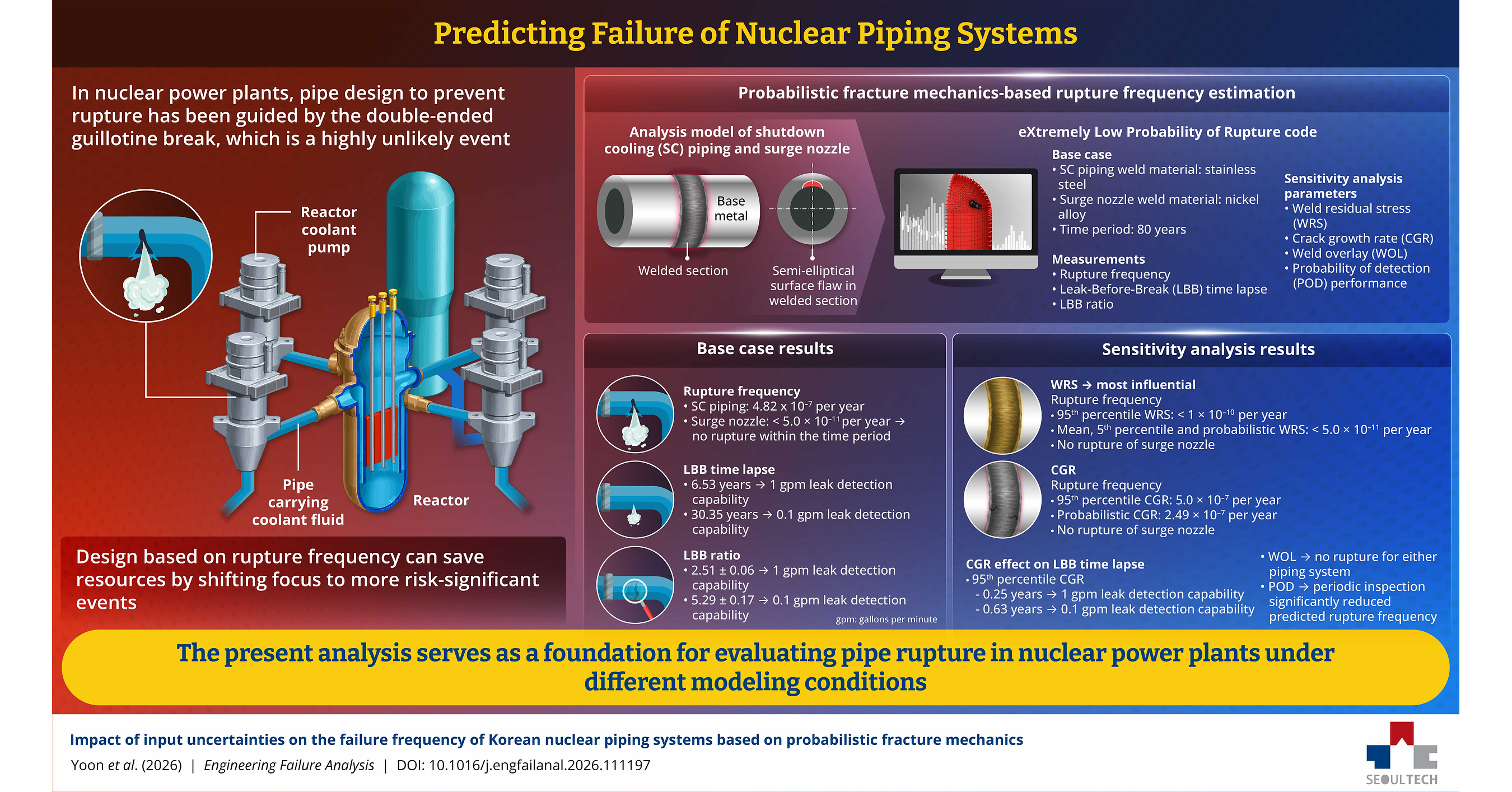
Researchers at Seoul National University of Science and Technology used probabilistic fracture mechanics (xLPR code) to estimate rupture frequency for Korean nuclear piping. In 80-year simulations focused on stress corrosion cracking, weld residual stress (WRS) was the most influential input—using the 95th-percentile WRS profile substantially reduced rupture frequency for SC piping versus the base case, while the surge nozzle and weld overlay scenarios showed no rupture in all cases. The study also found periodic inspections cut rupture frequency by several orders of magnitude, supporting more risk-informed maintenance and safety evaluations.
Analysis
The market implication is not "nuclear is safer" in a tradable sense; it is that aging-fleet economics get a little less scary when inspection and degradation modeling become more granular. That tends to favor operators with long-duration assets and the vendors who sell condition-monitoring, nondestructive testing, and outage services, while doing very little for uranium miners or fuel-cycle names in the near term.
The second-order winner is life-extension capex. If regulators and plant owners lean into risk-informed maintenance, budgets shift from headline-heavy safety spend to recurring inspection, welding, and analysis work, which is higher margin for specialty service providers and modestly accretive to utility allowed returns by lowering perceived tail risk. The loser is any thesis premised on a binary "nuclear accident premium" staying embedded in utility valuations; this framework slowly compresses that premium over 6-18 months if adopted widely.
Near term, this is mostly a watch item because it is academic, not policy. The catalyst path is 1-3 months of zero price impact unless a major operator cites the framework in a license renewal or inspection plan; the real structural effect would be multi-year if regulators standardize probabilistic methods. Contrarian view: consensus may miss that better modeling can actually extend plant lives and increase maintenance intensity, which is constructive for nuclear service revenues even if it looks safety-bearish on the surface.
AllMind Terminal
AI-powered research, real-time alerts, and portfolio analytics for institutional investors.
Request TrialMarket Sentiment
Overall Sentiment
neutral
Sentiment Score
0.05
Key Decisions for Investors
- No immediate trade in PLVFF; treat as informational only unless there is a direct regulatory or commercial tie-in disclosed in upcoming filings.
- Watchlist long BWXT and/or other nuclear services names on pullbacks: if probabilistic inspection frameworks gain adoption, recurring engineering and outage spend should improve 6-18 month visibility.
- Pair idea: long CEG vs short XLU basket for a modest duration trade only if a major U.S. utility cites risk-informed maintenance in guidance or a license-extension filing; thesis is lower tail-risk discount for nuclear-heavy cash flows.
- Avoid chasing URA on this headline alone; uranium beta is not the primary beneficiary. Reassess only if the story evolves into new build policy or life-extension approvals.
- Falsifier: if regulators reject risk-informed methods or if plant owners do not increase inspection/O&M budgets over the next 1-2 quarters, abandon the maintenance-spend thesis.
More News
- US forces disable ship ‘attempting to run’ Iran blockade in Gulf of Oman
- Middle East war, high debt levels to dominate IMF-World Bank meetings in Bangkok
- Attack on Saudi airport kills 12 people and wounds more than 300—the deadliest strike in any Gulf Arab country since the start of the Iran war
- Musk says Terrafab chip factory could outperform rivals despite challenges
- Stocks saw new highs and big declines: How the volatile AI trade moved last week's market
- Will Warner Bros. kill Skydance — or will David Ellison kill Warner Bros?
From AllMind Research
- Anthropic IPO Preview: Valuation, Timing, and What to Watch
- Shein After the IPO: Venue, Valuation, and What Must Be Proved
- What AI Research Tools Should a Small Hedge Fund Buy First?
- Reading Conviction in the Tape: What Level 3 Order Book Data Really Tells Discretionary PMs
- AI Tools for CFA Charterholders: An Evidence Standard