
Organizations' AI Success Starts With an Employee Skills Strategy: New Guide Published by HR Advisory Firm McLean & Company
Source: PR Newswire
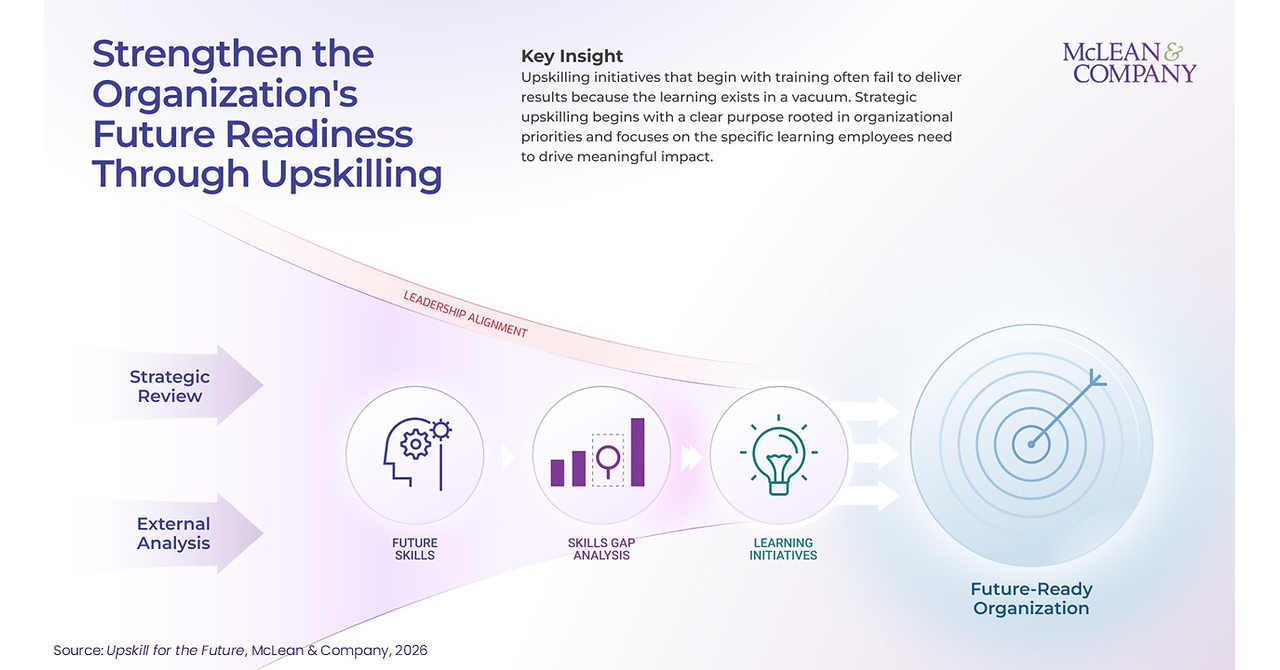
McLean & Company published its Define AI Skills Guide to help organizations align workforce capabilities with AI priorities. The guide outlines four steps for identifying, prioritizing, and embedding AI skills, and its skills library includes 19 foundational skills: nine technical and 10 durable. The resource is advisory content, with no financial results or market-moving figures reported.
Analysis
This is a positioning signal about enterprise AI adoption, not evidence of incremental software demand or measurable productivity gains. The economic bottleneck it highlights is increasingly organizational change: firms may buy AI tools faster than they can redesign workflows, set governance, and equip employees to use outputs appropriately. If that gap persists, realized returns on AI spending could lag vendor expectations, extending the payoff period for broad AI infrastructure and application investments. Conversely, vendors that can demonstrate workflow integration, role-based training, and measurable outcomes may gain budget share from standalone training content and undifferentiated AI tools.
The announcement is also commercial promotion by an HR advisory firm; a framework or skills library alone does not establish customer adoption, recurring revenue, or improved client outcomes. Near term (days), there is no clear public-equity catalyst. Over 1–3 months, watch enterprise survey evidence, earnings commentary, and renewals or bookings from workforce-learning and HR-services providers for confirmation that skills programs are receiving funded budgets. Over 6–18 months, the stronger structural test is whether AI changes role design and labor productivity enough to alter training, staffing, and software spend.
Contrarian angle: investors may over-focus on AI tool deployment and underweight the execution friction that delays monetization—but this release does not quantify that friction or identify a tradeable beneficiary. A rise in training activity could also be compliance-led and low-value rather than evidence of successful AI transformation. No company-specific valuation, financial impact, or trade setup can be established from the supplied information.
AllMind Terminal
AI-powered research, real-time alerts, and portfolio analytics for institutional investors.
Request TrialMarket Sentiment
Overall Sentiment
neutral
Sentiment Score
0.10
Key Decisions for Investors
- No trade on this announcement alone. Treat it as a thematic datapoint, not an earnings catalyst for McLean & Company’s parent, Infotech, or any AI vendor.
- Over the next 1–3 months, monitor public commentary from HR-services and learning-platform providers, including Skillsoft and Coursera, for paid AI-skills demand, bookings, renewal rates, and customer expansion; do not infer revenue impact from free guides or pilot announcements.
- For AI software and infrastructure exposure, track evidence that customers are moving from licenses and pilots to sustained workflow usage and measurable productivity. Delayed conversion would challenge near-term monetization assumptions across the theme.
- Revisit the view if companies disclose funded, scaled training programs tied to redesigned roles and realized productivity—or, in the opposite direction, if AI budgets rise while adoption, renewals, or customer outcomes remain weak.
More News
- Binance co-CEO Richard Teng says hackers used fake job interviews, AI tool to steal $6.3 billion in crypto 108511116
- AMD stock jumps 7% on earnings as data center revenue nearly doubles
- Marvell-Lumentum Deal Puts Optical Networking at the Center of the AI Boom
- Marvell Technology could plunge on latest multibillion-dollar acquisition
- Disney Plans Thousands of Layoffs Companywide
- AI Inference Startup Fal Raises Capital at $16 Billion Valuation