
J.S. Held Lending Climate Survey Finds Growing Lender Caution Amid Rising Economic and Geopolitical Risks
Source: PR Newswire
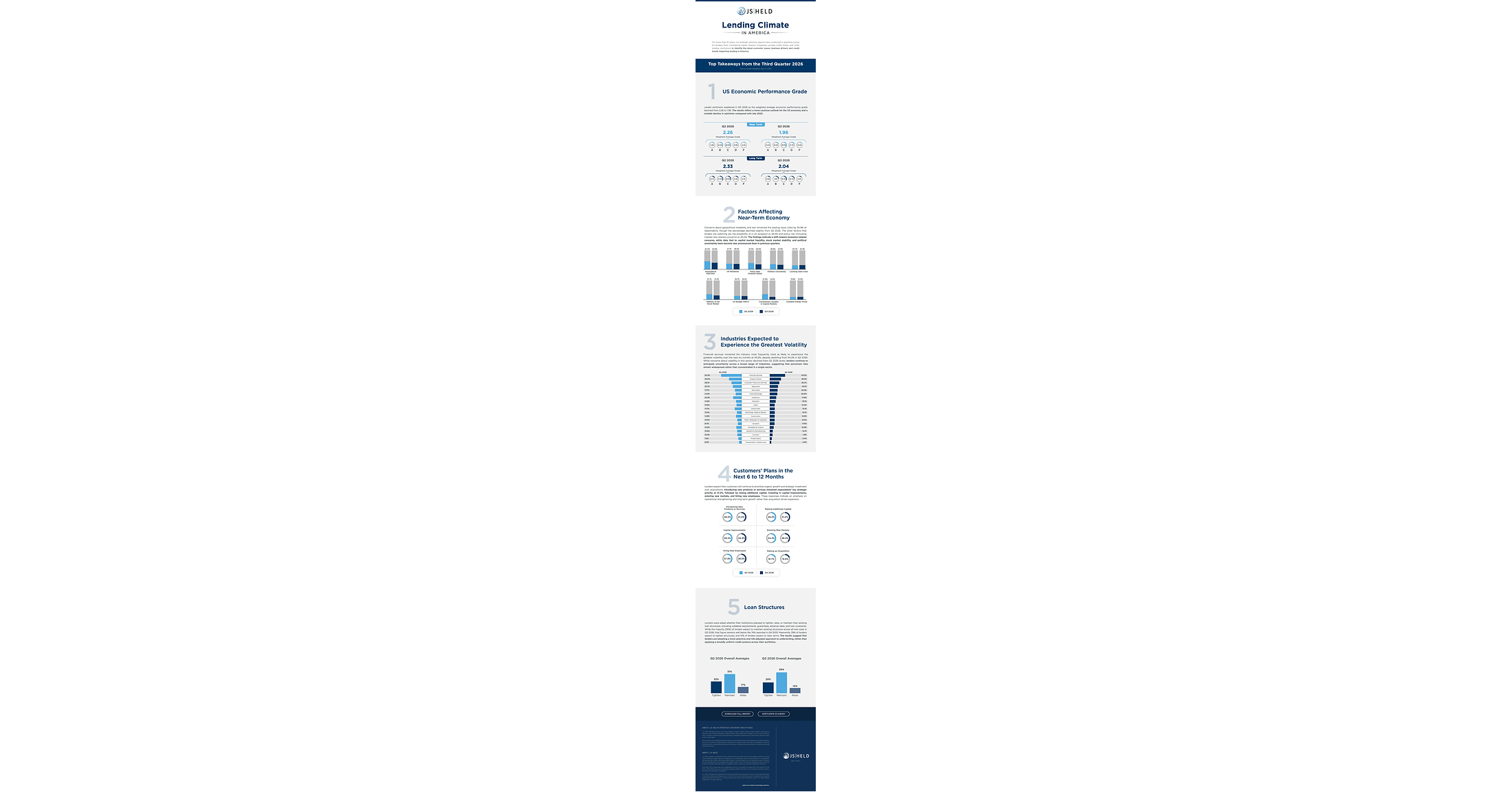
J.S. Held’s Q3 2026 Lending Climate in America survey shows US lenders growing more cautious as economic outlook scores fell versus Q2 and recession concerns remained elevated. Respondents cited tighter underwriting for loans over $25M, with lenders prioritizing disciplined underwriting, liquidity strength, and resilience despite borrowers continuing growth investments (product development, capital investment, market expansion, and hiring). Federal Reserve rate expectations were essentially unchanged from Q2, but broader volatility expectations across financial services, energy/power, consumer products, agriculture, and real estate point to potentially wider sector disruption.
Analysis
This reads less like a growth scare than a marginal cost-of-capital warning: lenders are likely to preserve balance-sheet capacity for the strongest credits while rationing everything else. That tends to hit the most levered parts of the market first — small caps, sponsor-backed borrowers, and companies reliant on revolvers or refinancing — well before it shows up in headline defaults.
The second-order effect is a widening dispersion trade. Large-cap, cash-generative borrowers can still fund capex, but mid-market M&A, add-on acquisitions, and CRE-adjacent lending are where the tightening shows up in earnings revisions over the next 1-3 quarters. Private credit and BDCs are the quietest transmission channel: tighter underwriting today usually means slower origination growth now and higher non-accrual pressure later if the macro softens.
Contrarianly, this may be more discipline than stress. Borrower demand is still there, and a stable rate backdrop means lenders are not yet forced into a true credit freeze; the market may be overpricing immediate downside if spreads do not widen. The thesis breaks if bank lending surveys and high-yield spreads fail to deteriorate over the next 4-8 weeks, or if the Fed turns meaningfully dovish, which would reopen risk appetite and compress the perceived scarcity premium in safer credits.
AllMind Terminal
AI-powered research, real-time alerts, and portfolio analytics for institutional investors.
Request TrialMarket Sentiment
Overall Sentiment
moderately negative
Sentiment Score
-0.35
Key Decisions for Investors
- Short IWM vs long SPY for 1-3 months: express the view that tighter underwriting hits small, financing-dependent companies first. Risk/reward improves if credit spreads and lender survey data continue to soften; cover if IWM outperforms SPY by >5% or if bank-loan conditions ease.
- Buy KRE puts or run a short KRE position over the next 1-3 months: regional banks have the cleanest exposure to slower loan growth plus CRE and middle-market credit caution. Falsify the trade if regional-bank loan growth re-accelerates or if loan-loss guidance stays benign into earnings.
- Pair long LQD / short HYG over 2-6 months: this is a cleaner expression of selective underwriting and refinancing stress than a broad equity short. The trade should work if spread dispersion widens; stop if HY spreads tighten materially or if default expectations roll over.
- Watch private credit/BDC exposure rather than force a trade today: ARCC, OBDC, BXSL, and Ares/Carlyle credit vehicles are vulnerable if origination volumes slow while borrower stress rises with a lag. Enter only if non-accruals or NAV marks begin to deteriorate.
- If you need a simple macro hedge, buy short-dated protection on IWM or KRE into the next credit-spread widening impulse; this is a tactical hedge, not a structural short, and should be reevaluated after 4-8 weeks.
More News
- Trump Hails Iran Talks, Tehran Sets 'Firm Positions'
- Zelenskyy says Ukraine ready for ‘energy ceasefire’, calls for trilateral meeting with Putin, Trump
- Iran floats conditions for Hormuz reopening as Trump says deal could come after midterms
- Trump-Xi summit puts AI safety talks on the table but neither side wants to slow down
- Treasury yields edge lower as Brent crude falls below $99
- Eurozone business growth hits 41-month high in September
From AllMind Research
- Anthropic IPO Preview: Valuation, Timing, and What to Watch
- Shein After the IPO: Venue, Valuation, and What Must Be Proved
- What AI Research Tools Should a Small Hedge Fund Buy First?
- How the 2026 Milan-Cortina Winter Olympics Will Reshape Company Revenues and Stock Performance
- Can Hedge Funds Use ChatGPT? A Control Framework