
DealLabs Builds Travel AI Data Layer with 280,000 Verified Local Records Across Seven Asian Cities
Source: PR Newswire
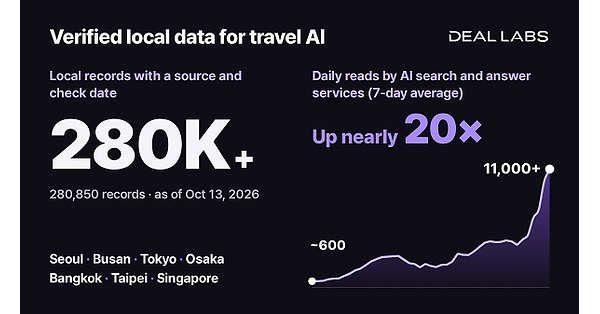
DealLabs says its verified travel database covered more than 280,000 records across seven Asian cities as of October 13, powering over 23,000 guide pages. Generative AI services accessed the data more than 11,000 times per day in mid-October, up from around 600 daily in late September. The company plans to expand to 10 cities by end-2026 and 30, including New York and Paris, by 2028.
Analysis
The investable signal is not the record count; it is whether frequently changing local data can be kept accurate at a cost low enough to support a paid product. Provenance and update cadence could become a differentiator for AI travel answers, while the underlying facts are largely replicable. If accuracy improves, AI interfaces may capture more travel-planning engagement and further weaken referral economics for publishers and affiliate content sites. But platforms such as Google, Booking Holdings, Expedia Group, and Tripadvisor could build or source comparable feeds; DealLabs may create value without capturing it unless it owns distribution or secures paid integrations. The reported rise in data access is an adoption indicator, not evidence of revenue, retention, or willingness to pay. Near term (days to weeks), this is not a material public-equity catalyst. Over 1–3 months, watch for commercial partnerships and repeat usage; over 6–18 months, expansion will test whether verification scales economically across cities. The main reversal risks are high maintenance costs, weak monetization, platform dependence, and errors that undermine trust. No supplied public-company identity or financial data supports a direct company trade.
AllMind Terminal
AI-powered research, real-time alerts, and portfolio analytics for institutional investors.
Request TrialMarket Sentiment
Overall Sentiment
mildly positive
Sentiment Score
0.35
Key Decisions for Investors
- No trade on the announcement alone. Treat DealLabs as a private-company watch item; verify paid API contracts, customer concentration, renewal rates, and the cost of maintaining current records before assigning venture or public-market value.
- Monitor Google, Booking Holdings, Expedia Group, Tripadvisor, and travel-content publishers for evidence that AI itinerary usage is changing referral traffic or booking conversion. A measurable traffic decline without offsetting conversion gains would support a relative short bias in exposed content businesses, but the article provides no such evidence yet.
- Set a 1–3 month catalyst alert for disclosed integrations or monetization, and a 6–18 month check on whether city expansion coincides with stable accuracy and improving economics. City-count growth without commercial adoption would falsify the scalability thesis.
- Avoid treating raw AI access growth as a revenue proxy. Upgrade the signal only if DealLabs or partners disclose paid usage, repeat customer demand, or measurable reductions in itinerary errors; downgrade it if coverage expansion produces persistent inaccuracies or platform access is curtailed.
More News
- What investors need to know about Alphabet's stock-busting earnings report
- Our next steps for Alphabet stock after earnings disappoint at nearly every turn
- Budget 2026 speech
- SK Hynix says the memory-chip shortage will last until 2030—and more than half its production is booked for the next two years
- China’s tech darlings are losing their shine. Here’s what’s behind the sell-off
- GE Vernova shares slip despite a beat-and-raise. What the sellers are getting wrong