
Pusan National University Study Reveals How Communication Sequence Strengthens Green Persuasion
Source: PR Newswire
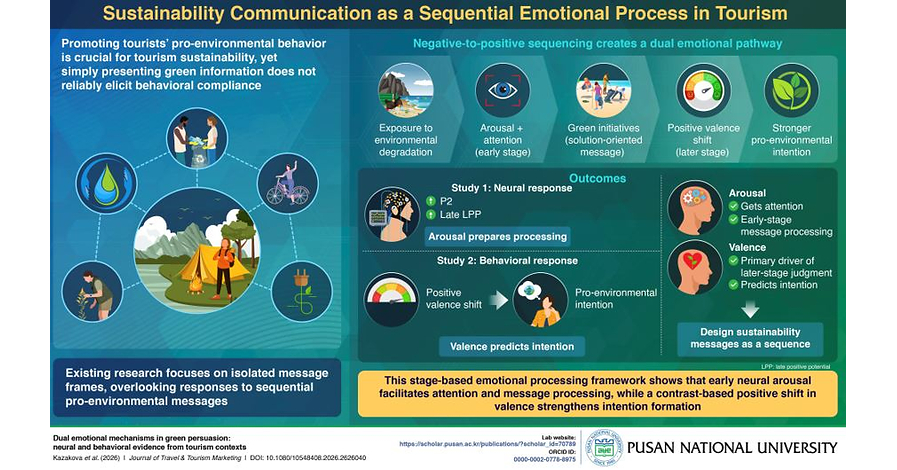
A Pusan National University study finds that sustainability messaging delivered in a negative-to-positive sequence can improve pro-environmental intentions in tourism. A 64-channel EEG study showed environmental-degradation messages increased subsequent attention to green solutions, while a behavioral study found the sequence improved emotional valence and intended participation. The findings may inform sustainability communications by airlines, cruise operators, destinations and digital travel platforms, but constitute academic research rather than an immediate commercial or market-moving development.
Analysis
This is not investable evidence by itself: the research measures stated intent in a controlled setting, not booking conversion, ancillary spend, or willingness to pay. The near-term implication is limited to marketing execution, and any revenue effect for travel operators is likely immaterial relative to fuel, capacity, FX, and macro demand. No broad sector rerating is warranted.
The potentially actionable second-order effect is that credible, sequenced sustainability messaging could improve adoption of opt-in products—carbon offsets, SAF-linked fares, conservation fees, rail substitution, and lower-impact itineraries—without requiring price discounts. Airlines and cruise lines with sophisticated owned digital channels, loyalty data, and ancillary-revenue infrastructure should be better positioned than fragmented destination operators; however, the economics depend on whether incremental take rates exceed reputational, verification, and program-administration costs.
Over 6-18 months, the more relevant risk is greenwashing scrutiny. Messaging that heightens environmental concern but offers poorly substantiated solutions could increase complaint, regulatory, and brand-damage exposure rather than conversion. Watch for disclosed opt-in conversion rates, ancillary revenue per passenger/day, sustainability-claim audits, and any guidance tying digital personalization to unit-revenue gains; absent these datapoints, treat this as a marketing test rather than an earnings catalyst.
Contrarian view: investors may over-credit low-carbon messaging as demand creation when it may merely reallocate purchases among existing customers. For airlines, a successful prompt toward lower-carbon choices could also divert customers toward lower-yield rail or reduce trip frequency, while for cruise operators it may amplify attention to their emissions footprint. The thesis is falsified if digital campaign tests fail to lift attachment rates or if compliance costs rise faster than sustainability-linked ancillary revenue.
AllMind Terminal
AI-powered research, real-time alerts, and portfolio analytics for institutional investors.
Request TrialMarket Sentiment
Overall Sentiment
neutral
Sentiment Score
0.10
Key Decisions for Investors
- No directional sector trade on this research alone; maintain exposure decisions in DAL, UAL, LUV, CCL and RCL around capacity, fuel and consumer-demand indicators rather than sustainability-message claims.
- Set a 1-3 month watch item for DAL and UAL investor disclosures: positive signal only if personalized digital/loyalty initiatives produce measurable ancillary-revenue or conversion uplift without a decline in fare yield. Do not underwrite earnings upside before that evidence.
- For a 6-18 month relative-value screen, favor travel operators with verifiable decarbonization programs and direct booking ecosystems over operators relying on generic ESG claims; use RCL versus CCL as a monitoring pair, conditional on disclosure of onboard conservation-program attachment rates and regulatory outcomes.
- Risk trigger: reduce any sustainability-premium valuation assumption if EU/UK consumer-protection actions, advertising-standard rulings, or customer litigation challenge environmental claims. Such events can create disproportionate multiple pressure even if immediate revenue exposure is small.
More News
- Meta announces new lightweight virtual reality glasses to one-up Apple’s Vision Pro
- Here's what happens to the economy when Treasury yields soar like they are now
- Oil industry warns a diesel export ban will raise fuel prices as Trump weighs restrictions
- Meta's standoff with Amazon over Muse could be a sign of things to come
- How a Diesel Export Ban Could Impact US Fuel Prices
- Why ASEAN’s coming digital economy trade agreement deserves your attention
From AllMind Research
- Anthropic IPO Preview: Valuation, Timing, and What to Watch
- Shein After the IPO: Venue, Valuation, and What Must Be Proved
- What AI Research Tools Should a Small Hedge Fund Buy First?
- AI Research Systems for Hedge Funds: A Pilot Design
- Weekly Update: New Reporting Features, UI Improvements, and Chat Optimizations