
KeyCorp Raises 2026 Revenue Outlook: What's Driving It?
Source: zacks.com
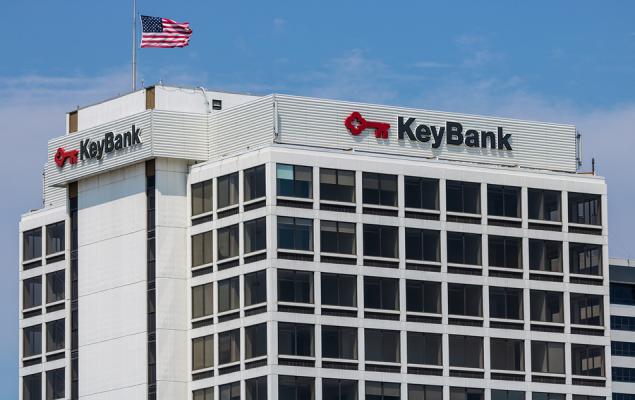
KeyCorp raised its 2026 revenue-growth outlook to about 8% from 7-8%, supported by projected 4-5% average loan growth, 9-11% net interest income growth and year-end NIM of 3.00-3.05%. Fee-income guidance increased to 4-5%, aided by the Clearwater Corporate Finance acquisition, which is expected to add $60-$70 million of revenue in 2027; Q3 investment-banking fees are projected to rise more than 20% sequentially. Management expects positive operating leverage despite roughly 4% expense growth, while charge-offs remain below the 40-45bp full-year target, though rate uncertainty and credit-sensitive sectors remain risks.
Analysis
The investable signal is less KEY-specific than it appears: three regionals pointing to asset repricing, commercial demand, and fee recovery implies that 2026 Street NII estimates may still be too low across the high-quality regional cohort. KEY has the largest near-term earnings torque to a clean execution print because incremental revenue should outpace costs, but its lower starting profitability and historically discounted valuation mean the multiple only rerates if management converts revenue growth into tangible ROTCE improvement rather than merely meeting guidance.
The more important read-through is a widening dispersion within regionals. PNC's substantially faster balance-sheet growth and acquisition contribution argue for superior absolute EPS revision potential, while CFG's higher expected margin profile offers better insulation if short rates decline gradually. KEY's commercial concentration creates a differentiated upside channel through power, utility, renewables and technology capex, but also embeds greater downside if project-finance demand weakens or credit stress emerges in CRE, agriculture, or cyclical middle-market borrowers.
Over the next days, the likely reaction is limited because guidance changes are incremental and management-supplied. The 1-3 month catalysts are third-quarter fee results, deposit-cost trends, and evidence that commercial originations are yielding above funding costs; these determine whether consensus upgrades are warranted. The 6-18 month risk is that faster deposit gathering turns into excess low-yield liquidity if loan demand moderates, while a sharper-than-expected easing cycle compresses the asset-repricing benefit before fee income can offset it.
Contrarian view: the market may be extrapolating a favorable rate backdrop across the entire regional-bank complex, yet the stated growth outlook depends on benign credit and capital-markets activity simultaneously. That combination is late-cycle sensitive. A sustained rise in criticized commercial credits or charge-offs above management's range would likely produce disproportionate multiple compression in KEY versus PNC, despite apparently modest earnings impacts.
AllMind Terminal
AI-powered research, real-time alerts, and portfolio analytics for institutional investors.
Request TrialMarket Sentiment
Overall Sentiment
moderately positive
Sentiment Score
0.58
Ticker Sentiment
Key Decisions for Investors
- Initiate a 3-6 month long PNC / short KEY pair, sized beta-neutral. PNC offers stronger earnings-revision potential from faster balance-sheet expansion and a more diversified fee base; KEY is the funding leg if commercial-credit or rate-cut risks reassert. Reassess if KEY demonstrates two consecutive quarters of accelerating ROTCE or if PNC's acquisition integration raises expense guidance.
- Maintain a tactical 1-3 month long KEY only on post-results confirmation that deposit costs are falling and commercial loan yields are expanding; target a 10-15% upside rerating versus a 7-8% stop. Do not buy solely on the revised outlook: the key missing data are current consensus EPS, valuation versus TBV, and the sensitivity of NII to 50-100bp of cuts.
- Favor CFG over the broader KRE ETF for a 6-12 month regional-bank allocation. Its expected margin profile and fee mix should provide better downside resilience than lower-quality CRE-heavy peers; invalidate if its efficiency ratio fails to improve or credit costs trend materially above plan.
- Set alerts around KEY's criticized/classified loan formation and net charge-off trajectory at each earnings release. Any move above the stated full-year charge-off range, particularly tied to CRE or agriculture, is a catalyst to exit KEY longs and increase the PNC/KEY relative-value short.
More News
- Safety Insurance Group merger with Mapfre advances as HSR waiting period ends
- Grab aims for 'next level' in financial services with purchase of buy-now pay-later platform Atome
- China's AI leaders keep quiet despite U.S. 'publicity' on tech risks
- US Senate crypto bill collapses in blow to industry
- U.S. stock futures drift higher with Fed rate hike in focus
- Exclusive-Malaysia talks to rival airlines as it monitors AirAsia’s financial health, sources say