
Organizations' AI Success Starts With an Employee Skills Strategy: New Guide Published by HR Advisory Firm McLean & Company
Source: PR Newswire
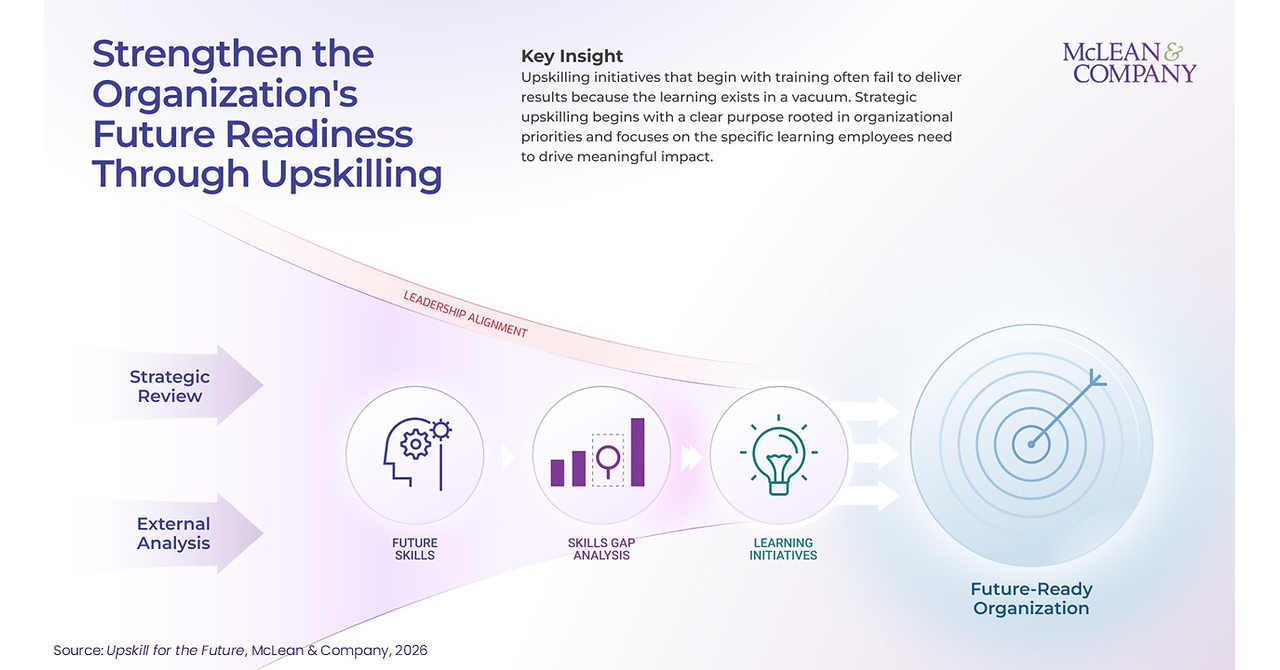
McLean & Company published a guide to help organizations define and embed workforce AI skills, with a four-step process spanning strategic scoping, skills-library development, prioritization, and integration into HR practices. Its AI Skills Library includes 19 foundational skills: nine technical and 10 durable; the firm recommends revisiting the library as AI tools and organizational priorities change.
Analysis
This is a weak commercial signal, not evidence of incremental AI demand or realized productivity. The economic bottleneck it highlights is implementation: if employees cannot reliably evaluate outputs or adapt workflows, AI software deployments may take longer to produce ROI, potentially delaying seat expansion and putting pressure on buyers to prove value before renewing or scaling tools. That is a conditional risk to enterprise AI monetization, not a company-specific earnings call.
Potential beneficiaries are workforce-learning and HR-advisory providers if organizations convert AI capability frameworks into funded training and change-management programs. But a free guide can also be lead generation, and the release supplies no adoption, contract, or revenue data; competitive read-through is therefore limited. Over 6–18 months, the key question is whether skills programs become recurring budgets tied to role-level deployment and measurable workflow outcomes, rather than one-off training.
Contrarian point: the focus on durable skills may overstate the need for broad workforce retraining if simpler interfaces and embedded safeguards reduce the expertise needed for routine tasks. Conversely, agentic tools could increase the value of judgment and oversight even as basic tool fluency becomes less differentiated. No immediate trade signal. Reassess if large employers disclose rising AI training spend alongside deployment metrics, or if software vendors report weaker expansion attributable to adoption friction.
AllMind Terminal
AI-powered research, real-time alerts, and portfolio analytics for institutional investors.
Request TrialMarket Sentiment
Overall Sentiment
mildly positive
Sentiment Score
0.20
Key Decisions for Investors
- No trade on this announcement alone: it provides no evidence of paid uptake, revenue contribution, or a change in enterprise AI spending.
- Set a 1–3 month watch item on earnings commentary from enterprise software vendors and HR-learning providers for quantified changes in AI deployment, training budgets, renewals, and seat expansion; treat qualitative readiness claims as insufficient confirmation.
- If adoption friction begins to appear in software results or guidance, consider a relative-value expression favoring workforce enablement providers over enterprise AI software exposures, but only after confirming revenue exposure and valuation; the article itself does not support selecting a named security.
- Falsify the adoption-friction concern if customers report faster production deployment and improving AI-related expansion without a material increase in training or implementation spend; revisit the thesis if training budgets rise but productivity or usage metrics fail to follow.
More News
- AMD stock jumps 7% on earnings as data center revenue nearly doubles
- Marvell-Lumentum Deal Puts Optical Networking at the Center of the AI Boom
- Marvell Technology could plunge on latest multibillion-dollar acquisition
- AI Inference Startup Fal Raises Capital at $16 Billion Valuation
- Stock futures plunge as blue tsunami hits red states and data center hot spots. Wall Street usually likes political gridlock—but maybe not this time
- AMD rides data center riches to ‘largest and most profitable’ quarter in history