
Transocean Boosts Backlog With New Deepwater Conqueror Deal
Source: zacks.com
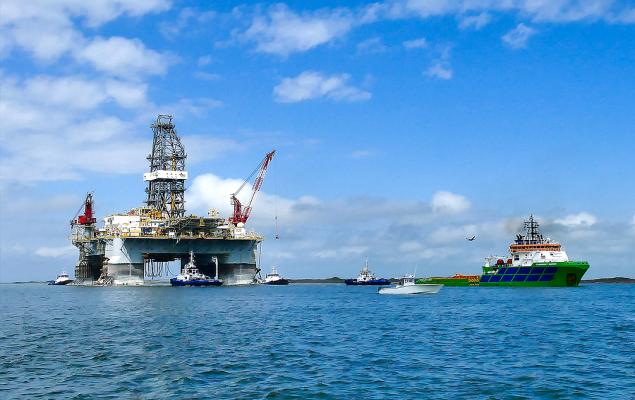
Transocean secured a two-well, approximately 170-day Equatorial Guinea contract for the Deepwater Conqueror beginning in 2027, adding about $80 million to backlog excluding services and mobilization fees. The rig will transition directly from its U.S. Gulf of Mexico assignment, reducing idle-time risk and improving revenue visibility. The award follows a $300 million, two-year ONGC drillship letter of award in India, with extension options that could run through early 2031, underscoring demand for Transocean's high-specification ultra-deepwater fleet.
Analysis
The relevant signal is not the incremental backlog itself but evidence that premium floaters are being redeployed without idle time into 2027. That raises fleet-wide utilization and reduces the probability that Transocean must compete aggressively on price to keep rigs working. The read-through is strongest for RIG because its operating leverage is unusually high; however, the equity’s debt burden means backlog only merits multiple expansion if it converts into materially higher cash dayrates and free cash flow rather than merely covering operating costs.
The more underappreciated beneficiary is OII. International ultra-deepwater activity pulls through remotely operated vehicles, subsea intervention and installation support, with less balance-sheet and contract-concentration risk than RIG. OII should see the benefit later—typically as project execution approaches—while RIG reprices immediately on contract awards. Competitors VAL and NE also benefit from tighter high-spec floater availability, although RIG’s international positioning makes it the cleaner sentiment vehicle.
Consensus may overvalue contract headline dollars while underweighting mobilization, regulatory, and customer-credit risk in frontier offshore markets. The key 1-3 month catalyst is whether subsequent fixtures establish rising dayrates, especially on uncontracted high-spec units; the 6-18 month catalyst is final investment decisions by offshore operators. The thesis is falsified if Brent weakens sufficiently to induce 2027 offshore capex deferrals, if RIG reports elevated reactivation/maintenance costs, or if new awards clear at rates below cash-flow-accretive levels.
AllMind Terminal
AI-powered research, real-time alerts, and portfolio analytics for institutional investors.
Request TrialMarket Sentiment
Overall Sentiment
moderately positive
Sentiment Score
0.48
Ticker Sentiment
Key Decisions for Investors
- Accumulate RIG only on weakness rather than chase the announcement; use a 6-12 month horizon and require evidence of sequential fleet dayrate improvement at the next earnings update. Target 2:1 upside/downside, with exit discipline on a material reduction in 2027 contract coverage or higher-than-guided capex/maintenance.
- Initiate a 6-18 month long OII / short RIG pair for a lower-beta offshore-cycle expression: OII captures subsea activity with a cleaner balance sheet, while RIG is more exposed if utilization fails to translate into free cash flow. Reassess if RIG secures additional high-rate contracts that materially accelerate deleveraging.
- Monitor VAL and NE contract fixtures as a real-time confirmation signal; broad dayrate strength supports a basket long in RIG/VAL/NE, while isolated RIG awards would argue against extrapolating a sector-wide upcycle.
- Do not use MGY or DK as direct expressions of this development: their earnings sensitivity is primarily to onshore commodity realization and refining margins, respectively, not multi-year offshore drilling utilization.
More News
- Jensen Huang says Nvidia will sell twice as many chips next year
- Generac shares surge on big Amazon deal. Wall Street thinks the generator stock has more to go
- This AI-picked stock jumps 18% on Amazon’s $8 billion power deal
- Crusoe raises $3.9B to build massive data centers and small modular “AI factories”
- Warsh spooks investors, OpenAI's 'concerning' incidents, Boeing's production problems and more in Morning Squawk
- Goldman’s top strategist just added hard numbers to his earnings-bubble warning
From AllMind Research
- Anthropic IPO Preview: Valuation, Timing, and What to Watch
- Shein After the IPO: Venue, Valuation, and What Must Be Proved
- What AI Research Tools Should a Small Hedge Fund Buy First?
- AI Tools for CFA Charterholders: An Evidence Standard
- Weekly Update: Unstructured Data Search, Ask AI, and Advanced Futures Data