
Pylontech lance la production en série des cellules LFP de 588 Ah et 601 Ah pour l'ESS
Source: PR Newswire
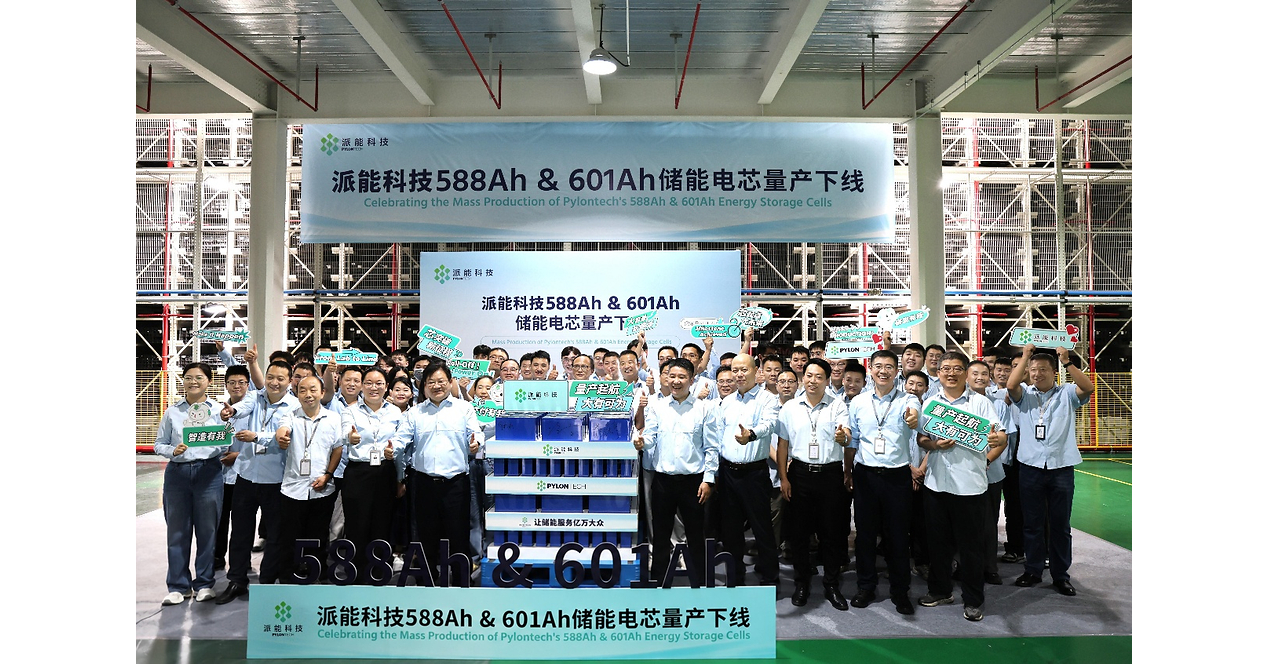
Pylontech began mass production on September 21 of its 588 Ah and 601 Ah prismatic LFP cells for utility-scale energy storage, with more than 100 MWh already produced at its Hefei facility. The 601 Ah cell delivers 425.8 Wh/L energy density, over 12,000 cycles and 96.5% energy efficiency, and will be integrated into the company’s next-generation 6.25 MWh and 8 MWh PyOcean systems. The launch supports Pylontech’s expansion in global large-scale storage following deployments including 120 MW/240 MWh in Jiangsu and 200 MW/400 MWh in Ningxia.
Analysis
This is more consequential for the stationary-storage cost curve than for Pylontech’s near-term equity value. Moving to very-large-format cells reduces pack-level non-cell content—interconnects, housings, assembly labor and control points—potentially widening system-integrator gross margins if warranty performance holds. The offset is concentration risk: a defect or thermal-event issue in larger cells creates a higher absolute loss per module and can delay bankability acceptance, particularly in Europe and the US where insurer and lender diligence determines project conversion.
Competitive pressure should fall most heavily on Chinese BESS vendors relying on purchased cells or older 280-314Ah architectures, including Sungrow (300274:SZ), CATL’s system business (300750:SZ), EVE Energy (300014:SZ) and REPT BATTERO (0666:HK). The likely second-order effect is accelerated cell-price competition rather than immediate demand creation: customers may demand the new form factor’s BOS savings be passed through, leaving cell makers with lower ASPs unless yields and utilization improve. For global listed proxies, Fluence (FLNC) and Tesla Energy (TSLA) face a lower-cost Chinese benchmark, while Nextracker (NXT) and utility-scale solar developers benefit only if cheaper storage improves hybrid-project IRRs enough to unlock marginal interconnection queues.
Near term, this remains a low-conviction catalyst because production claims do not establish qualified yield, third-party safety certification, or profitable external shipments. Over 1-3 months, watch announced utility contracts, system ASP per MWh, and evidence that insurers accept the architecture; over 6-18 months, successful deployments could shift procurement toward fewer, larger cells and compress the competitive moat of integrators without proprietary cell supply. The contrarian view is that larger-cell economics are already expected and may be outweighed by project bottlenecks—grid connection, fire codes, tariffs and financing—not battery hardware cost.
AllMind Terminal
AI-powered research, real-time alerts, and portfolio analytics for institutional investors.
Request TrialMarket Sentiment
Overall Sentiment
moderately positive
Sentiment Score
0.62
Key Decisions for Investors
- No standalone trade in Pylontech absent disclosed external order backlog, qualified production yield and system-level gross-margin guidance; treat initial deployment announcements as a watch-item rather than proof of earnings leverage.
- Monitor a relative-value short watch: short FLNC versus long NXT or a utility-scale solar proxy only if Chinese turnkey BESS pricing declines materially over the next two quarters while FLNC backlog margins fail to reprice. Thesis is falsified by FLNC securing margin-accretive software/service mix or tariff protection that sustains project economics.
- For China-accessible portfolios, prefer a 6-12 month pair of long vertically integrated leaders CATL (300750:SZ) or Sungrow (300274:SZ) versus short a less-integrated BESS/cell peer after verified large-cell tender wins. Enter only after tender data shows share gains; key risk is industry-wide ASP erosion exceeding BOM savings.
- Set alerts for third-party fire-safety certification, European/US bankability approvals, and disclosed 601Ah-system contract pricing. Positive verification plus repeat orders would support a broader long basket in Chinese storage supply chain; a safety incident or warranty reserve increase would invalidate the cost-down thesis quickly.
More News
- China's AI chip blitz arms Xi with a message for Trump: 'You can't choke us off'
- America’s Asian allies want a Trump-Xi truce — but not at their expense
- Meta announces new lightweight virtual reality glasses to one-up Apple’s Vision Pro
- Chinese authorities reportedly in possession of F-35 components in Hong Kong
- SoftBank shares jump over 7% after $11.1 billion bond issuance to fund OpenAI bet
- Meta's standoff with Amazon over Muse could be a sign of things to come