
AI Can Help CIOs Reclaim Capacity as 83% of IT Spend and 66% of Staff Time Go Toward Keeping the Lights On, Says Info-Tech Research Group
Source: PR Newswire
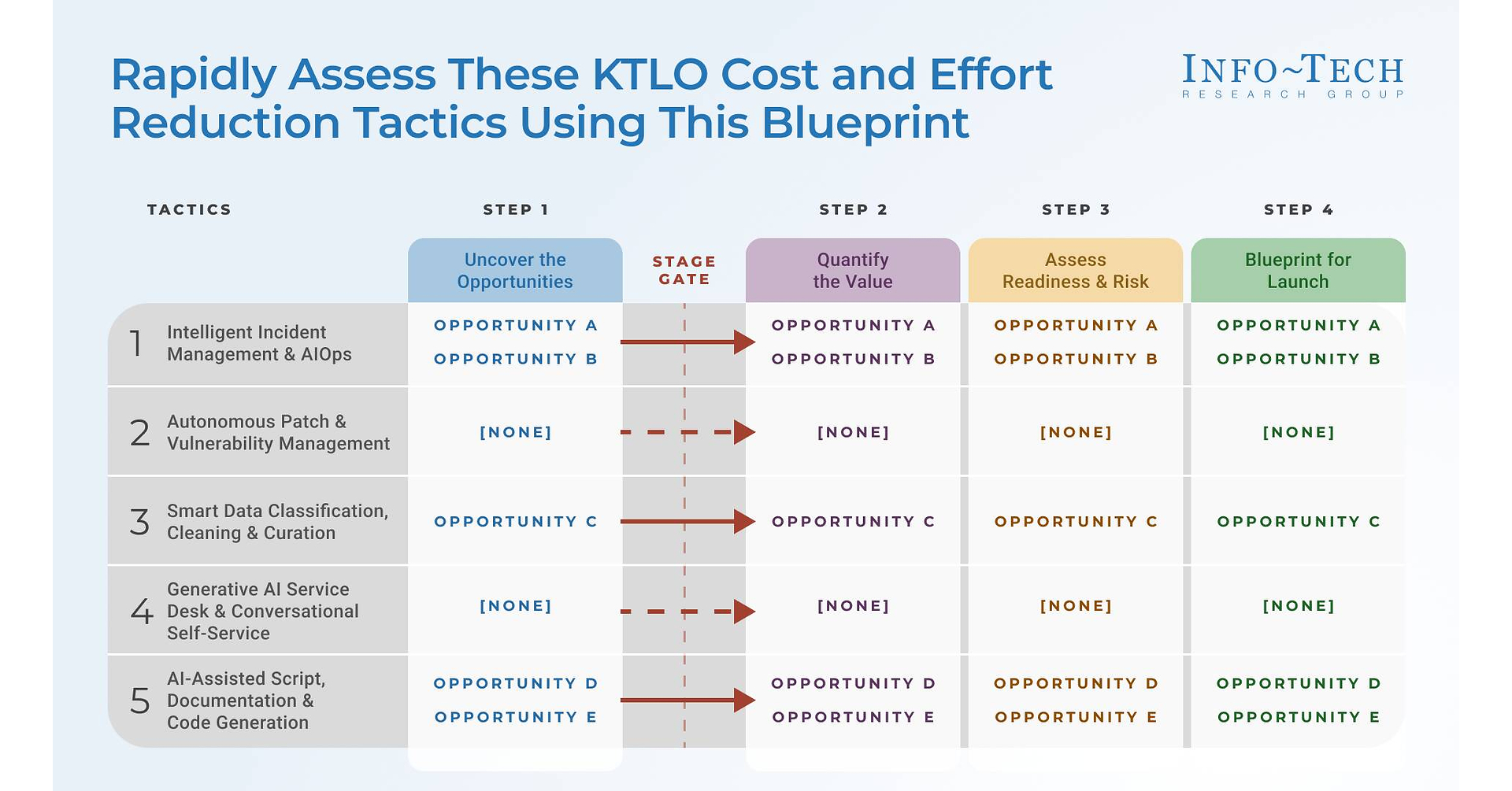
Info-Tech Research Group says routine IT maintenance (KTLO) consumes 82.6% of IT spend and 66% of staff time, leaving limited capacity for innovation. The firm argues targeted AI tactics—AIOps/incident automation, autonomous patching, and generative AI service desk/self-service—can reduce KTLO cost/effort and reclaim budget for higher-value initiatives. The article is advisory in nature with no direct company financial impact, but it supports a modest positive outlook for AI-enabled IT operations spending.
Analysis
This is less a demand shock than a budget-reallocation story: AI in IT ops is a productivity lever that should compress labor intensity before it expands software line items. The best-positioned beneficiaries are workflow-heavy platforms that can sit in the control plane of incidents, tickets, patching, and knowledge management; that argues for relative outperformance in names like NOW and, secondarily, MSFT/CRWD/PANW where automation is bundled into larger security and cloud stacks. The weakest link is labor-arbitrage IT services and MSPs, where every point of automation adopted by clients reduces billable headcount hours and pressures renewal pricing.
The second-order effect is that the spend likely shifts from commodity support to higher-trust integration and governance. That means near-term winners are vendors that can prove closed-loop remediation and auditability; pure advisory language is not enough, and implementation friction will slow actual savings. Over 1-3 months, the market may underappreciate how little of the savings turns into immediate margins because most enterprises will first absorb the capacity as backlog reduction rather than layoffs.
Contrarian view: the consensus is probably too optimistic on speed, not magnitude. Legacy estates, poor data quality, and security approvals make KTLO one of the hardest areas to automate cleanly, so the payback curve is likely back-half loaded over 6-18 months. Falsifiers: slower-than-expected NOW workflow monetization, stable services billings from CTSH/INFY/WIT despite AI pilot activity, or a wave of AI governance incidents that forces enterprises to slow autonomous remediation rollouts.
AllMind Terminal
AI-powered research, real-time alerts, and portfolio analytics for institutional investors.
Request TrialMarket Sentiment
Overall Sentiment
mildly positive
Sentiment Score
0.15
Key Decisions for Investors
- Long NOW vs short CTSH or INFY on a 6-12 month horizon: express the view that AI-driven IT automation is a software monetization tailwind but a headcount-hour headwind for labor-heavy services. Prefer entry on any post-earnings pullback; thesis breaks if services firms keep expanding margins while NOW billings decelerate.
- Add a small tactical long in PANW or CRWD into weakness, 3-6 months: autonomous patching/vulnerability management should incrementally lift demand for security automation. Risk/reward is better as a basket than a single name because the article is a theme signal, not a company-specific catalyst.
- Avoid chasing pure-play IT services after a strong run; use INFY/WIT/CTSH as relative shorts if management commentary starts emphasizing AI-led productivity over new demand. The first sign of damage would be slower headcount growth without offsetting revenue acceleration.
- Set a watch item on NOW earnings and enterprise IT budgets over the next 1-2 quarters: if customers cite measurable ticket deflection and lower MTTR, the productivity narrative becomes investable; if not, this remains a long-duration theme rather than a near-term catalyst.
- If you want a cleaner thematic expression, pair long XLK against short XLI only on evidence that enterprises are using AI to defer support labor and not just to redeploy staff internally. Without that evidence, keep sizing modest.
More News
- Indonesian stocks plunge to six-year low as MSCI downgrade fears mount
- Putin reportedly suggests summit with Trump and Xi to decide fate of Ukraine
- China's CXMT sees shares drop over 6% as investors look past chipmaker's profit turnaround
- Asian stocks skid, Wall Street and bonds aided by oil slip
- Australia’s Cleanaway agrees to $6.5 bln EQT buyout bid; shares surge
- India’s Finance Minister blames easy exits and excess liquidity for equity market's underperformance