
Durabook kündigt das Z14I-DX3 Rugged Mobile Laptop an, ein Notebook mit drei Displays, Workstation-Klasse und Edge-KI
Source: PR Newswire
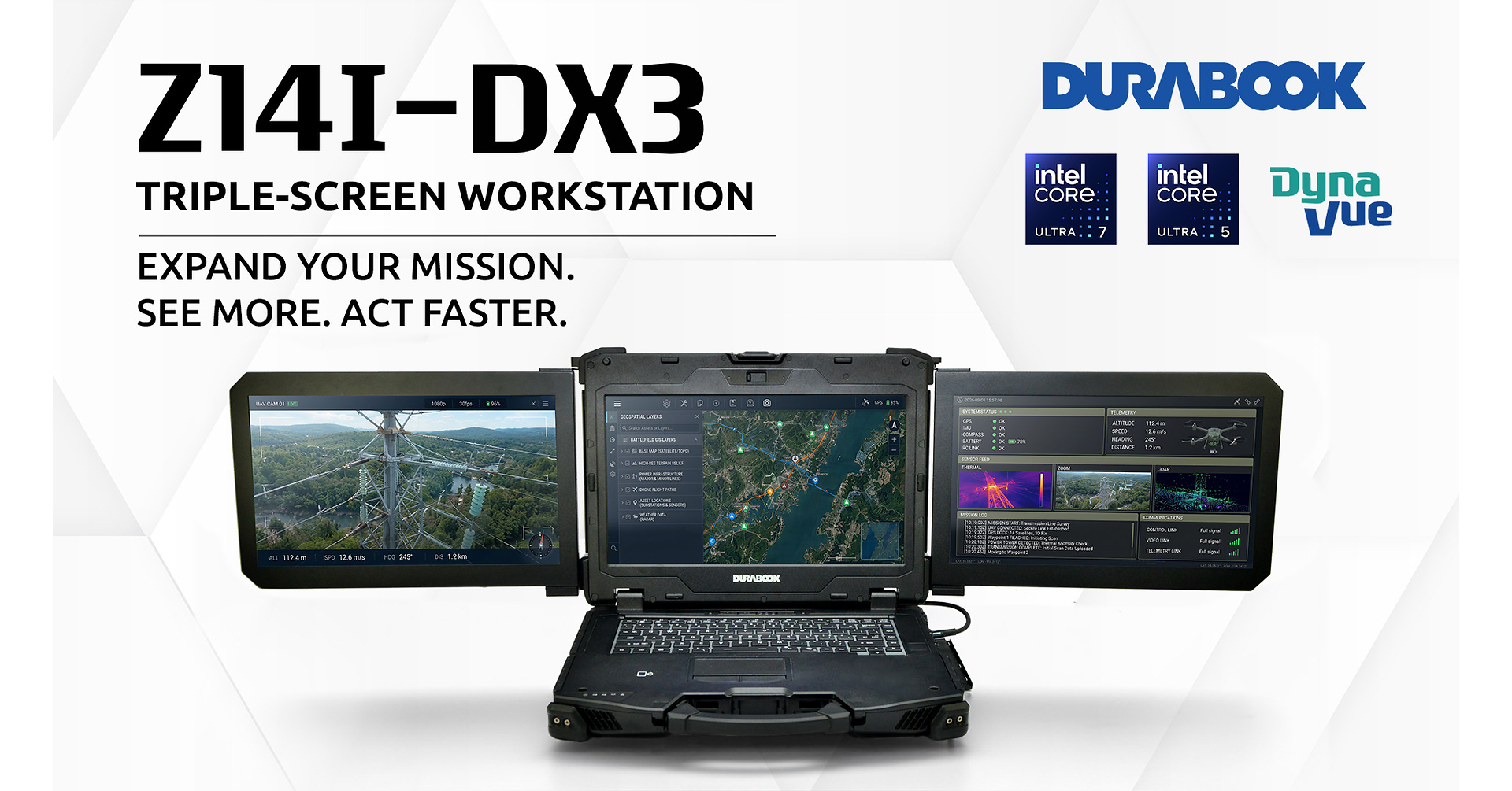
Durabook launched the Z14I-DX3, a rugged three-screen 14-inch FHD mobile workstation aimed at defense, public safety, utilities and field operations. The system uses Intel Core Ultra processors with an AI Boost NPU and offers NVIDIA RTX 5000 Ada graphics delivering up to 682 TOPS of AI performance, supporting edge workloads including real-time image recognition and sensor-data fusion. The laptop is available immediately, but the announcement provides no pricing, revenue outlook, order commitments or financial impact.
Analysis
This is immaterial to near-term INTC or NVDA estimates: a single rugged-workstation design win will not move unit volumes, revenue, or consensus. The more relevant signal is architectural: mission-critical edge deployments are retaining a discrete NVIDIA GPU alongside an Intel CPU/NPU, implying that integrated NPUs remain insufficient for high-throughput vision, sensor-fusion, and multi-stream inference workloads. That favors NVDA's CUDA/software moat in regulated field deployments, where validated hardware stacks tend to persist through multi-year refresh cycles.
The commercial constraint is procurement, not technical capability. Defense, public-safety, utility, and industrial buyers have long qualification and budget cycles, so any resulting accelerator demand would emerge over 6-18 months and be captured primarily through low-volume, high-configuration-value systems rather than a broad notebook cycle. A larger second-order beneficiary is the rugged-edge ecosystem—connectivity, storage, drone, and sensor vendors—but the launch itself provides no evidence of a material order backlog.
Contrarian view: investors should not extrapolate this into incremental AI-PC demand for INTC. The optional discrete GPU configuration effectively transfers the highest-value AI workload and bill of materials to NVDA, while Intel participates principally as the host platform. The thesis would improve only if multiple rugged OEMs standardize similar configurations and disclose defense/utility program awards; it weakens if customers choose cloud-connected processing or lower-cost integrated-GPU systems for non-classified workflows.
AllMind Terminal
AI-powered research, real-time alerts, and portfolio analytics for institutional investors.
Request TrialMarket Sentiment
Overall Sentiment
mildly positive
Sentiment Score
0.35
Ticker Sentiment
Key Decisions for Investors
- No standalone trade on this release; treat it as qualitative confirmation rather than an earnings catalyst for INTC or NVDA over the next 1-3 months.
- Maintain any existing NVDA core exposure rather than chase the news: monitor 6-18 month evidence of rugged-edge program wins, RTX workstation channel data, and adoption by peers such as Panasonic Connect and Getac. A cluster of disclosed deployments would support incremental upside to professional-visualization/edge assumptions.
- Avoid using this product as support for a bullish INTC AI-PC thesis. Reassess only if Intel discloses attach-rate or revenue evidence that Core Ultra NPUs are replacing, rather than merely accompanying, discrete accelerators in industrial edge systems.
- For relative-value books, keep NVDA-over-INTC as a watchlist expression rather than an immediate position: the spread is supported if discrete-GPU attach rates rise across edge OEMs, but is falsified by broad adoption of integrated solutions or a visible migration from NVIDIA Ada workstation GPUs to competing accelerators.
More News
- Wall Street’s Nasdaq hits all-time high as AI frenzy gathers pace
- Data-Center Bet Makes ESDS One of India’s Best New Listings
- Meta is breaking out after introducing Muse AI agent. Where the stock is going, according to the charts
- Anthropic in talks to lease 1 gigawatt from Stream Data Centers- The Information
- Meta's quick success with Muse puts consumers back in the driver's seat of the AI trade
- Alibaba says it built the ‘most powerful AI chip in China’ as the country races to catch up with the U.S.