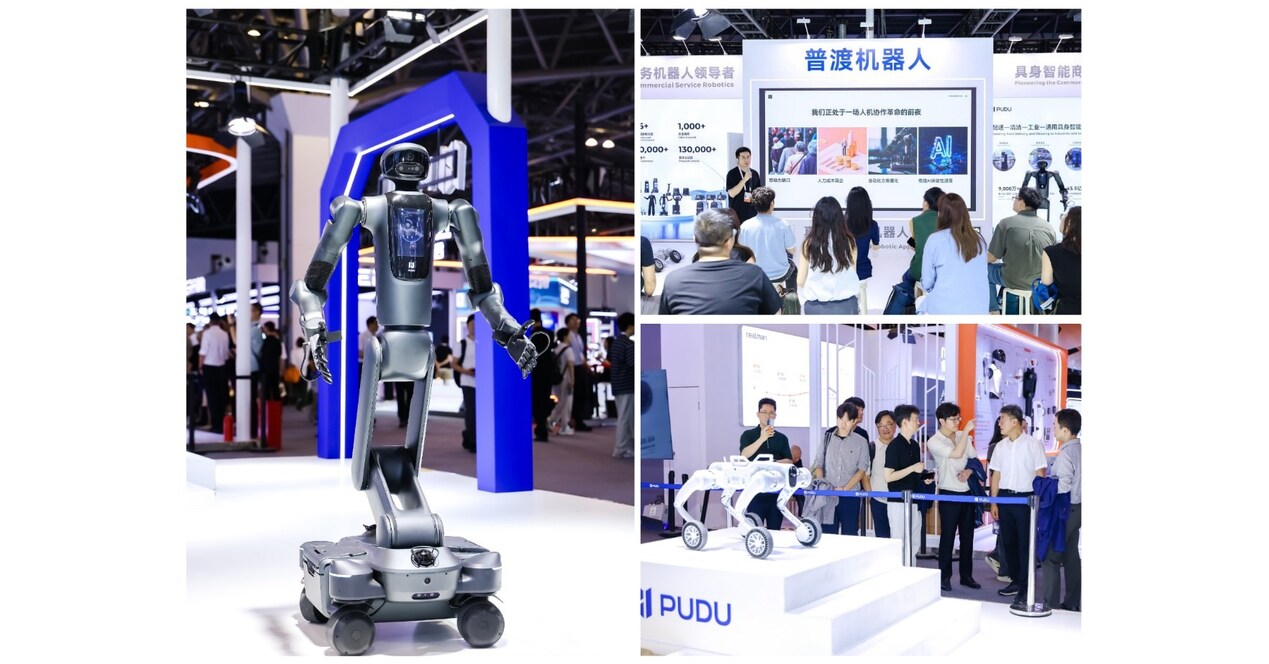
Pudu Robotics stellte auf der WAIC 2026 seine Physical-Agent-Architektur „One Brain, Multiple Embodiments“ vor und zeigte erstmals den semi-humanoiden Industrieroboter PUDU D7 öffentlich in einer Offline-Demonstration. Der D7 kann Nutzlasten von bis zu 14 kg bei einer Arbeitshöhe von 2 m bewegen und zielt auf Anwendungen wie Materialtransport, Kommissionierung in Höhe und Lagerlogistik. Die Mitteilung positioniert Pudu als führenden Anbieter im kommerziellen Servicerobotik-Umfeld und betont den Ausbau hin zu einer plattformbasierten KI-Fähigkeit über ein einheitliches System.
The economic signal here is less about a single robot launch and more about whether a company can convert installed base into a data moat. If that loop works, the winner is the platform owner and a narrow set of component suppliers; the losers are standalone point-solution vendors that lack software reuse across form factors and will face faster price competition on commoditized tasks. Second-order, a credible commercial fleet should also pull demand toward high-reliability actuators, depth sensing, edge compute, and battery systems, while pressuring labor-arbitrage service integrators whose value add is mostly deployment rather than IP.
The near-term market reaction is likely to overprice optionality on semi-humanoid exposure, but the real catalyst path is 1-3 months of proof points: repeat orders, disclosed utilization, and field-failure rates. If those metrics do not show up, the story reverts to a familiar hardware narrative of capital intensity, service burden, and slow payback, which can compress valuation quickly after the conference pop fades. The key falsifier is not the demo itself but whether gross margin and backlog improve on the next reporting cycle.
Contrarianly, consensus is probably underweighting how much of the addressable market is still mundane workflow automation rather than “general intelligence.” That means the best risk/reward may be in picks-and-shovels around commercial robotics, not the headline robot OEM, unless the OEM can prove software lock-in and after-sales monetization. Over 6-18 months, the upside case depends on whether one model really can scale across multiple embodiments without ballooning support costs; if not, the platform thesis is mostly marketing rather than economics.
AI-powered research, real-time alerts, and portfolio analytics for institutional investors.
Request TrialOverall Sentiment
mildly positive
Sentiment Score
0.25
Ticker Sentiment
