
Danish Startup Upends the Forklift Industry with a Self-Driving Pallet Jack That Keeps Humans in Charge
Source: PR Newswire
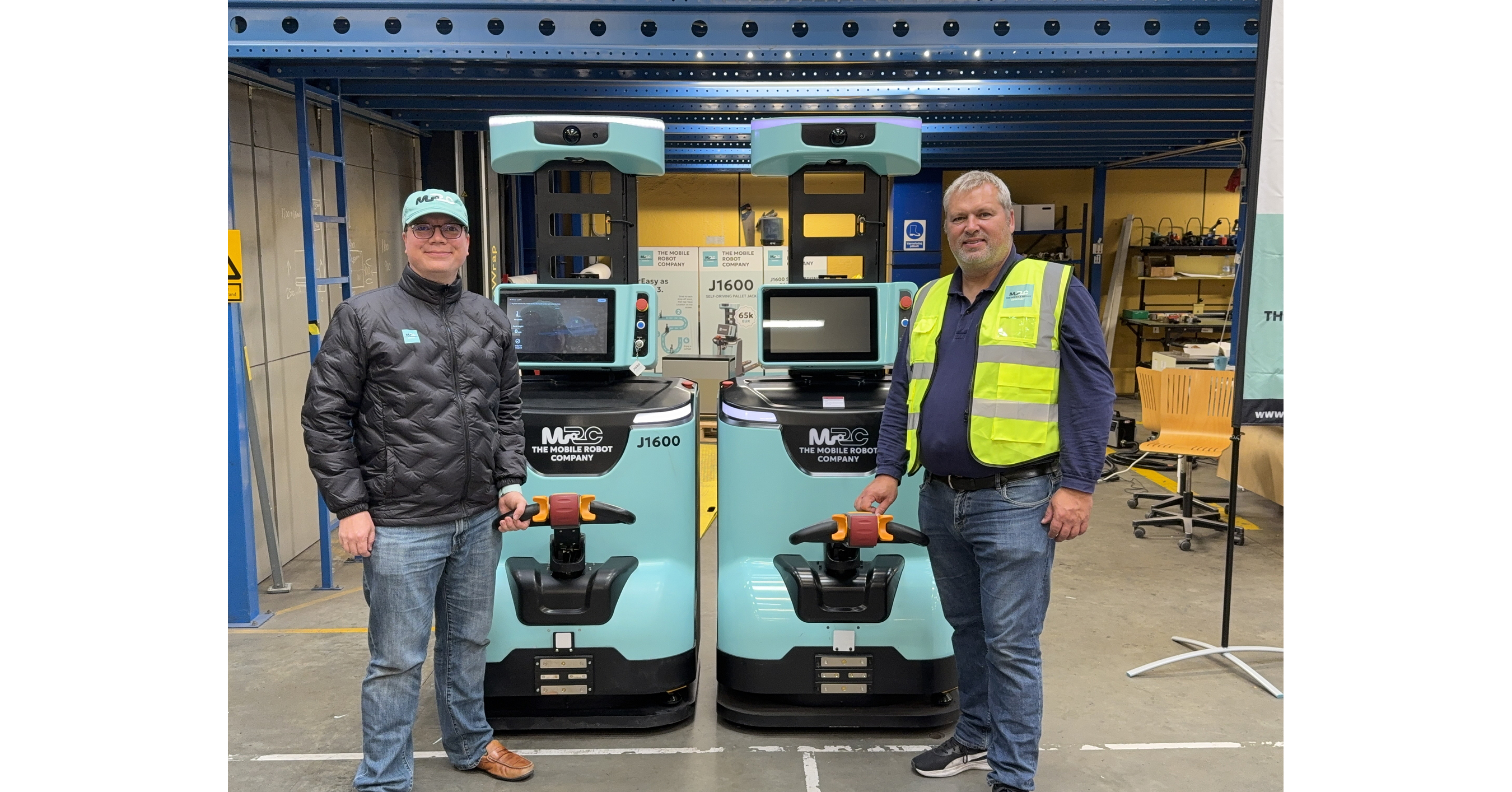
The Mobile Robot Company, a self-funded Danish startup with nine employees, won the 2026 IFOY Industrial Truck of the Year award for its J1600 autonomous pallet jack. Launched on 20 October 2025, the 1,600-kilogram truck supports manual and autonomous dual-mode operation while leaving pallet pickup to a human; its published price is €65,000, about half that of comparable robots. The company says it now has distributors in eight countries.
Analysis
The investable signal is not the award; it is a possible shift in warehouse automation economics. If buyers can automate repetitive transport while leaving pallet pickup and exception handling to people, adoption may broaden beyond facilities willing to fund fully autonomous redesigns. That would pressure incumbent vendors most at the lower-complexity end of their product range, but could also expand the addressable market rather than displace existing systems. Toyota Industries, KION and Jungheinrich are relevant competitors to monitor; the article provides no evidence yet of material share loss or incumbent revenue exposure.
The execution risk is integration, not the driving demonstration. A low list price does not establish total cost of ownership: installation, safety validation, software interoperability, service coverage and partner margins could erase the apparent advantage. A nine-person supplier also has limited demonstrated capacity to support a distributed installed base. The press release’s award and product claims are not substitutes for independently verified deployments, uptime or customer payback.
Near term, there is no clean public-equity trade from the information provided. Over 1–3 months, look for named customer deployments and repeat orders; over 6–18 months, the structural test is whether channel partners can deploy and service units at scale while incumbent pricing or product mix responds. The contrarian risk is that “partial automation” sounds easier to sell but creates handoffs and workflow exceptions that limit realized productivity. Widespread deployments with verified payback would weaken that concern; slow conversions, heavy customization or incumbent price cuts would undermine the disruption thesis.
AllMind Terminal
AI-powered research, real-time alerts, and portfolio analytics for institutional investors.
Request TrialMarket Sentiment
Overall Sentiment
mildly positive
Sentiment Score
0.35
Key Decisions for Investors
- No immediate position: the startup is private and the article supplies no independently verified deployment, revenue or unit-economics data. Treat this as an industry watch item, not a basis for trading public peers.
- Monitor Toyota Industries, KION and Jungheinrich for changes in entry-level truck pricing, dual-mode product announcements and warehouse-automation guidance. A sustained price response or weaker relevant order commentary would be a more actionable signal than the award.
- Set a 1–3 month diligence trigger around customer names, repeat orders and partner economics; verify installation time, uptime, service obligations and measured labor/productivity savings before treating the published price as evidence of lower customer cost.
- Reassess the 6–18 month displacement thesis if deployments scale without heavy customization. Falsifiers include slow pilot-to-order conversion, recurring integration work, poor uptime, or incumbent offerings matching the functionality without sacrificing economics.
More News
- The world needs Ukraine’s grain. Its farmers are running out of reasons to plant
- Trump vows quick end to Iran war as fighting in Yemen intensifies
- Israel’s economy prospers despite years of war, but prices worry voters
- Verizon stock heads for worst day since 2002 as SpaceX U.S. network plans whack telcos
- SpaceX’s Wireless Threat Rises With Spectrum Deal
- ‘I drive a Tesla’: After Elon Musk said he’d lose his job, Delta CEO Ed Bastian says there’s ‘no tit for tat’ as airline unveils earnings miss
From AllMind Research
- Anthropic IPO Preview: Valuation, Timing, and What to Watch
- Shein After the IPO: Venue, Valuation, and What Must Be Proved
- What AI Research Tools Should a Small Hedge Fund Buy First?
- Bitcoin's 52% Crash Proves It's a Tech Stock: Here's What That Means for Portfolio Construction
- What Is an AI Investment Research Platform?