
German Far-Right Wins Election Landslide in Best State Result
Source: Bloomberg
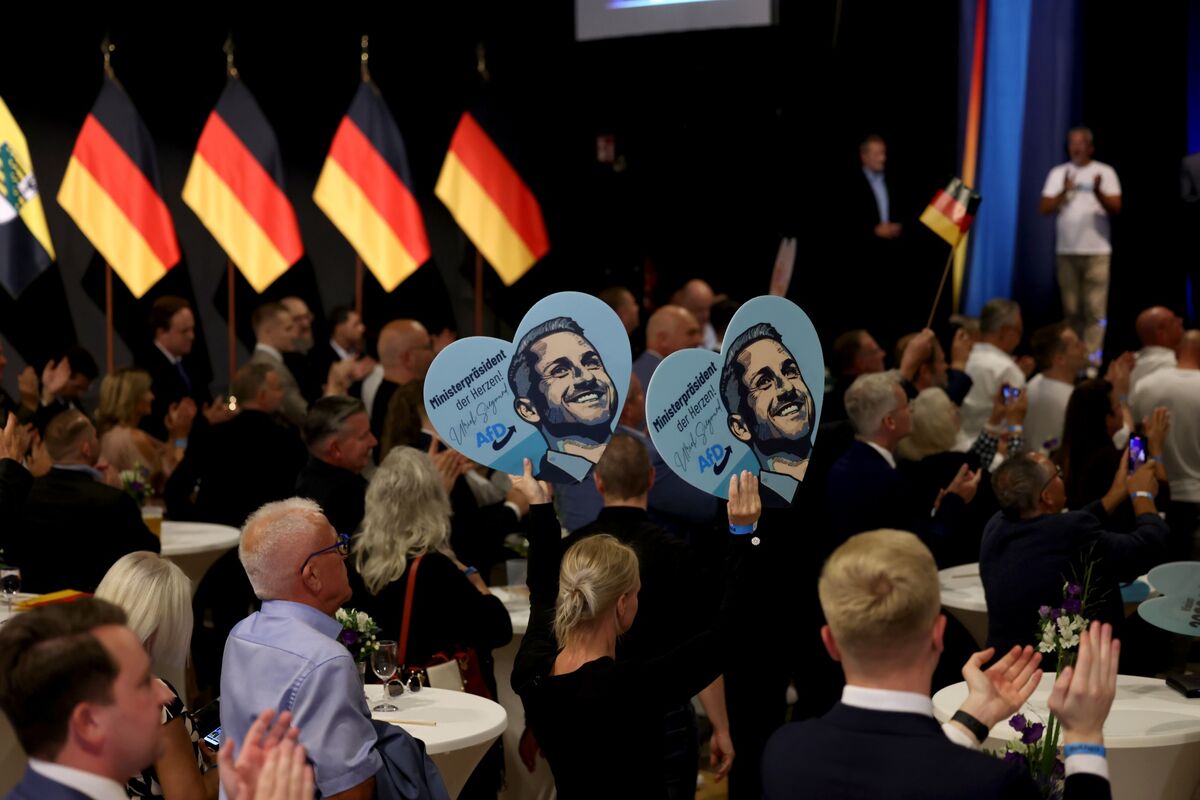
Germany's far-right AfD achieved its best-ever result in a state election, a development that could increase political uncertainty in Europe's largest economy. Separately, the US and Iran exchanged tanker strikes, raising geopolitical and shipping-risk concerns. A German startup also launched satellites into orbit, marking a European space-sector milestone.
Analysis
The investable implication is not the state-level result itself, but a higher probability of fragmented federal coalition arithmetic and a wider German political-risk discount over the next 6-18 months. That would weigh most on domestically regulated, capex-heavy businesses requiring stable permitting and subsidy regimes—particularly renewables developers and grid-exposed industrial suppliers—while exporters such as SAP and Siemens have relatively less direct German demand sensitivity. The near-term EUR and Bund reaction should remain contained unless subsequent polling shows a credible path to federal policy influence rather than protest-vote momentum.
A more consequential second-order effect is policy delay: uncertainty around defense appropriations, energy-transition implementation, and EU fiscal coordination can defer orders rather than permanently cancel them. This argues against reflexively shorting Rheinmetall or Hensoldt; delayed procurement can create attractive entry points if broader European security spending remains intact. Conversely, Nordex and Vestas are more exposed to a deterioration in German onshore-wind permitting economics, although EU-level targets and non-German order books limit a clean single-country short.
The tanker-strike item is potentially more immediately tradable than the political development, but the available detail does not establish sustained route disruption. A multi-week rise in war-risk premiums or vessel rerouting would tighten effective tanker supply and favor spot-exposed owners such as Frontline and DHT, while raising fuel and logistics costs for European industrials. Treat this as an alert rather than a position until freight-rate and insurance-premium data confirm persistence.
AllMind Terminal
AI-powered research, real-time alerts, and portfolio analytics for institutional investors.
Request TrialMarket Sentiment
Overall Sentiment
mildly negative
Sentiment Score
-0.20
Key Decisions for Investors
- Maintain a modest 3-6 month underweight in German domestic cyclicals versus pan-European exporters: pair short MDAX exposure (MDAX ETF proxy) against long SAP or Siemens. The thesis is permitting/fiscal-policy delay, not an immediate earnings collapse; exit if federal polling stabilizes coalition outcomes or German capex guidance improves.
- Use any election-driven weakness in Rheinmetall (RHM.DE) or Hensoldt (HAG.DE) to build rather than chase a short, with a 6-12 month horizon. Risk/reward improves if order timing slips while European defense-budget commitments remain unchanged; falsify on material procurement cancellations or a broad reduction in NATO spending targets.
- Avoid initiating a directional EUR/USD trade solely on this result. Instead, buy limited-duration EUR/USD downside only if German sovereign spreads widen meaningfully versus France and federal-election polling confirms sustained coalition fragmentation; absent those confirmations, the political signal is too localized.
- Set alerts on Brent, VLCC spot rates, and Persian Gulf war-risk insurance costs. If rates and premiums remain elevated for 10-15 trading days, initiate a 1-3 month basket long Frontline (FRO), DHT Holdings (DHT), and Scorpio Tankers (STNG); exit if convoy protection or de-escalation normalizes routing and rates.
More News
- Are global oil reserves sufficient to withstand renewed US-Iran war?
- France is flashing euro crisis signals. This time, the fault lines are different
- EU entering winter with lowest gas reserves on record, IEA boss warns
- OpenAI Trims Target Value & Volvo Cars Cuts 2,500 Jobs
- Russia and Ukraine trade fresh strikes despite renewed push for U.S.-brokered peace talks
- France is getting its credit rating reviewed by Moody’s. What to expect as French debt turmoil spills overseas.