
Recruiting Insight launches HiringCenter and Updated Core Capacities Index™
Source: PRWeb
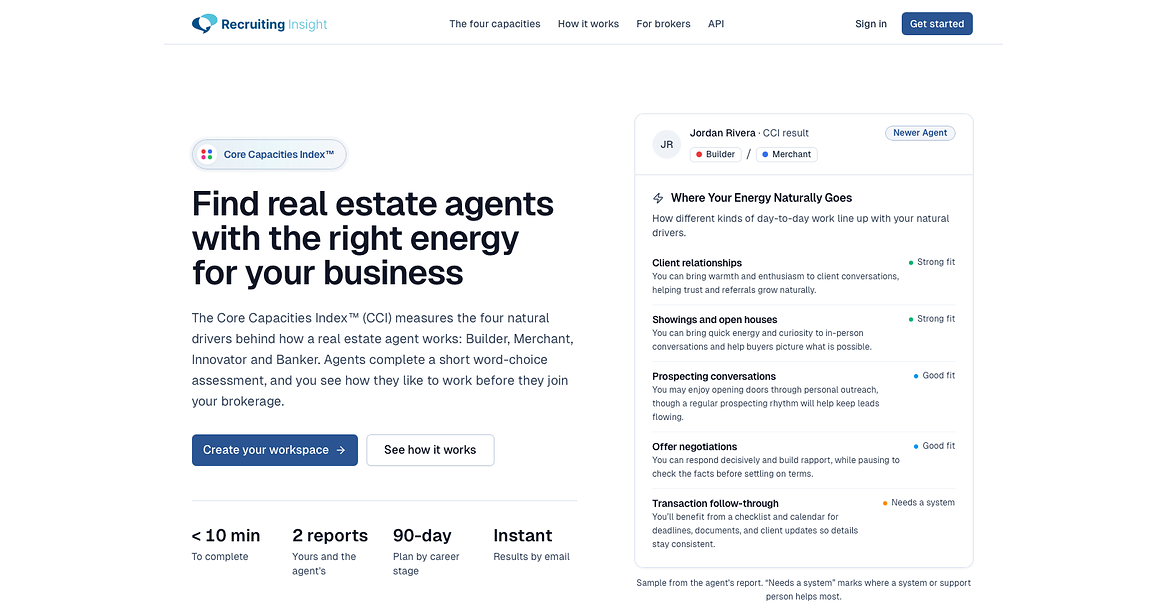
Recruiting Insight launched HiringCenter, a recruiting CRM with done-for-you outreach campaigns, and an upgraded Core Capacities Index that provides agents with personalized 90-day coaching plans. Its Q3 2026 report covered 109,176 producing agents across four U.S. MLS markets—not the national market—and found about 1 in 8 agents changes brokerages annually; 35 of every 100 recruits had no closing in the quarter after joining. In case studies involving six brokerages, agents using the process were reported as twice as likely to succeed and half as likely to fail.
Analysis
This is a product-launch signal for a private niche vendor, not yet an earnings signal for public real-estate companies. If the tools measurably reduce agent churn or accelerate new-hire productivity, brokerages could protect transaction volume and reduce the recurring cost of replacing agents; the benefit would accrue to operators that can retain productive agents, not necessarily those that simply increase recruiting. Recruiting Insight’s six-brokerage case studies are encouraging but self-selected and do not establish causality or scalable ROI. Its migration data also covers four MLS regions, so the reported turnover and productivity rates should not be treated as national benchmarks.
Over 1–3 months, the key evidence is paid brokerage adoption, renewal/expansion, pricing, and independently verifiable improvement in agent retention and closings—not downloads or assessment completion. Over 6–18 months, success could pressure incumbent brokerage CRM and recruiting-tool providers to bundle similar workflows, while creating a modest advantage for brokerages that convert recruiting spend into retained production. The launch itself is unlikely to move large public brokerages absent material contract disclosures. The contrarian risk is that recruiting is not the binding constraint: housing transaction volumes, agent economics, and lead supply may dominate outcomes, limiting willingness to pay. A failed retention/productivity lift or weak conversion from pilots to recurring contracts would falsify the commercial thesis.
AllMind Terminal
AI-powered research, real-time alerts, and portfolio analytics for institutional investors.
Request TrialMarket Sentiment
Overall Sentiment
mildly positive
Sentiment Score
0.30
Key Decisions for Investors
- No immediate public-equity trade: the vendor is private, and the release provides no pricing, customer count, revenue contribution, or independently validated results to size listed-company exposure.
- Treat as a watch item for residential brokerage operators and real-estate software vendors. Seek evidence of paid deployments, renewal rates, implementation costs, and cohort-level agent retention and closing volume before underwriting an earnings impact.
- Revisit the thesis over the next 1–3 months if named brokerages disclose adoption or Recruiting Insight reports recurring-customer growth; discount claims based only on the six case studies until comparable, controlled outcomes are available.
- Falsification alert: adoption without improved agent retention or production, or weak conversion to renewals, would suggest the tools automate outreach and coaching without changing brokerage economics.
More News
- Magnificent 7 loses $1 trillion. The most eye-popping stats from Thursday's tech stock plunge
- Tech stocks are suffering their biggest selloff since Covid, as investors see premature end to AI datacenter boom
- Wall Street’s best post-midterm rally in 44 years lasted just one day—then $3 trillion vanished as chip stocks plunged over AI fears
- How Wall Street's postelection rally got obliterated — and what's next
- AI stocks plunge after election, driving down US markets
- Elon Musk's Tesla and SpaceX lose over $420 billion in combined market cap after midterms