
Nordic brings edge AI to battery-powered Wi-Fi devices, achieving twenty times lower standby power with new nRF71 Series
Source: PR Newswire
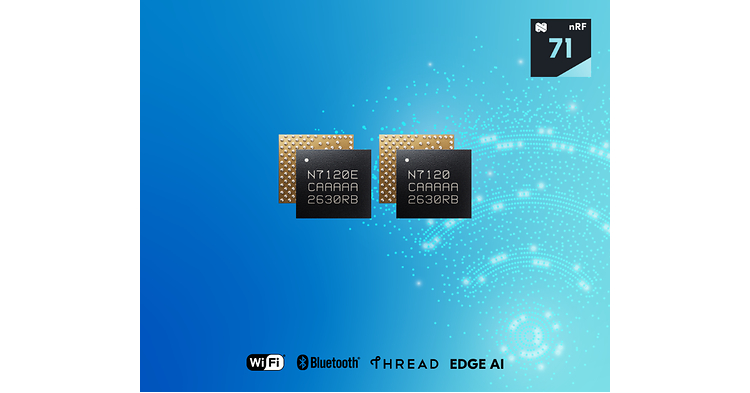
Nordic Semiconductor announced its nRF71 Series SoCs, combining Wi-Fi, Bluetooth LE, Thread, and edge AI on one chip for battery-powered devices. The company says standby power usage is up to 20 times lower than in its current-generation nRF70 Wi-Fi products, while the integrated NPU runs machine-learning models 10x–17x faster than the 256 MHz Arm Cortex-M33 alone. The nRF7120 and nRF7120E are sampling with selected customers; the latter adds tri-band Wi-Fi 6E, and both include 4 MB of non-volatile memory and 1 MB of user-accessible RAM.
Analysis
The strategic value is less “AI on a chip” than Nordic’s chance to expand its socket from Bluetooth into Wi-Fi-enabled designs while reusing its software and developer ecosystem. If customers can remove a separate connectivity or inference component, Nordic could gain content per device and make designs stickier; conversely, this raises integration and support expectations. Espressif, Silicon Labs, Qualcomm, and other connectivity vendors face a potential feature-led response, but Nordic’s stated 20x standby improvement is relative to its own nRF70 generation—not proof of an advantage over competing parts or of whole-device battery life.
Near term, selected-customer sampling is a proof point, not revenue validation. The 1–3 month watch is developer access, module availability, and named design wins; commercial contribution likely depends on customer qualification and product cycles over 6–18 months. The claim of running application, radio, and inference on one SoC creates execution risk around real workloads, RF coexistence, software maturity, and production availability. A further risk is that the incremental capability increases silicon cost or power under active use enough to weaken the system-level value proposition.
Contrarian view: investor enthusiasm may overvalue the “edge AI” label. Small inference workloads can support local responsiveness and reduce cloud dependence, but do not by themselves establish material near-term revenue or pricing power. The stronger thesis is platform expansion and design-win durability, contingent on independently demonstrated power and customer adoption.
AllMind Terminal
AI-powered research, real-time alerts, and portfolio analytics for institutional investors.
Request TrialMarket Sentiment
Overall Sentiment
mildly positive
Sentiment Score
0.35
Ticker Sentiment
Key Decisions for Investors
- Do not chase the launch as an earnings catalyst; treat NOD as a watchlist event until customer qualification or design wins establish adoption and timing.
- Track nRF71 sampling-to-production milestones, module availability, and customer disclosures over the next 1–3 months. Upgrade the thesis only if evidence shows wins beyond evaluation and products entering production.
- Verify like-for-like power tests against competing solutions, including whole-device standby and active-use consumption, plus real-world performance of the stated AI workloads. A failure to show system-level battery or bill-of-materials benefit would undermine the differentiation thesis.
- For a 6–18 month thesis, monitor wireless/IoT revenue growth, product mix, and management commentary on design-win conversion. Falsify the thesis if launches slip, adoption remains limited to samples, or competitive pricing prevents the new platform from supporting attractive economics.
More News
- Binance co-CEO Richard Teng says hackers used fake job interviews, AI tool to steal $6.3 billion in crypto 108511116
- AMD stock jumps 7% on earnings as data center revenue nearly doubles
- Marvell-Lumentum Deal Puts Optical Networking at the Center of the AI Boom
- Marvell Technology could plunge on latest multibillion-dollar acquisition
- Disney Plans Thousands of Layoffs Companywide
- AI Inference Startup Fal Raises Capital at $16 Billion Valuation