
Wherefour Launches AI Features for Manufacturing with Secure Data Access and Human-Approved Compliance Workflows
Source: PRWeb
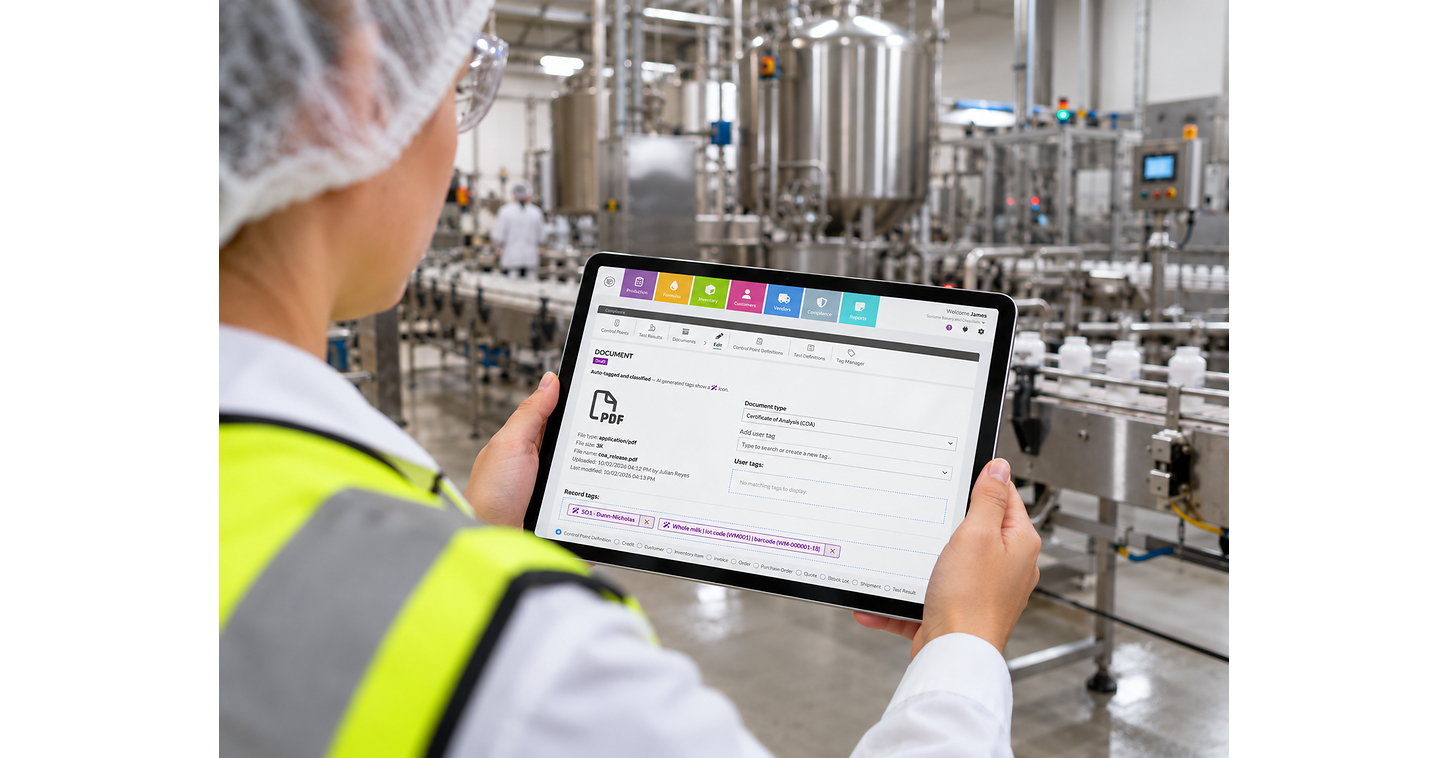
Wherefour launched AI features for all customers, including a read-only connector linking Claude, ChatGPT, and other compatible tools to manufacturing data, plus AI-assisted document tagging, control-point drafting, and test-definition drafting. Users review and approve AI-generated compliance work, and all AI features are off by default. The announcement is a product expansion with no financial results or market reaction reported.
Analysis
The strategic signal is not that AI replaces manufacturing ERP; it is that natural-language access may make the ERP’s underlying records easier to use while leaving the system of record and approval workflow in place. That could reduce the perceived need for a separate analytics layer and make data quality, permissions, and workflow ownership more important to customer retention. The compliance features are human-reviewed drafts, so near-term value depends on measurable reductions in setup and document-processing time—not autonomous decision-making. Wherefour’s claims about availability and controls are company-reported; adoption, usage, error rates, and customer retention impact are not established here.
For larger software names, this is a competitive proof point rather than an earnings catalyst. It does not establish a material threat to Intuit, Microsoft, Shopify, or Sage; their exposure would depend on whether similar capabilities become table stakes in their own customer segments. The more important sector-level risk is that AI interfaces lower switching friction for niche ERP customers if they can query and operationalize data across systems, while increasing the cost of weak data governance.
Horizon: immediate impact should be negligible. Over 1–3 months, watch customer uptake, renewal commentary, and whether ERP vendors broaden read-only connectors and approval controls. Over 6–18 months, sustained labor savings could improve retention and support pricing, but could also pressure analytics add-ons. The thesis weakens if usage remains low, outputs require substantial correction, or data-access concerns delay deployment. No public-market valuation or financial evidence here supports a directional trade.
AllMind Terminal
AI-powered research, real-time alerts, and portfolio analytics for institutional investors.
Request TrialMarket Sentiment
Overall Sentiment
mildly positive
Sentiment Score
0.30
Key Decisions for Investors
- No trade in INTU, MSFT, SHOP, or SGE on this announcement alone; the launch is from a private niche vendor and there is no demonstrated impact on listed-company revenue or guidance.
- Treat as a watch item for ERP and vertical-software diligence: seek evidence of active customer adoption, time saved per compliance workflow, error/correction rates, renewal effects, and any incremental pricing.
- Monitor competitor product releases and customer commentary over the next 1–3 months. Broader adoption of governed, read-only AI access would support the view that ERP differentiation is shifting toward trusted data and workflow control rather than interface features.
- Avoid extrapolating labor savings into margin expansion until vendors disclose realized customer usage and implementation costs; poor output quality or security concerns could reverse early enthusiasm.
More News
- US stock market hits all-time high as investors bet big on AI
- Google teams with nuclear power giant to give reactors a tune-up
- Meta Muse gives AMD a boost as AI momentum shifts to personal agents
- Why is Broadcom stock rallying today?
- How the S&P 500 can be at record highs, while the market remains oversold
- Unsure how long this AI bull has? Bonds now offer a cushion at the best values in years
From AllMind Research
- Anthropic IPO Preview: Valuation, Timing, and What to Watch
- Shein After the IPO: Venue, Valuation, and What Must Be Proved
- What AI Research Tools Should a Small Hedge Fund Buy First?
- Capital IQ Alternatives for Research and Deal Work
- Research Workflows, Report Format Selection, and Interactive Synthesis