
MSI Showcases Open Data Center and AI Infrastructure at 2026 OCP Global Summit
Source: PR Newswire
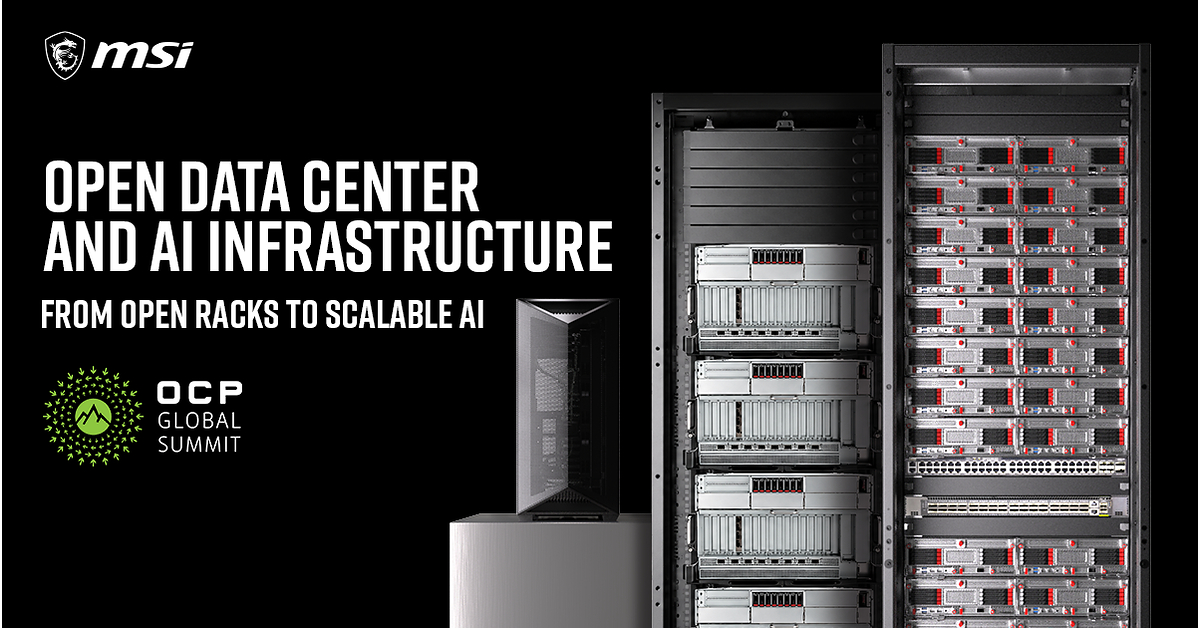
MSI showcased data-center and AI infrastructure at the 2026 OCP Global Summit, including 21-inch ORv3 systems, DC-MHS modular platforms, NVIDIA MGX servers and the XpertStation WS300 desktop AI system. The ORv3 platforms support up to 600W TDP per node, PCIe 6.0 and memory speeds up to 12,800 MT/s with MRDIMM; the liquid-cooled MGX system supports up to eight NVIDIA RTX PRO 6000 Blackwell GPUs. The announcement highlights product capabilities but provides no sales figures or financial guidance.
Analysis
MSI’s announcement is best read as ecosystem positioning, not evidence of incremental revenue: there are no disclosed customer orders, shipments, pricing, or qualification wins. The commercial test is whether open, modular designs shorten deployment cycles and win repeat rack programs; without that, the specifications are not a durable moat. Standardized platforms may expand the addressable market for AMD and Intel CPUs, but also shift differentiation toward GPU availability, system integration, networking, and power/cooling execution. AMD gets a modest design-in signal, not proof of server share gains; Intel’s inclusion similarly does not establish demand recovery. NVIDIA benefits from broader MGX deployment options, though MSI’s systems redistribute potential platform sales rather than demonstrate additional GPU supply or end-customer capex. Liquid cooling and higher rack density could support cooling and power infrastructure suppliers such as Vertiv, Eaton, and Schneider Electric if deployments scale. Deskside AI could move some experimentation from cloud to local systems, but may also seed larger centralized workloads; the net cloud effect is uncertain and likely small near term.
Over days, the announcement alone is unlikely to alter semiconductor earnings. Over 1–3 months, watch for named customer deployments, qualification milestones, and GPU availability. Over 6–18 months, repeat wins and delivered rack economics—not announced compatibility—would validate the platform strategy. Main risks are delayed customer qualification, constrained accelerator supply, and data-center power/cooling limits. The contrarian point: investors may overread broad CPU support as share capture; open standards can commoditize hardware and leave integration economics with established server OEMs and ODMs.
AllMind Terminal
AI-powered research, real-time alerts, and portfolio analytics for institutional investors.
Request TrialMarket Sentiment
Overall Sentiment
mildly positive
Sentiment Score
0.25
Ticker Sentiment
Key Decisions for Investors
- No trade on AMD, INTC, or NVDA from this release alone. Treat AMD’s platform compatibility and NVIDIA MGX breadth as watch items, not earnings catalysts; reassess only with independently verifiable customer wins or shipment guidance.
- Track server OEM/ODM competition and data-center cooling/power exposure, including Vertiv, Eaton, and Schneider Electric. A sustained rise in liquid-cooled rack deployments would be the relevant demand confirmation, not product showcases.
- For a 1–3 month catalyst check, seek disclosed order volume, deployment timing, system pricing, and GPU allocation. If those remain absent, avoid extrapolating the technical specifications into revenue estimates.
- Falsify the constructive infrastructure thesis if customer qualification slips, deployments fail to convert to repeat orders, or relevant suppliers report weaker data-center demand/cooling orders; local AI systems alone would not validate a broad cloud-capex thesis.
More News
- Applied Materials’ $5 billion AI lab aims to cut chip development time in half—and restore Silicon Valley’s edge
- Meta’s Muse models reach the AI frontier—and kill any hopes to ‘pace’ it
- We're upgrading our Goldman Sachs rating after a strong quarter bodes well for the future
- Iran threatens Gulf data centres: How exposed is the region’s internet?
- Global chip selloff deepens as AI worries, China competition weigh
- Apple unveils new smart home products, showcasing updated Siri AI
From AllMind Research
- Anthropic IPO Preview: Valuation, Timing, and What to Watch
- Shein After the IPO: Venue, Valuation, and What Must Be Proved
- What AI Research Tools Should a Small Hedge Fund Buy First?
- AllMind Discusses Ontario's AI Economy with Minister Stephen Crawford and Supply Ontario CEO James Wallace
- AI Research Tools for SEDAR+, UK and ASX Filings