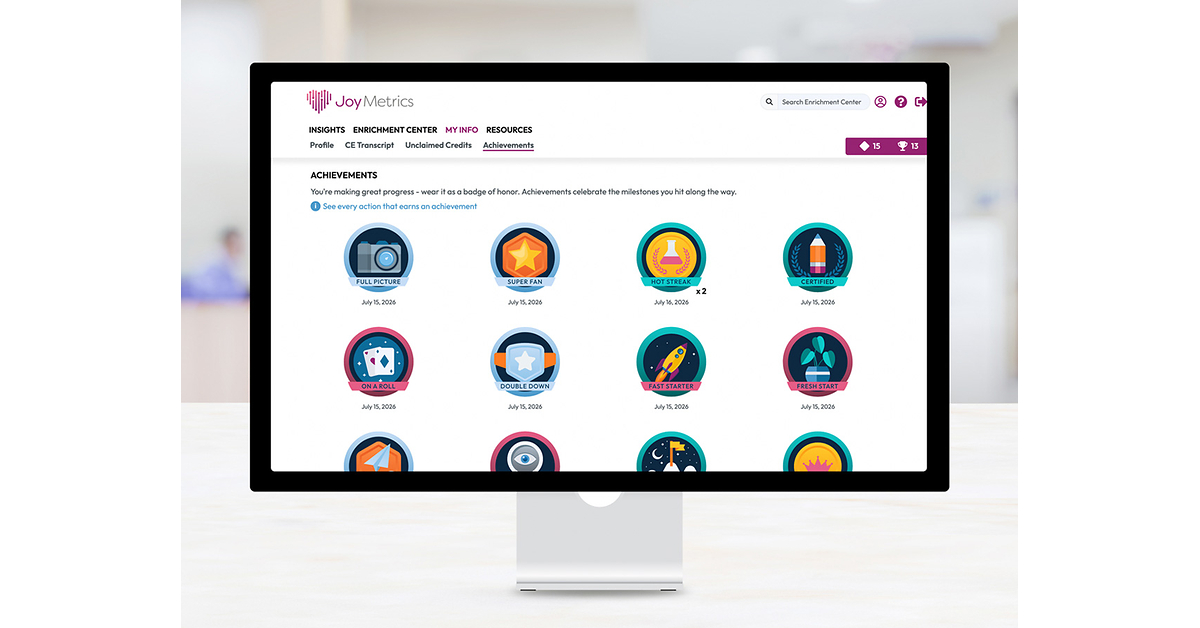
Joy Metrics (formerly SE Healthcare) launched expanded Rewards & Recognition capabilities to incentivize clinicians to complete microlearning and continuing education aimed at reducing fatigue risk. The firm cites engagement through the ANA Member Benefit: 10,000+ nurses, 50,000+ microlearning sessions, and 22,000 continuing education credits, with 52% reporting decreased burnout symptoms and a 35% reduction in highest burnout levels (reported in June 2025). Healthcare organizations can enable point-earning and redeemable rewards via Tremendous (or an existing recognition program), which may modestly improve clinician participation in its predictive workforce analytics platform.
The economic value here is not the training content; it is whether a lighter-touch incentive layer can change clinician behavior enough to alter labor economics. If participation translates into fewer agency shifts, lower overtime, and slower turnover, the first P&L benefit shows up at the operator level in the next 1-2 quarters, while the revenue side barely moves. The best positioned beneficiaries are scaled hospital operators with centralized staffing leverage; the weakest are smaller systems where adoption may be too shallow to move the needle.
The second-order losers are contract labor intermediaries and travel-nursing channels. A modest improvement in retention would likely pressure the highest-margin fill rates first, then compress bill-rate growth with a lag, which is why AMN and CCRN are cleaner shorts than hospitals are longs if the thesis is confirmed. Conversely, if the program only lifts completion metrics without reducing vacancy, overtime, or agency spend, the product is just incremental HR budget and the market will eventually discount it as feature bloat.
The contrarian risk is that investors overrate engagement metrics and underrate implementation friction. Rewards can boost short-term activity, but durable ROI requires hard proof on 90-180 day retention and labor-cost per adjusted patient day; without that, pricing power stays limited and renewal economics will be noisy. The thesis breaks if next-quarter staffing costs re-accelerate or if customers fail to show measurable savings by the next budget cycle.
AI-powered research, real-time alerts, and portfolio analytics for institutional investors.
Request TrialOverall Sentiment
mildly positive
Sentiment Score
0.15
