
Hylenr Technologies détecte des traces de terres rares et ouvre une nouvelle voie technologique grâce à la fusion nucléaire
Source: PR Newswire
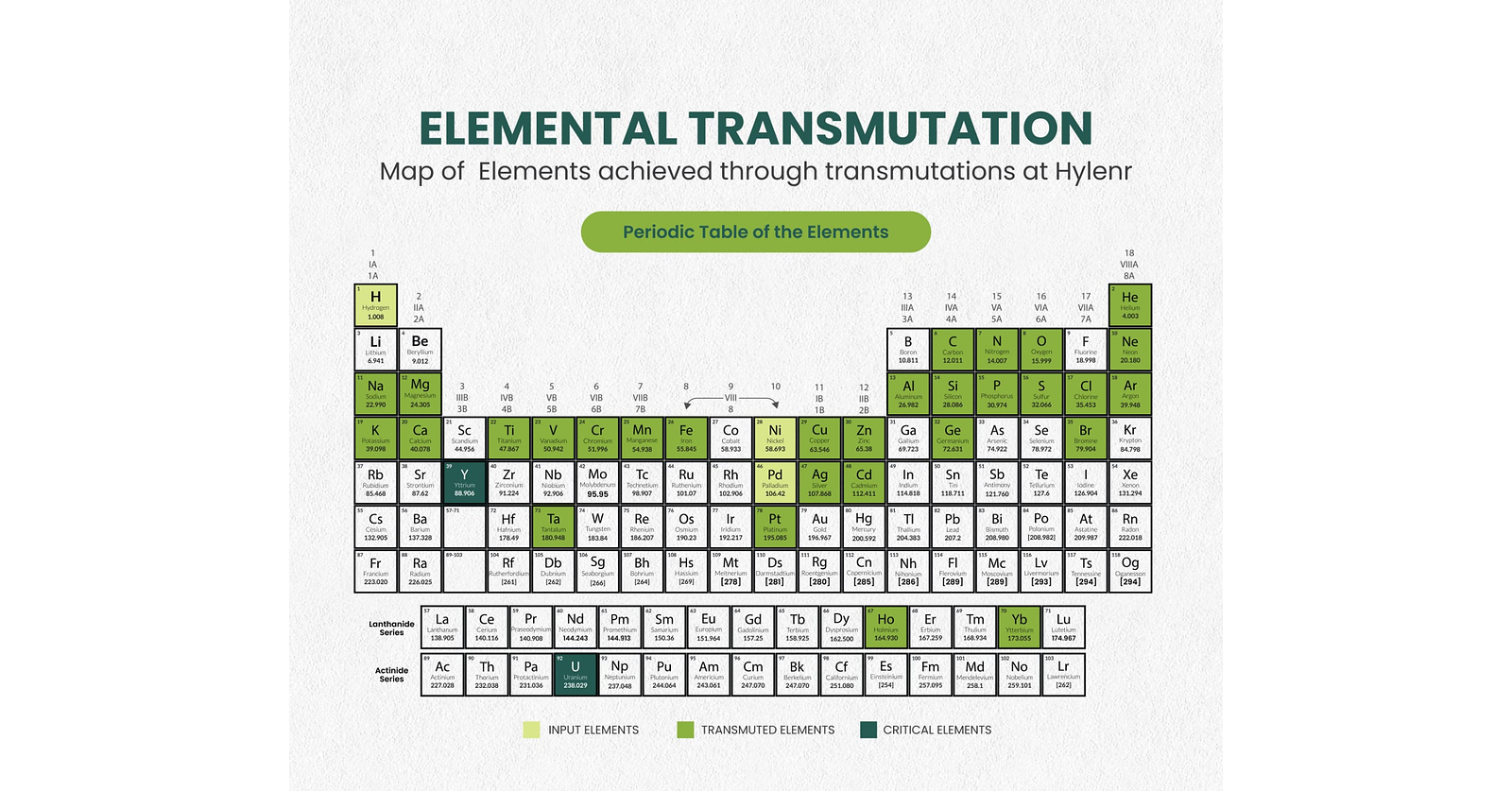
Hylenr Technologies claims to have detected signatures of 32 elements—including rare earths such as yttrium, noble gases and uranium—in post-operation hydrogen-loaded nickel-palladium lattice samples, based on roughly two years of materials analysis. The company says its solid-state fusion approach could eventually enable artificial nucleosynthesis of strategic materials, potentially reducing dependence on geographically concentrated rare-earth mining supply chains. The announcement is an early-stage corporate research claim presented at ICCF-27 rather than a commercial production milestone, with no disclosed output volumes, economics, third-party peer-reviewed validation or timeline to commercialization.
Analysis
This is not investable validation of a new rare-earth supply route; it is an extraordinary materials claim without disclosed yields, isotope ratios, energy balance, contamination controls, reproducibility, or third-party chain-of-custody testing. Detection of post-operation elemental signatures is materially weaker than demonstrating net production at commercially relevant purity, throughput, cost, and radiation-safety levels. Until an independent laboratory reproduces isotope-resolved results and reconciles mass inputs/outputs, the appropriate market read-through is zero for rare-earth pricing and zero for incumbent miners' terminal value.
If independently replicated, the first-order disruption would be to the scarcity premium embedded in separated magnet rare earths rather than to bulk mining immediately. MP Materials (MP), Lynas Rare Earths (LYSCF), and China-exposed rare-earth producers would face a long-dated multiple risk only if the process can selectively produce NdPr/Dy/Tb at scale; a reported yttrium signature alone has limited relevance to the highest-value magnet supply chain. The nearer second-order beneficiary would be strategic buyers—defense, magnets, robotics and electronics—because localized production could reduce inventory buffers and geopolitical procurement costs, but nuclear-material handling and export-control regimes could make commercialization slower than the underlying science.
The contrarian view is that even genuine nuclear transmutation could be economically irrelevant: producing trace quantities at high catalyst, hydrogen, palladium, shielding, assay, and regulatory cost would not compete with conventional separation. Over the next 1-3 months, watch for a peer-reviewed methods package, blinded independent replication, isotope-abundance data, measured grams-per-hour output, and a credible energy-cost calculation. Over 6-18 months, the decisive catalyst would be a continuously operated pilot with independently audited output; absent that, this should remain a scientific-monitoring item rather than a commodities trade.
AllMind Terminal
AI-powered research, real-time alerts, and portfolio analytics for institutional investors.
Request TrialMarket Sentiment
Overall Sentiment
mildly positive
Sentiment Score
0.25
Key Decisions for Investors
- No directional position in MP, LYSCF, or rare-earth ETFs on this release; avoid treating a company press release as a supply shock before independently verified production yields and isotope data are published.
- Create an event-driven watch alert for MP and LYSCF: reassess short exposure only after blinded third-party replication plus disclosed output economics. A credible pilot could compress long-duration scarcity multiples, but the probability-weighted impact before then is immaterial.
- For existing strategic-minerals longs, retain exposure but monitor NdPr, Dy, and Tb-specific evidence rather than broad 'rare-earth' claims. Thesis falsification would require demonstrated selective production of magnet-grade material at a cost below prevailing separated-oxide prices, not laboratory detection.
- Monitor PALL and nickel/palladium supply-chain names only as optional second-order signals. The proposed lattice architecture may require specialty Ni-Pd inputs, but no bill of materials, catalyst life, or scale requirement is disclosed; do not establish a materials-input trade without those data.
More News
- Here’s the ‘core economic flaw’ in the AI bull case as stock and bond trades unravel, according to a top economist
- Israelis hold final rally against Netanyahu ahead of what may be the most consequential election in the country’s history
- 5 big analyst AI moves: ’Uniquely catalyst-rich’ months ahead for SpaceX
- First Russian diesel tanker heads to New York after Trump's deal with Putin to lower fuel prices
- Saudi Arabia intercepts drones and missiles as fighting with Yemen’s Houthis continues
- Qatar official calls for peace and security to boost trade, investment
From AllMind Research
- Anthropic IPO Preview: Valuation, Timing, and What to Watch
- Shein After the IPO: Venue, Valuation, and What Must Be Proved
- What AI Research Tools Should a Small Hedge Fund Buy First?
- The Great Divergence: North American Banking at the Crossroads of Monetary Policy and Agentic AI (Q4 2025 Bank Earnings)
- AI for M&A Target Screening: From Universe to Deal File