
D. Boral Capital Acted as Bookrunner to Leader's Advantage Acquisition Corp. (Nasdaq:LEDRU) in Connection with its $150,000,000 Initial Public Offering
Source: Newswire
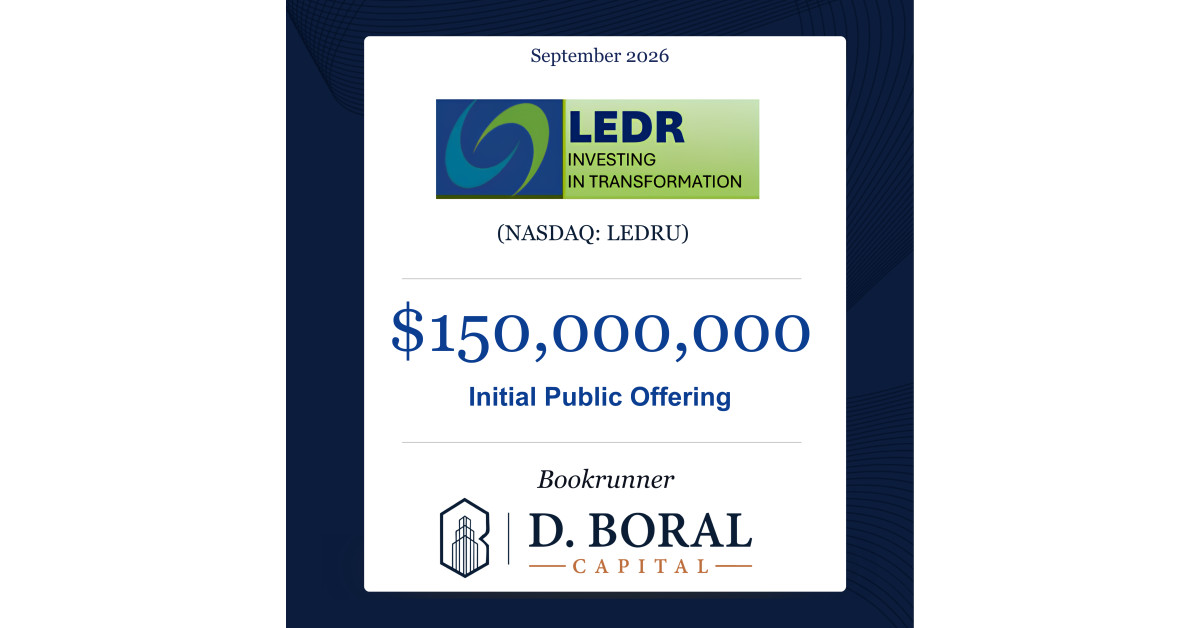
Leader's Advantage Acquisition Corp. closed its $150 million IPO, selling 15.0 million units at $10.00 each and beginning Nasdaq trading under LEDRU on September 18, 2026. Each unit includes one Class A share and one-half warrant, with whole warrants exercisable at $11.50 per share. The SPAC intends to pursue a business combination with an established growth company in healthcare, specialty chemicals, pharmaceuticals, or defense, though no target or transaction has been identified.
Analysis
This is not an operating-company catalyst; it creates a small, option-like pool of capital seeking a transaction in sectors where credible private assets remain scarce. The relevant signal is whether a $150M SPAC can secure a target without excessive sponsor economics, PIPE dilution, or a large minimum-cash condition. Until a definitive agreement, LEDRU should behave primarily as a Treasury-backed redemption instrument rather than a sector read-through.
The second-order effect is concentrated in subscale healthcare services, specialty chemical platforms, defense suppliers, and pharma-adjacent businesses that are too small or operationally complex for strategic buyers but too mature for venture financing. A successful deal could provide a valuation benchmark for public microcaps such as RDW, KOPN, or small defense-electronics suppliers; however, one vehicle's buying power is insufficient to alter broad-sector multiples. More likely, it competes at the margin with private equity for founder-owned assets, potentially raising acquisition multiples rather than creating public-market upside.
Near term, the key trade is the unit’s structure, not the announced target themes. The embedded half-warrant creates limited upside if the units trade near trust value, but warrant value depends entirely on a credible merger and post-close equity performance; historical de-SPAC outcomes imply substantial downside after redemption protection expires. Over the next 12-24 months, monitor redemption rights, trust yield, sponsor promote terms, extension votes, and any forward-purchase/PIPE commitments—these determine whether headline transaction value translates into usable deal capital.
Consensus may overvalue the optionality attached to broad target-sector language. Attractive defense, healthcare, and specialty-chemical targets generally have alternative capital sources and can demand better terms, leaving SPAC investors exposed to either an overpaid transaction or liquidation. A disciplined no-deal outcome is economically preferable to a merger completed solely to avoid sponsor forfeiture.
AllMind Terminal
AI-powered research, real-time alerts, and portfolio analytics for institutional investors.
Request TrialMarket Sentiment
Overall Sentiment
mildly positive
Sentiment Score
0.25
Key Decisions for Investors
- No directional sector position from this event. Treat LEDRU as a watchlist special situation until its SEC filings establish trust value, deadline, sponsor promote, underwriting deferred fees, and redemption mechanics.
- If LEDRU units trade at a meaningful discount to independently verified per-unit trust value, consider a small cash-management long with redemption as the downside anchor; exit before any vote if the proposed transaction lacks committed financing or has elevated projected redemptions. Do not underwrite warrant value as base-case return.
- Do not buy LEDRW on listing absent a definitive agreement and disclosed pro forma valuation. A warrant position is only attractive after a credible target is announced and implied common-equity value supports a realistic path above the $11.50 strike; size as a zero-to-low-recovery option.
- At merger announcement, evaluate a relative-value trade: long redeemable shares near trust value only if the deal includes enforceable minimum cash and modest dilution; otherwise short post-redemption exposure or avoid. Falsifiers for any long are trust impairment, extension-related dilution, weak PIPE terms, or redemptions that leave insufficient cash to close.
More News
- Houthi attack on Mecca, Medina would cross ‘red line’, Pakistan PM tells UN
- Bonds Stabilize as Oil Retreats
- Wall Street Week | China’s Trade Reckoning, Syracuse’s Second Chance, Humanoids in Healthcare
- Saudi Arabia allies line up support as Houthi attacks mount
- U.S. appeals court upholds Pentagon designation of Anthropic as supply chain risk
- Yields keep rising, Novo's tough week, why cat product sales are surging and more in Morning Squawk
From AllMind Research
- Anthropic IPO Preview: Valuation, Timing, and What to Watch
- Shein After the IPO: Venue, Valuation, and What Must Be Proved
- What AI Research Tools Should a Small Hedge Fund Buy First?
- Choosing an AI Copilot for Equity Research
- Weekly Update: Advanced Search Filters, Redesigned Ticker Dashboard, and Improved Search Experience