
New ASA AI Impact Index Reveals the Jobs Most Impacted by AI
Source: PR Newswire
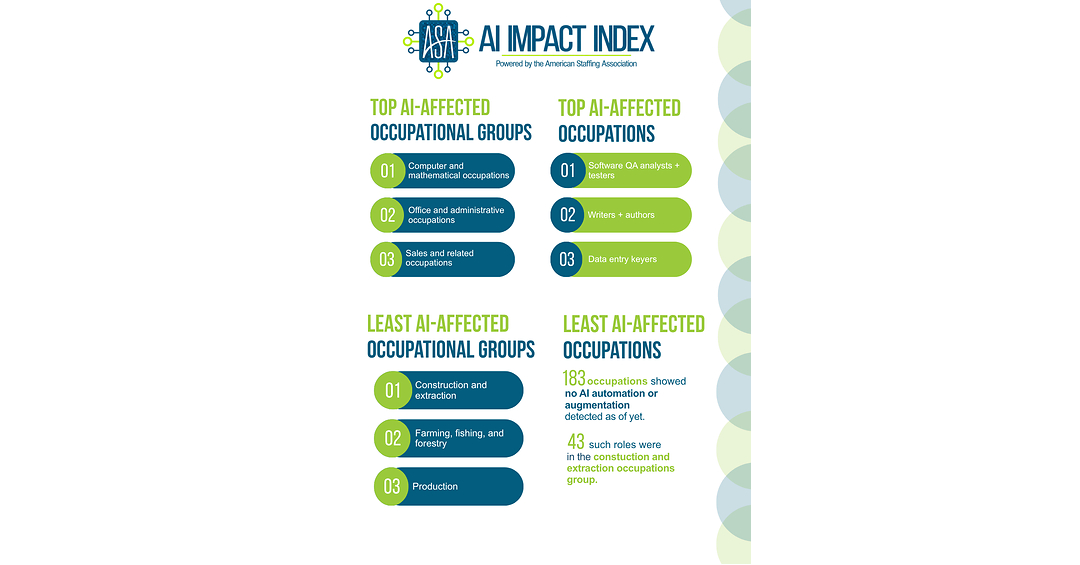
The American Staffing Association launched an AI Impact Index using Anthropic and U.S. Department of Labor O*NET data to estimate AI automation and augmentation across occupations and tasks. Computer and mathematical roles show the greatest impact, while construction and extraction, farming, fishing and forestry, and production show the least; 183 occupations had no AI impact detected, including 43 in construction and extraction.
Analysis
The index is a labor-task exposure measure, not evidence of job cuts, productivity gains, or lower labor costs. Its main near-term market effect is likely to be narrative: investors may treat high-exposure occupations as a proxy for staffing demand or software substitution, even though augmentation can increase output and create new hiring needs. Task-level exposure also risks overstating labor substitution when human review, integration, and client-specific workflows remain necessary.
For staffing firms, the more plausible 6–18 month shift is mix rather than outright demand destruction: less value in routine placement and screening, more in skills assessment, redeployment, and supplying workers able to supervise AI-enabled workflows. Robert Half, ManpowerGroup, and Adecco are worth monitoring for evidence in segment revenue, bill rates, and client demand—not presumed winners or losers from this index. The periodic, input-dependent methodology creates revision risk; a change in measured exposure need not correspond to a change in employment.
Contrarian view: the index may be more useful to workforce planners than to equity investors. Occupational exposure is not a reliable leading indicator of near-term layoffs, and the low-exposure result for physical occupations could eventually make skilled-trades labor more valuable, not simply safer. The thesis would strengthen only if staffing metrics or employer guidance show sustained weakness concentrated in exposed white-collar roles; it weakens if hiring and bill rates remain resilient or AI adoption drives incremental labor demand.
AllMind Terminal
AI-powered research, real-time alerts, and portfolio analytics for institutional investors.
Request TrialMarket Sentiment
Overall Sentiment
neutral
Sentiment Score
0.00
Key Decisions for Investors
- No event-driven position on this release alone. Treat it as a monitoring signal, not a forecast of staffing-company earnings.
- Over the next 1–3 months, track Robert Half, ManpowerGroup, and Adecco disclosures for professional versus clerical demand, bill rates, and any explicit AI-related client or placement trends. Do not infer company exposure from the index without mapping its occupations to each firm’s business mix.
- Avoid a broad short of staffing or office-work names on task exposure alone. Reassess only if multiple firms report deteriorating exposed-role demand or cut guidance; resilient bill rates and placement volumes would falsify the displacement thesis.
- For a 6–18 month watchlist, favor firms that demonstrate revenue from workforce transition, skills matching, or AI-enabled services over firms reliant on routine placement—but require segment-level evidence before expressing that view.
More News
- Anthropic's third-quarter revenue is said to hit $16.8 billion ahead of IPO
- SK Hynix plunges 8% amid Asia tech rout as Fed rate hike fears, AI funding worries mount
- Why is Samsung Electronics stock plunging today?
- Why is Advantest stock plummeting today?
- Japan, U.S. reach first chip deal under $550 bln investment plan
- Elon Musk says Trump is 'ultimately' responsible for any curbs on Ukraine's Starshield systems