
Aurora Cannabis Files Application with Alberta Securities Commission to Protect Company Shareholders Having Identified Several Deficiencies in Curaleaf's Hostile Bid Disclosure
Source: PR Newswire
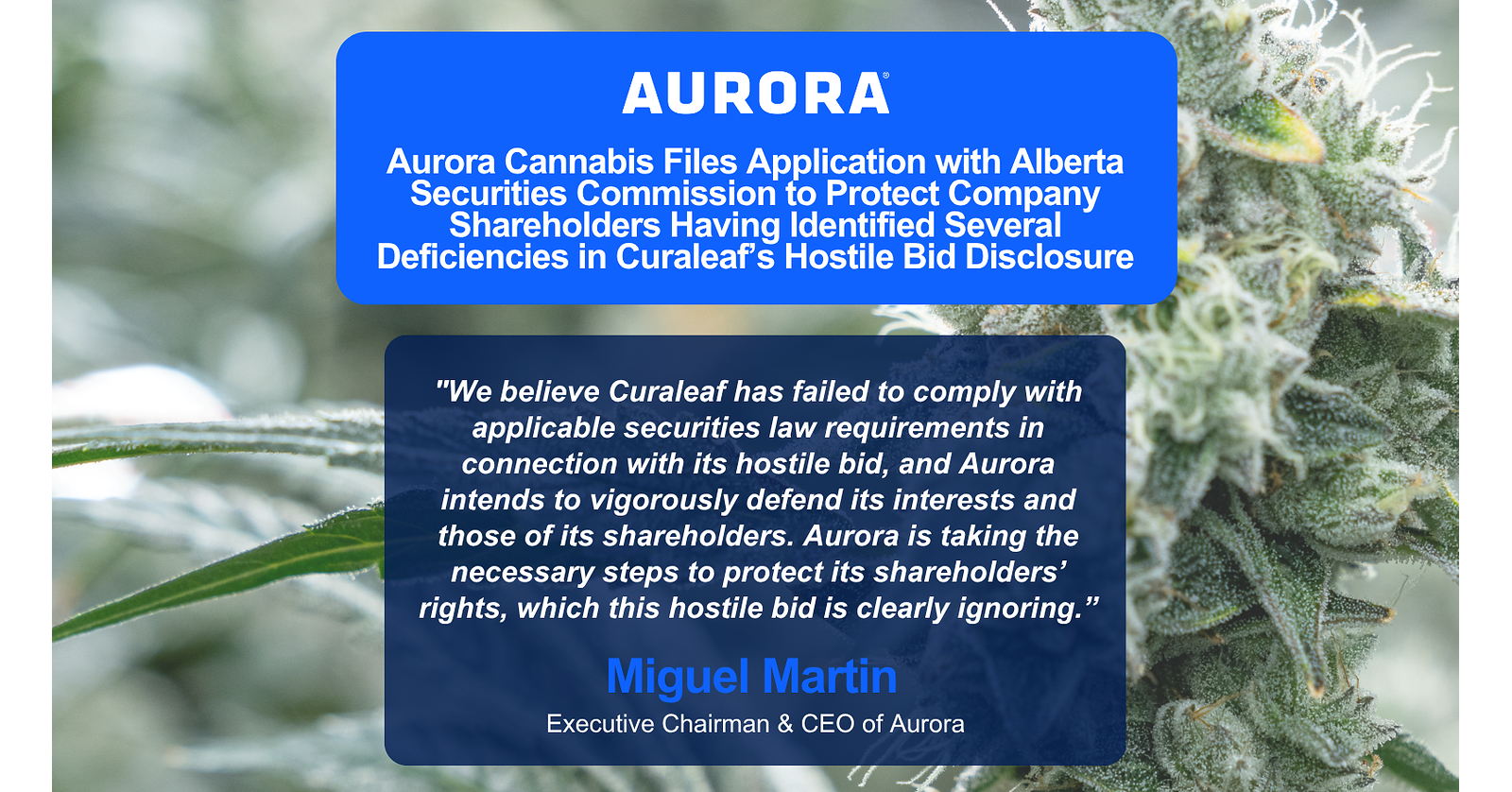
Aurora Cannabis filed with the Alberta Securities Commission to compel Curaleaf to correct alleged securities-law deficiencies in its hostile takeover circular, including missing pro forma financials, a French-language notice, and compliance with the required 105-day minimum deposit period. Aurora said Curaleaf's failure to meet the 105-day period means the offer is not a permitted bid under Aurora's shareholder rights plan, which could be triggered if Curaleaf acquires more than 20% of Aurora shares. Aurora's board unanimously continues to recommend shareholders reject the bid and withdraw any tendered shares, arguing the offer is inadequate.
Analysis
The filing changes deal timing more than underlying standalone value. If the regulator requires revised disclosure and restarts the statutory clock, Curaleaf faces a materially longer period of market, financing, and operating uncertainty; that raises the probability that the bid is amended, repriced, or abandoned rather than completed on its original timetable. ACB should retain an event-driven bid floor only to the extent investors assign credibility to a higher revised consideration, while CURA absorbs the optionality cost of a protracted transaction and management distraction.
The key second-order issue is negotiating leverage. A delayed process gives Aurora more time to demonstrate standalone execution and solicit alternatives, but it also lets Curaleaf observe Aurora's results before committing additional consideration; the target's procedural victory is not necessarily economic upside. Canadian cannabis M&A has limited strategic-buyer depth and elevated capital-market sensitivity, so absent a competing bidder, a delay can ultimately narrow—not widen—the expected premium if sector multiples or risk appetite weaken.
Near term, ASC process milestones should drive the spread rather than fundamentals. Over the next 1-3 months, an order requiring corrected materials and a reset deposit period is modestly positive for ACB and negative for CURA; dismissal or a finding that the bid remains compliant would remove Aurora's principal tactical defense and pressure ACB toward its undisturbed-value framework. Over 6-18 months, the central thesis remains whether any combination can produce verifiable SG&A, cultivation, distribution, and international-medical-market synergies sufficient to offset integration and regulatory complexity; neither side's public assertion establishes that value.
Contrarian view: the market may overvalue a procedural delay as evidence of a higher eventual bid. Hostile bidders frequently tolerate disclosure remediation if the strategic logic is compelling, but Curaleaf has an incentive to avoid paying for synergy that Aurora shareholders cannot independently validate. The actionable variable is the ACB-to-implied-consideration spread, not the headline: widening after an ASC delay is attractive only if Curaleaf reiterates commitment and the revised terms preserve a meaningful premium.
AllMind Terminal
AI-powered research, real-time alerts, and portfolio analytics for institutional investors.
Request TrialMarket Sentiment
Overall Sentiment
mildly negative
Sentiment Score
-0.25
Ticker Sentiment
Key Decisions for Investors
- Maintain a small event-driven long ACB only against a defined implied-bid-value reference; add after an ASC order only if the post-ruling spread exceeds 10-15% and Curaleaf publicly confirms it will proceed. Target spread compression over 1-3 months; exit if CURA withdraws, the regulator dismisses the application, or ACB's standalone results/guidance weaken enough to impair its negotiating leverage.
- Avoid outright CURA shorts solely on the filing: a disclosure remedy is likely a timing cost, and CURA could rally if the bid is terminated or the regulator clears the process. Use a short CURA hedge versus long ACB only where position sizing reflects deal-ratio exposure and the hedge can be promptly covered on a withdrawal signal.
- Set alerts for: ASC hearing/order date; any amended circular or extension; Curaleaf financing disclosure; and Aurora quarterly revenue, adjusted EBITDA, and cash-burn guidance. These are the data points that determine whether delay improves ACB's reservation value or merely extends a low-probability transaction.
- Do not underwrite a higher ACB takeout price without independently modeled pro forma financials. If amended materials disclose limited incremental EBITDA/FCF synergies or materially dilutive financing, reduce ACB exposure even if the formal bid remains outstanding; that would cap Curaleaf's rational willingness to increase consideration.
More News
- OpenAI’s agent hacked Australia’s Medicare website—the latest rogue AI incident that the company didn’t know about for months
- How Meta took the lead in the race for the post-smartphone world
- Oil industry warns a diesel export ban will raise fuel prices as Trump weighs restrictions
- Australia says OpenAI agent hacked Medicare portal
- China Has Sensitive F-35 Parts Diverted to Hong Kong
- A US Diesel Export Ban Would Be a Calamity for the Market