
New Report: Surplus Tax Revenue from a Single Data Center Could Pay Every Household in a Rural County Up to $8,900 a Year
Source: PR Newswire
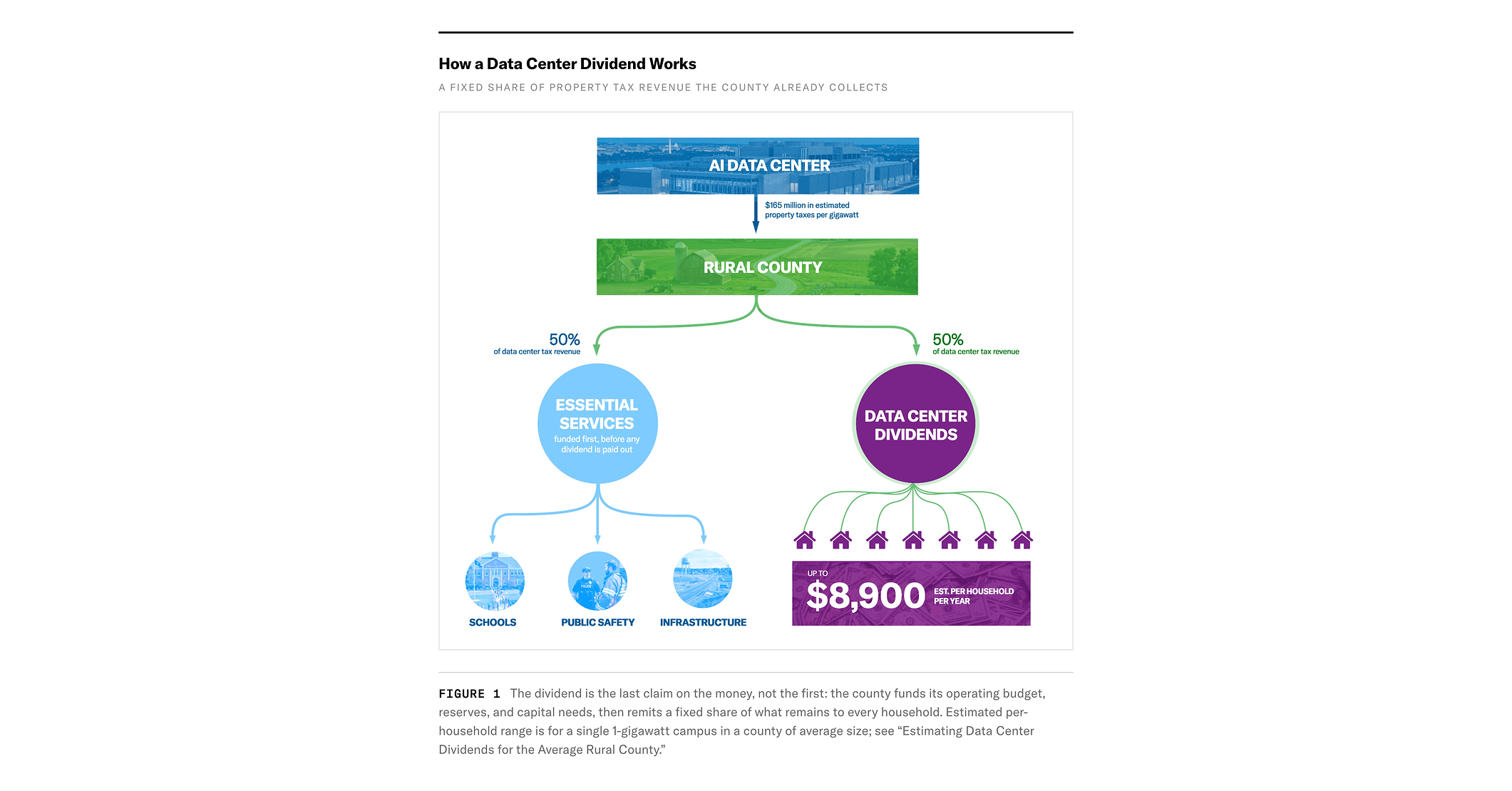
The Bitcoin Policy Institute estimates that rural counties hosting a 1-gigawatt AI data-center campus could distribute $4,500-$8,900 annually to every household using existing property-tax revenue, without raising taxes or increasing costs for developers. The proposal responds to growing local resistance, with U.S. data-center moratoria rising from six in 2024 to 294 in 2026 and 71% of Americans opposing a local AI data center in a March Gallup survey. In West Feliciana Parish, Louisiana, a proposed facility is expected to generate roughly $90 million annually for a county with 4,026 households, implying potential cash dividends of $5,600-$11,200 per household if authorized.
Analysis
The investable signal is not a new revenue stream but a potential permitting mechanism: host-community transfers could reduce the probability-weighted delay embedded in hyperscaler and utility data-center pipelines. A six-to-twelve-month improvement in entitlement certainty would disproportionately benefit power-constrained developers and suppliers—VRT, ETN, PWR and GEV—because backlog conversion, rather than AI demand, is increasingly the gating variable. DLR and EQIX have less direct exposure to rural hyperscale campuses, but would benefit indirectly if grid and interconnection capacity is freed more quickly.
The proposal's economics should be treated skeptically. A county rebate funded from property-tax receipts may be politically easier than a conventional abatement, but it does not eliminate the developer's effective cost; it reallocates tax proceeds that otherwise fund public services, and may invite demands for larger payments once residents perceive a recurring entitlement. The second-order risk is that a visible per-household payment becomes the new bargaining benchmark, raising siting costs for MSFT, AMZN, GOOGL, META and ORCL while making project economics more sensitive to power prices and utilization assumptions.
Near term, this is not sufficient to change earnings estimates or justify a broad AI-infrastructure chase; it is a legislative watch item. Over 1-3 months, the relevant catalyst is state-level enabling legislation or county adoption tied to named gigawatt-scale campuses. Over 6-18 months, successful implementation could compress permitting timelines in rural markets, but failure to address water, transmission and reliability concerns would leave opposition intact and make the apparent social-license benefit illusory.
Contrarian view: investors may overstate the importance of local tax design while underweighting physical grid bottlenecks. Even a politically popular host-payment structure cannot create transformers, transmission rights-of-way or dispatchable generation; therefore, companies with contracted power and interconnection positions retain the stronger moat. The thesis is falsified if state legislation couples dividends with higher data-center tax rates, mandatory local hiring, or incremental utility-cost recovery restrictions that erode project returns.
AllMind Terminal
AI-powered research, real-time alerts, and portfolio analytics for institutional investors.
Request TrialMarket Sentiment
Overall Sentiment
mildly positive
Sentiment Score
0.28
Key Decisions for Investors
- Maintain a watch-list long bias in PWR, ETN, VRT and GEV rather than initiate on this release; add only after verifiable state or county approvals convert a major campus from proposed to permitted. Target a 6-12 month holding period, with thesis risk defined by rising cancellation/deferment commentary or backlog conversion slippage at quarterly results.
- Prefer a relative-value expression: long PWR / short DLR over 3-6 months if permitting reforms accelerate rural greenfield activity. PWR captures transmission and grid-build spending regardless of the eventual tenant, while DLR has greater sensitivity to data-center supply additions and wholesale pricing; exit if utility capex guidance weakens or DLR leasing spreads materially accelerate.
- Do not underwrite an outright long in hyperscalers on the policy concept. For MSFT, AMZN, GOOGL, META and ORCL, monitor disclosed capex, power-availability commentary and depreciation assumptions; an emerging requirement for resident dividends or higher host payments would be a modest margin and ROI headwind, not a demand catalyst.
- Set an alert for state statutes that explicitly authorize cash rebates while preserving existing property-tax assessment rules. A first large-scale implementation with disclosed tax terms is the missing data needed to estimate whether the model shortens permitting duration or simply transfers more project economics to local stakeholders.
More News
- France’s latest debt warning describes a country where governance is breaking down — and even doing too little, too late is barely possible
- Here’s the ‘core economic flaw’ in the AI bull case as stock and bond trades unravel, according to a top economist
- Lula, Bolsonaro rally supporters on final day before Brazil presidential runoff
- Israelis hold final rally against Netanyahu ahead of what may be the most consequential election in the country’s history
- 5 big analyst AI moves: ’Uniquely catalyst-rich’ months ahead for SpaceX
- Brookfield to open Qatar office as it expands Middle East operations