
Can WEN's Turnaround Change Traffic Weakness Into EBITDA Progress?
Source: zacks.com
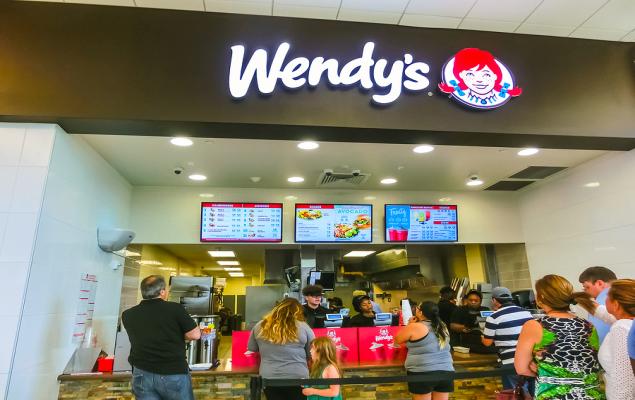
Wendy's Q2 2026 adjusted EBITDA fell $22.5 million year over year to $124.1 million as U.S. same-restaurant sales declined 7%, driven by a 12.5% traffic drop partly offset by a 5.6% higher average check. The company withdrew its 2026 outlook and expects no year-over-year systemwide sales growth in Q3 or Q4, with margins and EBITDA pressured by sales deleverage, 5%-6% commodity inflation and turnaround-related G&A. Consensus 2026 EPS now implies a 44.3% year-over-year decline, despite WEN shares rising 12.7% over the past three months.
Analysis
WEN's issue is not merely weak demand but a deteriorating unit-economic loop: traffic losses reduce labor and occupancy leverage, requiring franchisee/company investment in value and operations precisely when commodity inflation constrains funding. Incremental discounting is unlikely to be margin-neutral because WEN lacks MCD's scale purchasing, digital frequency data, and advertising reach; a value reset could therefore stabilize transactions while further pressuring restaurant-level profitability over the next 1-3 quarters. The guidance withdrawal also leaves consensus vulnerable to another downward reset rather than providing a clean turnaround setup.
MCD is the relative winner in a value-oriented quick-service environment. If WEN responds aggressively on price, MCD can selectively match promotions while protecting traffic through its larger loyalty ecosystem; smaller burger peers such as JACK and SONC may face localized promotional pressure without receiving WEN's potential share gains. SBUX is less directly exposed, but its transaction-led recovery underscores that loyalty-led demand repair is structurally more valuable than check-led growth; WEN's digital investment is unlikely to produce a measurable retention benefit until 6-18 months.
The contrarian case is that the equity's low sales multiple already discounts a severe earnings decline and that even modest sequential traffic improvement can create substantial operating leverage. That is not yet a buy signal: the recent share-price outperformance increases the risk that investors are prematurely capitalizing a turnaround before evidence appears in transaction trends, franchisee economics, and revised EBITDA guidance. Falsification of the bearish relative view would be two consecutive monthly improvements in U.S. traffic toward flat, stable company margins despite investment, and no further reduction in FY2026/FY2027 EBITDA estimates.
AllMind Terminal
AI-powered research, real-time alerts, and portfolio analytics for institutional investors.
Request TrialMarket Sentiment
Overall Sentiment
strongly negative
Sentiment Score
-0.62
Ticker Sentiment
Key Decisions for Investors
- Initiate a 3-6 month relative short: short WEN / long MCD, sized beta-neutral. Target 10-15% relative downside if WEN estimates reset again; exit if U.S. traffic improves to better than -3% for two consecutive months or management restores a credible full-year outlook.
- Avoid buying WEN solely on the apparent low P/S multiple. Set an alert for third-quarter results: consider a tactical long only if transactions inflect materially, company-operated margin holds above the prior-quarter level, and management quantifies a path to positive system sales in 2027.
- Maintain or add MCD versus lower-scale QSR exposure over the next two earnings cycles. The risk is a broad consumer slowdown that overwhelms share gains; trim the relative long if MCD U.S. comparable sales turn negative or digital/value spend begins materially diluting franchisee margins.
- Watch JACK and SONC for promotional spillover rather than initiating preemptive shorts. A sustained widening of burger-category discounting, paired with negative traffic disclosures, would support a 1-3 month underweight because these operators have less margin capacity to absorb a value war.
More News
- Starbucks stock outlook: premium valuation meets a turnaround still in progress
- Guggenheim reiterates Neutral on Wendy’s stock, cuts estimates
- Grab aims for 'next level' in financial services with purchase of buy-now pay-later platform Atome
- Attacks on Saudi oil expose Iraqi PM’s struggle to control armed factions
- China's AI leaders keep quiet despite U.S. 'publicity' on tech risks
- Oil prices dip as U.S. inventory build offsets M.East supply jitters
From AllMind Research
- Anthropic IPO Preview: Valuation, Timing, and What to Watch
- Shein After the IPO: Venue, Valuation, and What Must Be Proved
- What AI Research Tools Should a Small Hedge Fund Buy First?
- AI Tools for CFA Charterholders: An Evidence Standard
- Weekly Update: Unstructured Data Search, Ask AI, and Advanced Futures Data