
Huayan Robotics to Present Chinese Intelligent Manufacturing Solution at IMTS 2026
Source: PR Newswire
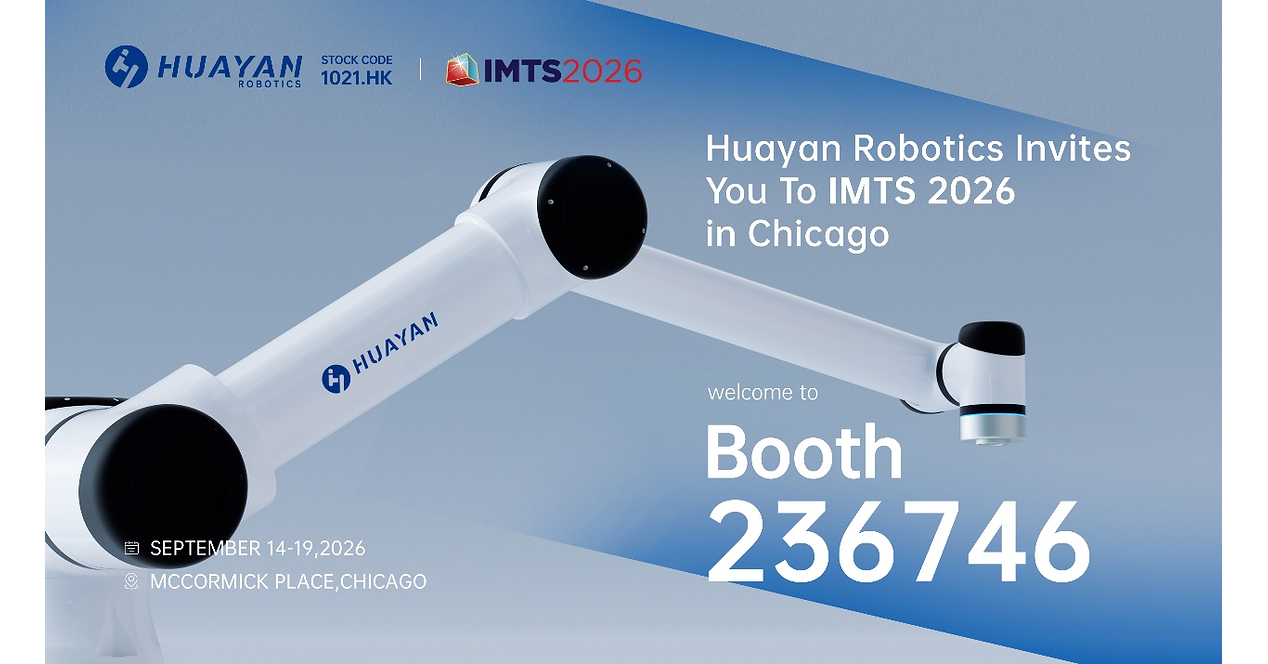
Huayan Robotics will showcase intelligent manufacturing and collaborative-robot solutions at IMTS 2026 in Chicago from September 14-19. Featured products include the E12-Pro welding cobot with a 1.8-meter reach, a 60 kg-payload palletizing robot operating at 8-13 cycles per minute, and a CNC machine-tending system claimed to improve loading and unloading speeds by up to 50%. The announcement highlights product capabilities and international expansion potential but provides no financial results, orders, or guidance.
Analysis
This is not a fundamental catalyst by itself, but it reinforces a competitive pressure point in collaborative robotics: Chinese vendors are extending from low-cost arms into application-specific cells, motion components and software integration. If credible in North America, that can pressure pricing and distributor economics for pure-play cobot suppliers such as Teradyne (TER), while the larger automation incumbents ABB (ABB), Fanuc (FANUY) and Yaskawa (YASKY) retain advantages in installed base, service coverage and safety certification. The more relevant read-through is to mid-market manufacturers, where labor scarcity makes payback periods—not robot brand loyalty—the purchase driver.
Near term, IMTS customer meetings are unlikely to move listed-company estimates. Over the next 1-3 months, watch for announced U.S. distributors, customer deployments, UL/ANSI certifications, local service commitments and quoted system pricing; these are the data needed to judge whether the entrant is a real channel threat rather than trade-show marketing. A verified 15-25% price discount for comparable welding, machine-tending or palletizing cells would likely force lower ASP assumptions across cobot vendors before it materially affects global revenue.
The structural implication over 6-18 months is margin segmentation: standardized handling and machine-tending hardware becomes more commoditized, while value migrates to vision, end-effectors, safety integration and recurring service. That favors diversified suppliers with proprietary components and integration ecosystems—Keyence (KYCCF), Cognex (CGNX), Rockwell (ROK) and ABB—over vendors dependent on robot-arm gross margin. Contrarian view: geopolitical procurement restrictions and weak U.S. field-service infrastructure can sharply limit Chinese penetration in aerospace, defense-adjacent and critical-infrastructure end markets, leaving the initial addressable market concentrated in price-sensitive commercial users.
AllMind Terminal
AI-powered research, real-time alerts, and portfolio analytics for institutional investors.
Request TrialMarket Sentiment
Overall Sentiment
mildly positive
Sentiment Score
0.28
Key Decisions for Investors
- No directional trade solely on this release; set an IMTS follow-up alert for U.S. channel partnerships, certified installations and disclosed pricing within 30-90 days.
- Maintain a relative-quality bias: long ABB or ROK versus TER over a 6-12 month horizon if evidence emerges of sub-20% discounted Chinese cobot pricing. The thesis is hardware-margin compression at TER offset by ABB/ROK service, controls and installed-base exposure.
- Watch CGNX as a second-order beneficiary rather than a direct robot competitor: broader deployment of lower-cost arms can increase machine-vision attachment rates. Add only if order commentary confirms automation demand without a corresponding pricing reset; falsifier is renewed guide-down tied to discrete-manufacturing capex.
- For TER, treat sustained China-origin pricing competition as a valuation-risk alert, not an immediate short. Escalate to a bearish position only after either a cobot bookings miss, gross-margin guide-down, or U.S. channel evidence shows meaningful displacement; absent those signals, the press-release impact is too low to justify risk.
More News
- Are global oil reserves sufficient to withstand renewed US-Iran war?
- OpenAI Trims Target Value & Volvo Cars Cuts 2,500 Jobs
- U.S. oil holds above $100, Brent at five-month high as Iran says it’s prepared for warfare
- PG&E’s CEO says AI is ‘the best thing that could’ve ever happened to the grid’
- The mobile ambitions of SpaceX see telecom stocks get hit again. What the latest developments mean.
- Wake up! The long bond’s up two points!