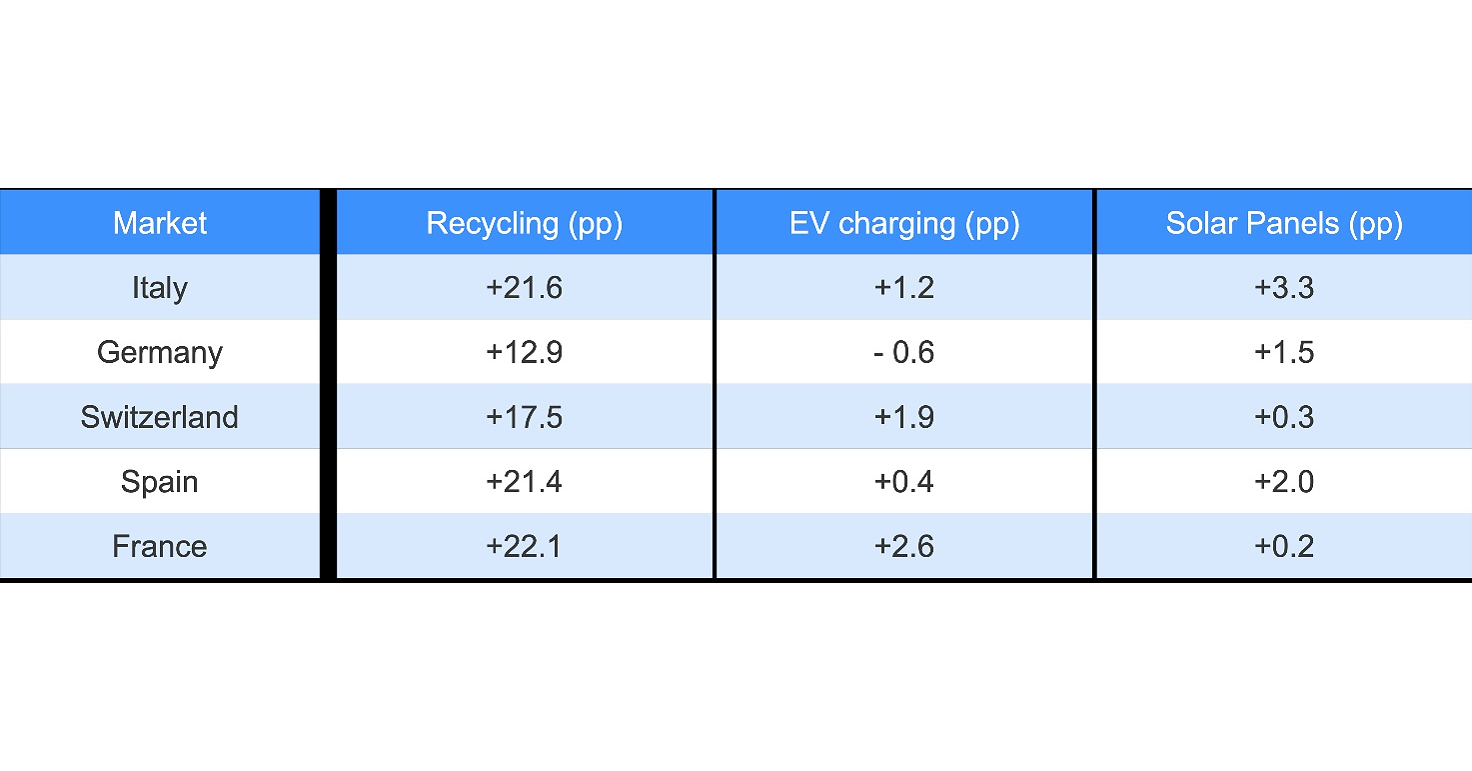
Interhome reports that summer bookings for sustainable holiday accommodations more than doubled from 2020 to 2025, while the share of sustainable bookings rose from 16.7% to 29.5% (+12.8 percentage points). In 2025, sustainable-booking shares were highest in Italy at 40.1%, followed by Germany (36.1%) and Switzerland (35.9%), while France (16.1%) and Spain (29.3%) lagged. The company also highlights stronger growth in sustainability features such as recycling (broad-based gains) and country-specific advances in EV charging and solar energy.
The investable read-through is not "sustainability is trending"; it is that premium, filterable inventory is gaining share inside a fragmented lodging market. That helps the asset owner first: hosts with chargers, insulation, and lower utility intensity can defend occupancy and maybe ADR, while undifferentiated homes in lower-adoption markets risk getting sorted down the funnel. For the platform layer, the upside is mostly conversion efficiency and a slightly better mix, not a step-change in revenue unless the company can actually monetize those filters with higher take-rate or lower acquisition cost.
Second-order beneficiaries are the capex enablers around the asset base: local electricians, solar installers, window/insulation contractors, and charger suppliers see recurring retrofit demand if this becomes a host-level ROI decision rather than an ESG preference. The loser is the long tail of older stock, especially in Spain/France, where weaker adoption suggests a slower upgrade cycle and potentially more price competition into peak season. Time horizon matters: the stock reaction should be negligible today, but the next 1-3 quarters of booking mix data will tell us whether this is a real demand shift or just a marketing segment.
The contrarian point is that "sustainable" may simply proxy for newer, better-located, higher-quality homes, so the causal label can overstate the economics. If the platform cannot show higher occupancy, tighter cancellation rates, or better monetization versus non-sustainable inventory, the story is basically noise. The thesis is falsified if the sustainable share stalls despite continued energy-price pressure, or if incremental retrofit costs compress host returns and slow supply growth.
AI-powered research, real-time alerts, and portfolio analytics for institutional investors.
Request TrialOverall Sentiment
mildly positive
Sentiment Score
0.18
