
Huawei stellt verbessertes Stellar-KI-Netzwerk vor, um die Welt der autonomen Agenten mit sicherer, intelligenter Konnektivität zu versorgen
Source: PR Newswire
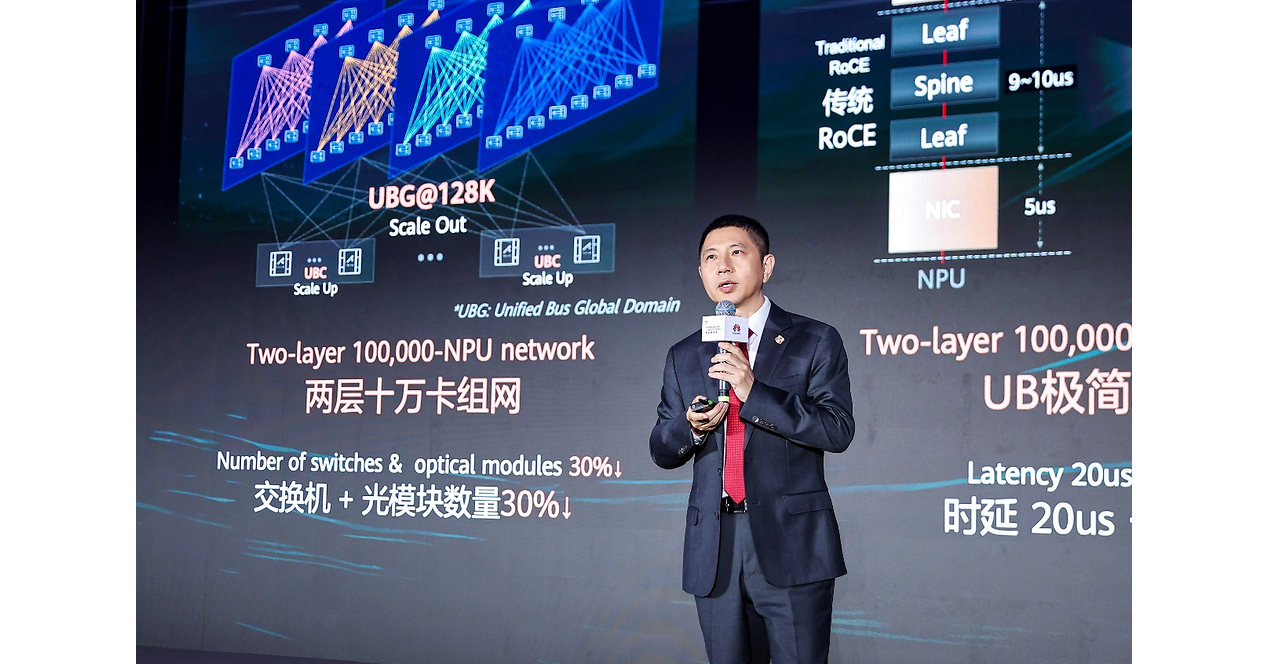
Huawei unveiled its upgraded Stellar AI Network at HUAWEI CONNECT 2026, targeting secure connectivity for AI-agent workloads across data centers, WANs and enterprise campuses. The company says its SF9300 architecture can cut network deployment costs by 30% and reduce end-to-end latency from 20μs to 11μs, while its NPO switches lower link power consumption from 1,000W to 600W. Huawei also cited security detection rates of 95%, remote-computing efficiency above 95% over 1,000 km, and campus-network MTTR below five minutes, although these are company-provided performance claims.
Analysis
The investable read-through is less about Huawei’s direct economics than whether it can package compute, switching, optics and security into a credible domestic AI-cluster standard. If adopted by Chinese enterprises and state-linked cloud customers, the architecture raises switching costs for installed Huawei networking while reducing the addressable opportunity for foreign AI-fabric vendors in China; ANET and CSCO have limited direct China sensitivity, but the development reinforces a fragmented global networking TAM rather than a winner-take-all Ethernet outcome.
The potentially underappreciated second-order effect is on optical components. A shift toward tightly integrated optical/network designs could increase domestic content and favor Chinese optical suppliers such as Accelink (002281.SZ), but it may ultimately reduce unit demand for conventional pluggable transceivers if deployment scales around more integrated designs. That is a mixed 6-18 month signal for global component vendors COHR and LITE, whose near-term AI optical demand remains driven primarily by U.S. hyperscalers rather than China.
Company-supplied performance and security metrics are not independently verified, so this is not a near-term earnings catalyst for listed peers. The 1-3 month catalyst is evidence of large external deployments, procurement wins, or Ascend ecosystem adoption; without these, the announcement is likely marketing rather than a material revision to AI-infrastructure estimates. Falsification would be continued reliance by Chinese customers on Nvidia-compatible networking stacks, weak third-party customer references, or evidence that proprietary integration creates interoperability friction.
AllMind Terminal
AI-powered research, real-time alerts, and portfolio analytics for institutional investors.
Request TrialMarket Sentiment
Overall Sentiment
moderately positive
Sentiment Score
0.48
Key Decisions for Investors
- No immediate directional trade: treat this as a watch item rather than a catalyst, given Huawei is unlisted and the financial impact on global networking vendors is presently unquantified.
- Maintain ANET over CSCO as the preferred developed-market AI-networking exposure over 6-12 months; Huawei-led China substitution marginally reduces foreign-China optionality, but ANET’s earnings sensitivity remains concentrated in hyperscaler capex. Reassess if hyperscaler capex guidance weakens or ANET’s backlog/conversion commentary deteriorates.
- Create an alert on 002281.SZ (Accelink) and 300308.SZ (Zhongji Innolight) for disclosed Huawei-related optical design wins or order growth over the next two earnings cycles. Initiate only if revenue mix and margin contribution are disclosed; integrated-optics architectures can increase content per cluster while compressing merchant-module volumes.
- Avoid using COHR or LITE shorts solely on this announcement. A bearish position requires confirmation that Chinese integrated networking is displacing conventional optical demand at scale, not merely redirecting supply within China; a material acceleration in U.S. AI-cluster buildouts would invalidate that thesis.
More News
- Google's Gemini becomes latest AI model to break out and hack computer systems
- Trump says U.S. to build a 'large Military presence' in Greenland as part of a security deal with it and Denmark
- Stocks face a key hurdle in next week’s U.S.-China summit. Here’s what’s at stake
- Houthis accuse Saudi Arabia of launching 26 strikes in 24 hours
- European Economies Eye Another Energy Crisis Heading Into Winter
- AI almost led the US military to start a war with China, report says
From AllMind Research
- Anthropic IPO Preview: Valuation, Timing, and What to Watch
- Shein After the IPO: Venue, Valuation, and What Must Be Proved
- What AI Research Tools Should a Small Hedge Fund Buy First?
- How to Build an Automated Research Process for a Fund
- Weekly Update: AI-Powered Report Editing, Investor Relations, and Enhanced Search