
Global Cruise Market Set to Reach USD 38.48 Billion by 2034 as Experiential Tourism, Fleet Expansion and Luxury Cruise Demand Strengthen, says Maximize Market Research
Source: PR Newswire
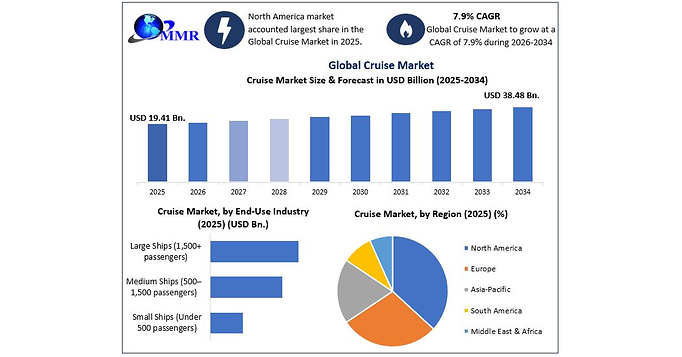
The Global Cruise Market was valued at USD 19.41 billion in 2025 and is forecast to reach USD 38.48 billion by 2034, a projected 7.9% CAGR over 2026–2034. Global ocean-cruise passenger volume reached approximately 37.2 million in 2025, up 7.5% from 2024; the report cites fleet expansion, tourism demand and new destinations as growth drivers. Operators are investing in cleaner propulsion and digital onboard services, with nearly 80 new ocean, expedition and river ships in the pipeline through 2036. These are market-research forecasts and industry figures, not reported company earnings or share-price moves.
Analysis
The actionable signal is not the long-range market CAGR; it is the capital-cycle implication. More berths can support passenger growth but also create a supply hurdle: if deliveries outpace itinerary demand, operators may defend occupancy through discounting, pressuring ticket yields and onboard spend. Capacity additions therefore benefit incumbents only when pricing holds—not simply when passenger counts rise.
Treat the report’s forecast as promotional, not underwriting evidence. Its scope is unclear (market value versus operator revenue), and the copy contains an unrelated elastomers reference. The passenger and pipeline figures need independent verification before they inform earnings estimates. Near term (days), this is not a standalone catalyst. Over 1–3 months, track operator commentary on net yields, occupancy, booking curves, and fuel costs. Over 6–18 months, delivery timing, financing burden, and the ability to fill incremental berths determine who captures growth.
RCL and Disney may have differentiated demand propositions, but Disney’s cruise exposure is only one part of The Walt Disney Company; the article provides no basis to translate cruise growth into consolidated earnings. CCL and NCLH are also exposed to the same pricing-versus-capacity test. Fuel, labor, port access, environmental rules, and recession-sensitive discretionary spending could reverse the demand case. Contrarian read: passenger growth can look bullish while per-berth economics weaken. Prefer evidence of yield resilience over market-size forecasts.
AllMind Terminal
AI-powered research, real-time alerts, and portfolio analytics for institutional investors.
Request TrialMarket Sentiment
Overall Sentiment
moderately positive
Sentiment Score
0.35
Ticker Sentiment
Key Decisions for Investors
- No trade on this report alone. Use it as a monitoring prompt, not an earnings upgrade: verify bookings, net ticket yields, onboard revenue, occupancy, and capacity delivery schedules in company disclosures.
- Conditional relative-value watch: consider long RCL versus CCL only if RCL’s reported net yields and forward bookings hold up better while capacity growth remains manageable; avoid entry until comparable metrics and current valuation are checked. Falsify if RCL’s yield advantage narrows or its capacity outlook worsens.
- For DIS, do not capitalize the cruise narrative into the whole-company thesis. Reassess only if Disney separately quantifies cruise contribution, investment needs, and returns; otherwise the cruise signal is too small and unverified for a consolidated position.
- Risk monitor for the next 1–3 months: a sustained deterioration in booking curves or net yields, material delivery delays/cost changes, rising fuel expense, or adverse port/environmental restrictions would weaken the sector thesis and favor reducing cruise exposure.
More News
- Security researcher claims to they found KVM guest-host escape flaw
- CH Robinson to Buy RXO for $5.8B in Bet on AI Model
- Nike’s China troubles: What are the implications for other sportswear brands?
- SpaceX stock climbs to highest since June, returning Musk to trillionaire status
- Schneider Electric drops $22.6B on PTC as datacenter boom rains money on infra companies
- Wells Fargo gets a bold upgrade ahead of earnings. Why the stock can play catch-up