
Biohaven Enters Strategic Licensing Agreement with Ono Pharma for Extracellular IgG Degraders in Japan and Select Asian Regions, Lead Candidate BHV-1300 in Phase 3 for Graves' Disease
Source: PR Newswire
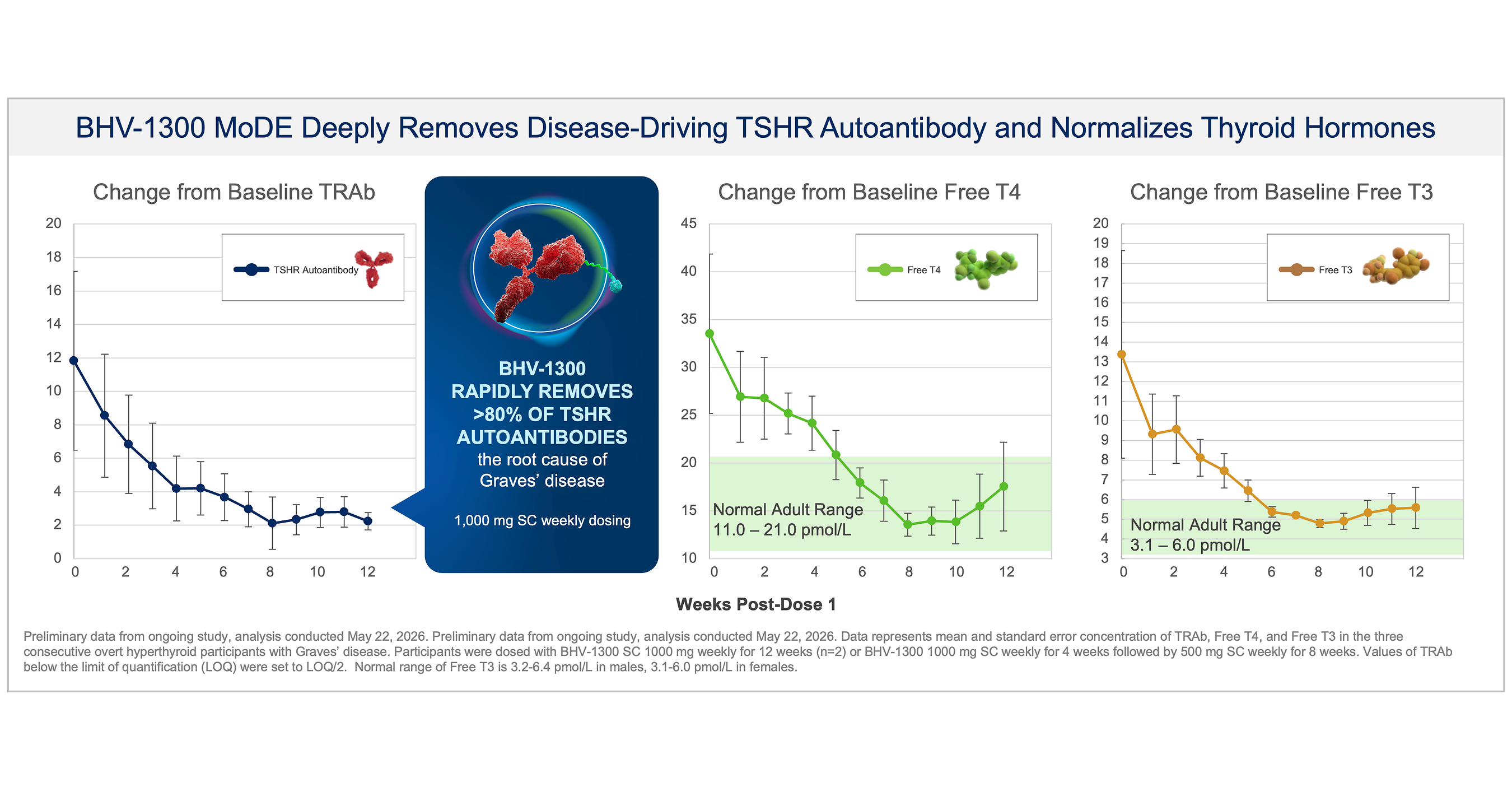
Biohaven granted Ono exclusive rights to develop and commercialize BHV-1300, BHV-1310 and BHV-1320 in Japan, South Korea, Taiwan and ASEAN, receiving $80 million upfront and an expected $20 million milestone within a year, plus approximately 20% royalties on regional net sales. Biohaven retains rights outside the territory; lead candidate BHV-1300 is in Phase 3 development for Graves’ disease. The regional licensing deal provides non-dilutive capital and commercial support, while development, milestone and commercialization outcomes remain subject to risk.
Analysis
The agreement adds external validation and a non-dilutive funding source, but its strategic value is more informative than immediately transformational: regional rights and royalties do not establish global commercial economics, and the pivotal clinical risk remains with BHVN’s retained territories. The key distinction is between validating Ono’s willingness to partner and validating that MoDE can deliver durable clinical benefit with an acceptable safety profile. The latter requires Phase 3 evidence; company-reported early signals are not a substitute.
Second-order, the deal gives Biohaven a partner with local development and commercialization capability while letting it preserve upside elsewhere. It may also sharpen competitive scrutiny of IgG-lowering approaches, including FcRn-targeting therapies such as those from Argenx and competitors in autoimmune disease. Any advantage from faster or deeper IgG reduction or simpler administration remains a hypothesis until supported by comparative clinical and real-world data; the mechanism could also face safety, dosing, or durability trade-offs.
Near term, the upfront payment reduces financing pressure, while the additional milestone is conditional and should not be treated as cash certainty. Over 1–3 months, watch for trial execution updates and confirmation of the milestone conditions. Over 6–18 months, pivotal efficacy, safety, and regulatory progress—not the licensing headline—should dominate valuation. The contrarian point: platform validation may be over-read; this is a regional license, not proof of broad adoption or a global partner bidding war.
AllMind Terminal
AI-powered research, real-time alerts, and portfolio analytics for institutional investors.
Request TrialMarket Sentiment
Overall Sentiment
moderately positive
Sentiment Score
0.65
Ticker Sentiment
Key Decisions for Investors
- BHVN: avoid chasing a headline-driven gap; consider a staged long only if the price holds after initial reaction and the Phase 3 timeline remains intact. The agreement improves funding optionality, but does not remove the central clinical binary.
- Treat the stated near-term proceeds as a partial funding cushion, not as evidence of a lower long-run cash-burn rate. Verify closing and the conditions for the anticipated milestone; do not capitalize the milestone as certain.
- Set the principal thesis-failure alert at a material Phase 3 delay, an adverse safety signal, or failure to show clinically meaningful Graves’ disease benefit. Any of these would outweigh regional platform validation.
- Watch competitor disclosures for evidence that IgG degradation offers a differentiated benefit versus FcRn-based treatment. Without comparative outcomes, avoid a relative-value short in competitors based solely on this partnership.
More News
- The world needs Ukraine’s grain. Its farmers are running out of reasons to plant
- Verizon stock heads for worst day since 2002 as SpaceX U.S. network plans whack telcos
- Why is the Chinese stock market missing the AI rally
- OpenAI's revenue scare, Delta earnings, what investors think of a Starbucks-Chipotle deal and more in Morning Squawk
- Tesla drops 'Full Self-Driving' brand name in Europe after regulator pushback
- Why is T-Mobile stock tumbling today?
From AllMind Research
- Anthropic IPO Preview: Valuation, Timing, and What to Watch
- Shein After the IPO: Venue, Valuation, and What Must Be Proved
- What AI Research Tools Should a Small Hedge Fund Buy First?
- How to Evaluate AI Report Writers for Financial Analysis
- Weekly Update: Sector Analysis, Improvements on Research Data, and Performance Enhancements