
Caterpillar vs. Komatsu: Which Heavy Equipment Stock is the Better Buy?
Source: zacks.com
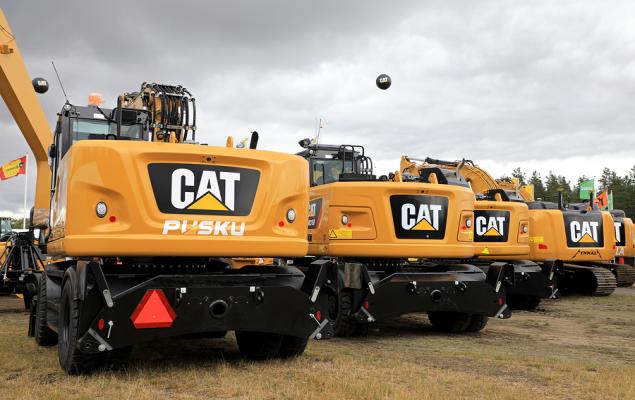
Caterpillar reported Q2 2026 revenue growth of 24% to a record $20.5 billion and adjusted EPS growth of 73% to $8.17, while backlog reached $72 billion. It raised its 2026 revenue outlook to mid-to-high-teens growth and consensus EPS forecasts imply 43.6% growth to $27.37, supporting the article's preference for CAT despite its 25.68x forward P/E. Komatsu posted 14.7% fiscal-Q1 sales growth but EPS fell 3%; it expects fiscal-2026 operating income and net income to decline 2.2% and 7.3%, respectively, including a JPY 37.8 billion ($240 million) annual tariff cost impact.
Analysis
CAT's earnings revision cycle is the relevant near-term driver, but the valuation now embeds unusually little execution slack for a cyclical capital-goods company. The mix shift toward distributed power and service revenue can support a higher through-cycle multiple than traditional construction equipment, yet the incremental power capacity is likely to be constrained by component availability and commissioning timelines rather than end demand. Over the next 1-3 months, order conversion, dealer inventories, and margin realization in Energy & Transportation matter more than additional headline backlog growth.
The overlooked second-order effect is that CAT's North American manufacturing footprint creates relative pricing flexibility versus import-dependent rivals if tariffs persist. That should widen competitive separation in U.S. equipment tenders and potentially pressure Deere (DE), CNH Industrial (CNH), and Komatsu (KMTUY) in select construction categories. Conversely, tariff-driven price increases could ultimately defer lower-return construction purchases; mining and mission-critical power customers are less price elastic, so CAT's mix quality—not aggregate equipment demand—is the key earnings sensitivity.
Consensus is treating the power-generation opportunity as a durable AI-data-center proxy, but it carries lumpy project timing and customer-concentration risk. A moderation in hyperscaler capex, easing grid interconnection constraints, or gas-turbine supply normalization would compress the scarcity premium within 6-18 months. The long thesis is falsified by sequential dealer inventory accumulation, a miss in Energy & Transportation margins, or management reducing the following-year power-delivery outlook; these signals would imply backlog quality is weaker than the market assumes.
AllMind Terminal
AI-powered research, real-time alerts, and portfolio analytics for institutional investors.
Request TrialMarket Sentiment
Overall Sentiment
moderately positive
Sentiment Score
0.48
Ticker Sentiment
Key Decisions for Investors
- Maintain a tactical long CAT for the next 1-3 months only on pullbacks, sized against a 8-10% downside stop; target a further 10-15% upside requires continued upward EPS revisions and clean quarterly power-equipment execution.
- Express relative tariff and mix exposure through long CAT / short KMTUY in equal-dollar terms over 3-6 months. Cover if U.S. tariff exemptions or broad tariff rollback becomes credible, or if KMTUY demonstrates full cost pass-through in its next guidance update.
- For a less directional expression, long CAT / short DE can isolate distributed-power and mining exposure from more discretionary agricultural equipment demand over 6 months; reassess if U.S. farm income or large-equipment orders inflect materially upward.
- Do not initiate a direct QBTS position from this item. The data-center power theme is not a validated revenue linkage to quantum spending; monitor hyperscaler capex revisions and grid/power procurement announcements rather than extrapolating CAT demand into QBTS.
More News
- Nasdaq Index and S&P500: US Stocks Retreat From Record Highs as Oil and Yields Rise
- Is Sterling's $130M-$140M CapEx Plan Fuel for Its Next Growth Leg?
- Burlington's Beauty & Accessories Categories Lead Sales Trends
- Will OPRX's OpenPath Deal Help TTD Capture More Healthcare Ad Dollars?
- D-Wave Quantum stock rises on CGI partnership deal
- America’s Asian allies want a Trump-Xi truce — but not at their expense
From AllMind Research
- Anthropic IPO Preview: Valuation, Timing, and What to Watch
- Shein After the IPO: Venue, Valuation, and What Must Be Proved
- What AI Research Tools Should a Small Hedge Fund Buy First?
- Weekly Update: Adding Live MBO Level 3 Data - Liquidity Heatmap, OFI Charts, and More
- Alternative Data Due Diligence for Institutional Investors